

Iraq's Federal Supreme Court says Prime Minister Mustafa Al Kadhimi's caretaker government has no authority to create legislation to present to parliament, or strike agreements that could influence Iraq's future.
Sunday's ruling throws into doubt government efforts to meet urgent needs during a transitional period, including the passing of a law that Mr Al Kadhimi says is vital to stem a rise in food poverty.
Iraq held elections on October 10, the fifth parliamentary vote for a full-term government since the 2003 US-led invasion that toppled Saddam Hussein, in response to one of the core demands of a nationwide, pro-reform protest movement that erupted in 2019.
But since then, political rivals have been at loggerheads over the formation of the new government, delaying ratifying the federal budget.
-
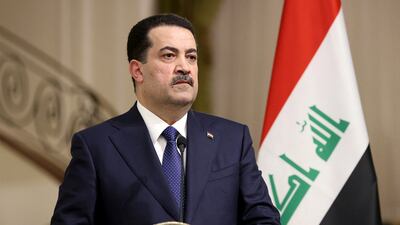
Iraq's Prime Minister Mohamed Shia al-Sudani. AFP -

Hadi al-Amiri leader of the Badr Organisation attends an election rally, along with his Fatih bloc supporters, ahead of the parliamentary election in Baghdad, Iraq October 5, 2021. REUTERS/Ahmed Saad -
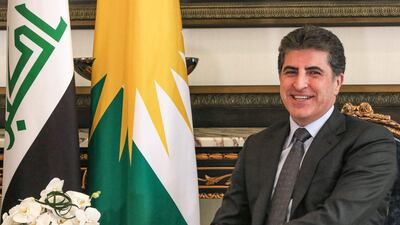
Nechirvan Barzani, President of Iraq's autonomous Kurdistan Region, meets with the Iraqi prime minister in Erbil, the capital of the northern Iraqi Kurdish autonomous region, on March 14, 2022. AFP -
Shiite Muslim cleric Moqtada Sadr gives a speech in Iraq's central holy shrine city of Najaf. AFP -
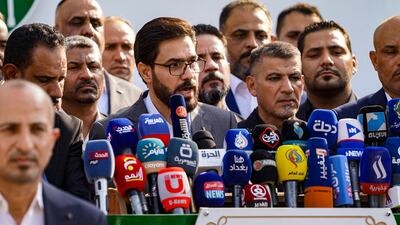
A member of the Iraqi Sadrist bloc (of Shiite leader Moqtada Sadr) announces the party's electoral programme for the upcoming elections, in the central city of Najaf, on September 30, 2021. - Iraq will hold parliamentary elections on October 10, a year early to appease an anti-government protest movement, at a time of simmering anger over graft and economic crisis. (Photo by Ali NAJAFI / AFP) -

Ammar al-Hakim, Leader of the Hikma movement and accompanied by his children, shows his inked finger at a polling station in Baghdad, as Iraqis go to the polls to vote in the parliamentary election, in Iraq, October 10, 2021. REUTERS/Thaier al-Sudani -

Former Iraqi Prime Minister Nouri al-Maliki shows his inked finger at a polling station in Baghdad, as Iraqis go to the poll to vote in the parliamentary election, in Iraq, October 10, 2021. REUTERS/Thaier al-Sudani


The delay has caused financial chaos despite record oil revenues, affecting businesses that hoped surging oil income would boost consumer spending and public sector investment.
More importantly, the budget delay is impacting efforts to improve services such as electricity and water provision as Iraq enters another hot summer.
Iraq's fiscal year runs from January 1 to December 31.
In the meantime, the caretaker government's monthly spending is limited to a twelfth of the previous year’s budget amount. Last year's budget was 130 trillion Iraqi dinars ($89.65 billion), with an estimated deficit of 28.7trn dinars.
In order to meet the urgent needs, the government sent to parliament a draft of the Emergency Law for Food Security and Development.
The 25-trillion Iraqi dinar (about $17.25 billion) bill to stem food poverty will not include public hiring but is hoped to mitigate the impact of increasing food prices in the wake of the war in Ukraine, and to keep the government-run food ration programme going.
Iraq is seeing record oil revenues this year with Baghdad earning more than $10 billion per month since March.
In Iraq, legislation is proposed by the Cabinet of an existing government or the president and has to be approved by parliament, according to the constitution. The bills can also be proposed by at least 10 lawmakers or any of the parliamentary committees.
Protests continue as electricity shortages loom
Iraq is also struggling to maintain supply of vital services including electricity. On Friday, Iraq's Ministry of Electricity said it had agreed with Iran to settle a debt owed for gas imports with Iran, which would increase gas exports to Iraq to 50 million cubic metres of gas per day. Iran has struggled to meet its promised export levels, however, due to its own rising spikes in demand in the summer and winter months.
Iraq’s unemployment level has often been high amid decades of conflict and economic sanctions, but youth unemployment soared in the years following the US-led invasion in 2003.
In many areas, more than 30 per cent of young Iraqis lack work, according to the UN International Labour Organisation.
Desperation for work has been a key driver of protests across the country since October 2019, unrest which has seen at least 500 demonstrators killed by security forces. Protests under the government of Prime Minister Al Kadhimi have been met with a less violent response, but demonstrations are still met with tear gas and occasionally live fire.
Protests continued across Iraq on Saturday and Sunday, with thousands of people outside government buildings in Baghdad and Nasiriyah demanding employment.
The teachers of Sulaymani University in the Kurdish region have been protesting long-delayed salaries, amid erratic fund transfers to the semi-autonomous Kurdish region by Baghdad, due to an ongoing dispute over Kurdish oil exports.
Protests outside energy facilities in Iraq are also frequent, especially in oil-rich parts of the country’s south where the oil and gas sector is Iraq's biggest employer.
Successive governments have promised the Ministry of Oil will create tens of thousands of new jobs in impoverished provinces such as Basra.
But due to oil revenue volatility and limits to how many people the sector can meaningfully employ, additional jobs have not been forthcoming.
For these reasons, Iraqi legislation that requires foreign oil companies to employ at least 80 per cent of staff from local communities has made little impact.

