


Scientists at the University of Texas have linked “Gulf War syndrome”, a debilitating illness suffered by tens of thousands of British and American soldiers who served in the First Gulf War in Iraq, to exposure to chemical weapons.
Operation Desert Storm liberated Kuwait from Iraqi occupation in 1991 and involved a US-led force of about 650,000 troops, including British, French, Saudi Arabian and Egyptian forces, in one of the largest military confrontations since the Second World War.
-

American airforce F-15 C fighters flying over a Kuwaiti oilfield which had been torched by retreating Iraqi troops during the Gulf War. Getty Images -
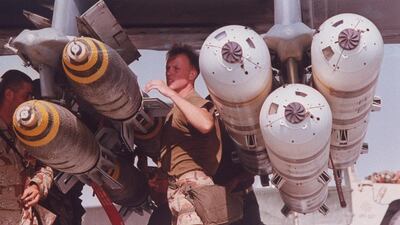
US Air Force ground crew loading 500-pound bombs onto an aircraft during operation Desert Storm - the mission to drive Iraqi forces out of Kuwait, January to February 1991. Mark Peters / Department Of Defence -

Gen Norman Schwarzkopf, commander-in-chief, US Central Command, presents the Legion of Merit to Maj Gen Muhammed Al Badi, chief of staff of the UAE Armed Forces, for his role in liberating Kuwait from occupying Iraqi forces during Operation Desert Storm. April 2, 1991. Corbis via Getty Images -

British engineers from the 7th armoured brigade in action on January 7 1991 in the Saudi Arabian desert. Patrick Baz / AFP -
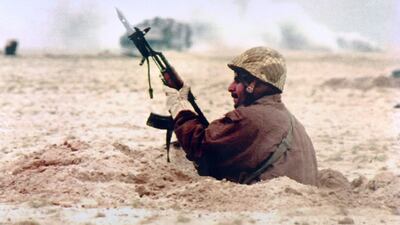
An Egyptian soldier holding a bayonet takes shelter in a hole to protect himself from Iraqi artillery fire on February 25, 1991 while Allied troops launch a ground offensive to free Kuwait from Iraqi invasion. Pascal Guyot / AFP -
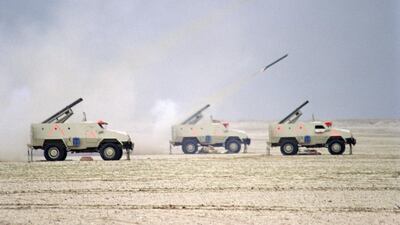
Egyptian army fire missiles on February 25, 1991 on the second day of the massive ground assault of the Allied Forces into Kuwait and Iraq. Pascal Guyot / AFP -
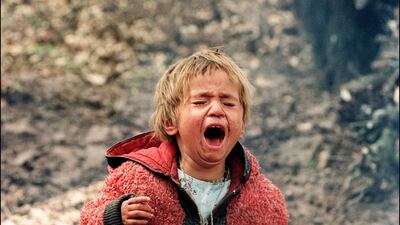
An Iraqi Kurdish refugee child cries on April 11, 1991, in Isikveren refugee camp situated on the Turkish border with Iraq. Nabil Ismail / AFP -
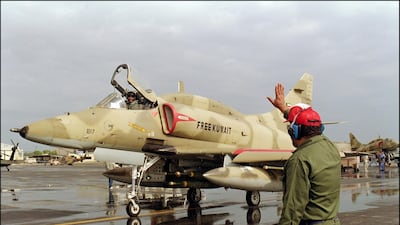
A Kuwaiti airfield worker waves to a departing of a Kuwaiti Air Force A-4 US-made Skyhawk jet fighter pilot 24 January 1991 leaving the Al Hasra air base for a bombing mission over Iraq. Chris Wilkins / AFP -
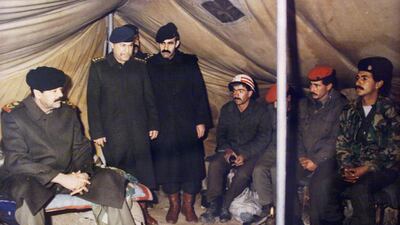
Iraqi President Saddam Hussein (L) is seen sitting in a tent in Najaf (Irak) in 1991 during the Gulf War. AFP -
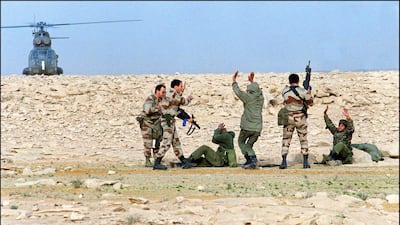
French special forces capture Iraqi soldiers on February 26, 1991 somewhere in Iraqi desert. Mike Nelson /AFP -
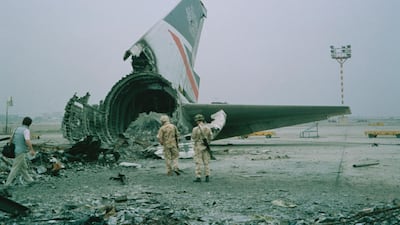
The wreckage of a British Airways Boeing 747-136 at Kuwait City airport, after BA Flight 149 was detained in Kuwait during the Gulf War, 1991. Colin Davey / Getty Images


After the conflict, many veterans said they developed chronic muscle pain, problems with speech and memory loss and gastrointestinal problems, among other mysterious and undiagnosed symptoms.
A report by the US Institute of Medicine in 2013 said that as many as 30 per cent of Gulf War veterans had experienced symptoms.
The University of Texas Southwestern Medical Centre said their research examining 1,000 US veterans of the conflict was “the most definitive” to date.
Researchers said the illnesses were likely caused by small amounts of sarin, the nerve gas released into the atmosphere within Iraq when coalition forces bombed chemical weapons facilities.
Lead report author Dr Robert Haley said that even small amounts of the nerve agent released into the atmosphere could cause illness, but some people were genetically more susceptible to becoming ill, suffering a defective gene called PON1 which when fully functional helps the body to process harmful chemicals.
The level soldiers might have been exposed to “was enough to make people ill if they were genetically predisposed to illness from it”, Dr Haley told the BBC.
Previously, some experts had suggested the illness may have been caused by exposure to depleted uranium ammunition, which uses the extremely dense but highly toxic radioactive metal to penetrate tank armour. When stored, the metal is harmless but it creates a toxic dust when used against armoured targets.

Coalition aircraft and tanks used about 300 tonnes of depleted uranium during the war and in some cases soldiers came into contact with Iraqi tanks that had been destroyed by the weapons.
But a study last year by the UT Southwestern Medical Centre in Dallas, found that soldiers exposed to depleted uranium dust did not have high enough concentrations of the metal in their body to cause serious illness.
Instead, a more serious health risk may have arisen during the war, as soldiers advanced towards Iraqi military bases that had been heavily bombed. Some of these sites were identified by UN inspectors in the months after the war as having stored chemical weapons.
While UN authorised operations to liberate Kuwait after Saddam’s invasion in August 1990, coalition forces made an incursion into Iraq to envelop Iraq-occupied Kuwait and cut off enemy forces.
US, French and British forces advanced as far as the southern Iraqi towns of Samawah and Nasiriyah – possibly putting them close to sites that may have stored chemicals, including a military depot in Al Qurnah, north of Basra, were a small number of degraded chemical weapons munitions were discovered by Danish forces in early 2004.
The extent to which Iraqi civilians and soldiers may have suffered these symptoms has not been well documented but a 1996 report by the Canadian Institute for International Studies said there had been an “increased incidence of similar illnesses” in Iraq.

