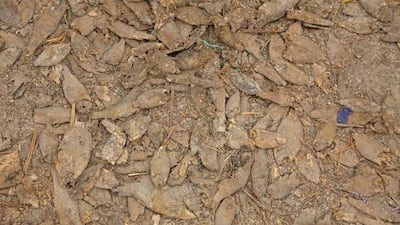
Water scarcity in Iraq has affected agricultural land such as on this farm in Jaliha village in central Diwaniya province. AFP

Experts and officials warn of bleak outlook for drought-hit Iraq


Sinan Mahmoud
  • English
  • Arabic

Iraq will experience full-blown environmental degradation unless swift action is taken to tackle climate change, government officials and experts said on Monday.

The Ministry of Environment stated that Iraq ranks fifth on the list of countries that are most vulnerable to the effects of global warming, while the country's population of 40 million people is already facing environmental challenges including water scarcity, heatwaves and dust storms.

These challenges “limit the capabilities to fight poverty, to enhance livelihoods and to temper conflicts over natural resources”, Mohammed Al Allaf, dean of the Faculty of Agriculture at Mosul University, told a forum on climate change.

“By now, all have realised that protecting natural resources is essential to protect the environment,” Mr Al Allaf said. “Everyone will lose with any environmental collapse.”

Abandoning outdated agricultural methods and preserving the country’s vegetation cover are among the top priorities, he said.

Trees once covered more than 60 per cent of Iraq's land but Mr Al Allaf said this had dropped to less than 4 per cent.

“This a great catastrophe for us.”

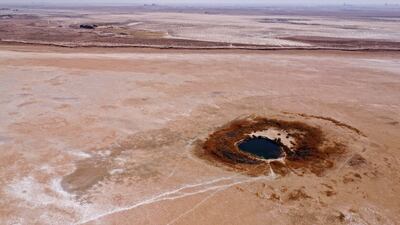
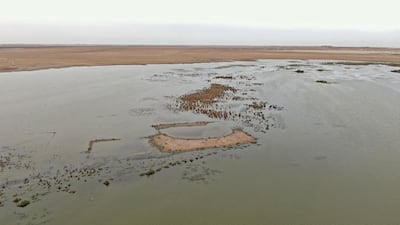
  • A remaining pond at the dried-up Sawa Lake on the edge of Iraq’s western desert. AFP
    A remaining pond at the dried-up Sawa Lake on the edge of Iraq’s western desert. AFP
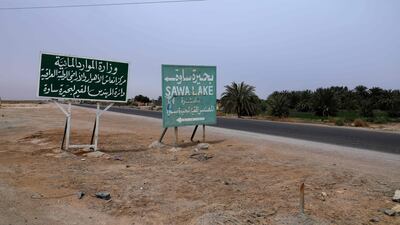
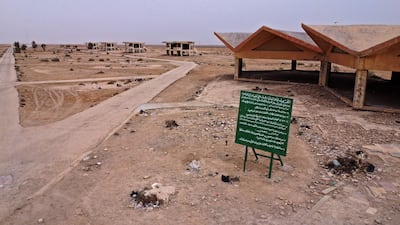
  • A street sign for Sawa Lake. A sharp drop in rainfall –now only at 30 per cent of what used to be normal for the region – has lowered the underground water table, said a senior advisor at Iraq's water resources ministry. AFP
    A street sign for Sawa Lake. A sharp drop in rainfall –now only at 30 per cent of what used to be normal for the region – has lowered the underground water table, said a senior advisor at Iraq's water resources ministry. AFP
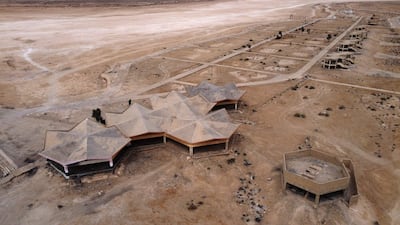
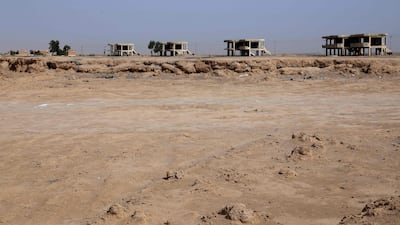
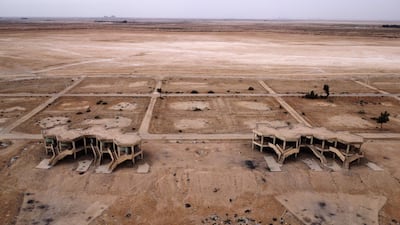
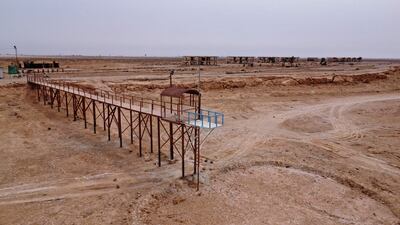
  • Hotels and tourist facilities near Sawa Lake have been abandoned. AFP
    Hotels and tourist facilities near Sawa Lake have been abandoned. AFP
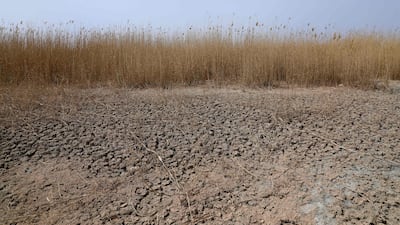
  • Dry, arid landscape remains. AFP
    Dry, arid landscape remains. AFP
  • What's left of hotel accommodation. AFP
    What's left of hotel accommodation. AFP
  • Iraq's Sawa Lake was once a popular tourist destination. AFP
    Iraq's Sawa Lake was once a popular tourist destination. AFP
  • What was once a tourist hotspot now stands empty. AFP
    What was once a tourist hotspot now stands empty. AFP
  • Parts of Sawa Lake are completely dry. AFP
    Parts of Sawa Lake are completely dry. AFP
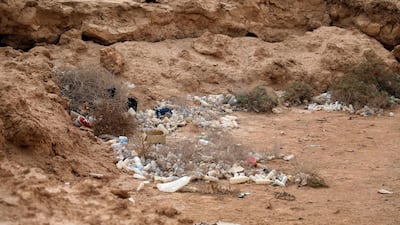
  • Bottles and plastic bags litter what was once a luscious lake. AFP
    Bottles and plastic bags litter what was once a luscious lake. AFP
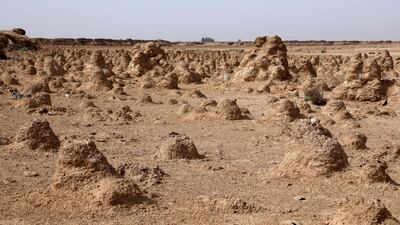
  • What was once a lake is now dry, arid landscape. AFP
    What was once a lake is now dry, arid landscape. AFP
  • Lake Milh, also known as Razzaza Lake, in Iraq's central province of Karbala is also facing the perils of drought. AFP
    Lake Milh, also known as Razzaza Lake, in Iraq's central province of Karbala is also facing the perils of drought. AFP
  • Dead fish litter Iraq's Lake Milh. AFP
    Dead fish litter Iraq's Lake Milh. AFP
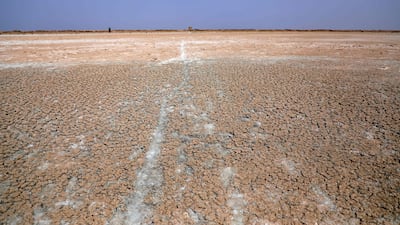
  • Human activity and climate change have combined to turn the site into a barren wasteland with piles of salt. AFP
    Human activity and climate change have combined to turn the site into a barren wasteland with piles of salt. AFP
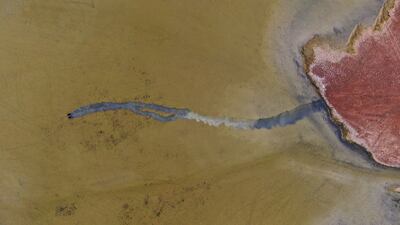
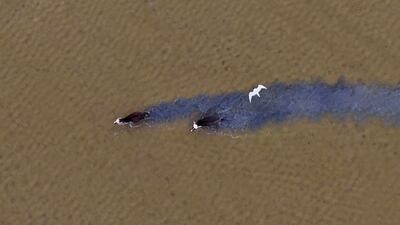
  • This aerial view shows horses running in Lake Milh. AFP
    This aerial view shows horses running in Lake Milh. AFP
  • Sawa Lake is now dry due to years of drought. AFP
    Sawa Lake is now dry due to years of drought. AFP

One dunam — 1,000 square metres — of forest can absorb 140 kilograms of carbon dioxide and three to five tonnes of dust each year, he said.

Planting millions of dunams of forest, therefore, is urgently needed to reduce CO2 emissions, increase oxygen levels and cut pollution.

“Vegetation is not only a friend to the environment but also the cornerstone in the efforts to protect it,” Mr Al Allaf said.

Another pressing issue addressed during forum was water scarcity. About 90 per cent of the water feeding Iraq’s two main rivers, the Tigris and Euphrates, originates in Turkey or Iran.

The two countries — both facing their own recent water crises — have built dams and diverted water away from the rivers.

For decades, Iraq has failed to reach agreements with Iran and Turkey on how to ensure a fair division of the water supply, as both countries say that they, too, are suffering from scarcity of water and that Iraq follows outdated irrigation methods.

Other speakers at the forum called for more investment in renewable energy, modern waste-management technology, reducing the number of cars on Iraqi roads, raising awareness through new school curricula and for new laws aimed at stopping damage to the environment.

'We don't have time'

Abdullah Al Khafajy, a doctor and a climate activist, blamed the poor state of Iraq's environment on government inaction and the bad habits of Iraqis.

Dr Al Khafajy chastised the government for the absence of a proper green strategy in the oil sector and said that the country’s waste-management system was outdated, contributing to high air and water pollution.

“In a lot of cases, [government agencies] just burn the trash and this leads to very disastrous health outcomes — especially for the respiratory systems of human beings,” he said.

“Those fumes contain toxic materials — we in Baghdad smell those toxins almost weekly where they are burned.”

High levels of air pollution, he said, was one of the main reasons why rates of cancer and birth defects were rising in the country.

“All the time we try to advocate, we try to make change, [then] we get hit very hard by bureaucracy, corruption and political instability,” he said.

Dr Al Khafajy said the government had to act fast “because we don’t have time, Iraq is becoming a huge desert, we’re getting buried with sandstorms almost weekly and we can’t stand this and tolerate this any longer”.

He called on government and private sector to fund green initiatives, to allow youths to play their role in shifting the economy and to encourage more environment-focused start-ups.

However, he acknowledged that the road to environmental progress will be long.

“We need to educate, we need to advocate for the inclusion of climate action in our curricula not just the university curricula, but also middle school and primary school,” he said.

“We need children to grow up learning about the climate change and the catastrophe that could happen if we do not take action as soon as possible,” he added. “We should all take action to combat that.”

The one-day Climate Change International Forum took place in Mosul, a city that is still recovering from the three-year reign of ISIS and the war to drive the militants out.

Mosul and surrounding areas are facing a wide range of challenges, from postwar reconstruction to threats from climate change.

Despite its woes, Mosul has set an example for other Iraqi cities.

Last year, the non-governmental group Mosul Eye launched a drive to plant trees in and around the city, including a forest inside the city itself. More than 9,000 trees have been planted so far.

Provincial authorities in the province of Nineveh, where Mosul is located, planted more than 21,000 trees of different varieties last year, reviving part of its famous forests damaged during the war against ISIS. More than 3,000 trees have been planted this year alone.

“The current situation in Iraq is critical and we need to act swiftly,” said Anas Al Taie, executive director of Mosul Eye, which organised the forum.

“The problems we are facing in Iraq in general and Mosul in particular need years to be dealt with in order to change the reality.

“More provinces, especially those in southern Iraq, will lose a lot due to searing temperatures, lack of water and lost vegetation.”


What is Folia?

Prince Khaled bin Alwaleed bin Talal's new plant-based menu will launch at Four Seasons hotels in Dubai this November. A desire to cater to people looking for clean, healthy meals beyond green salad is what inspired Prince Khaled and American celebrity chef Matthew Kenney to create Folia. The word means "from the leaves" in Latin, and the exclusive menu offers fine plant-based cuisine across Four Seasons properties in Los Angeles, Bahrain and, soon, Dubai.

Kenney specialises in vegan cuisine and is the founder of Plant Food Wine and 20 other restaurants worldwide. "I’ve always appreciated Matthew’s work," says the Saudi royal. "He has a singular culinary talent and his approach to plant-based dining is prescient and unrivalled. I was a fan of his long before we established our professional relationship."

Folia first launched at The Four Seasons Hotel Los Angeles at Beverly Hills in July 2018. It is available at the poolside Cabana Restaurant and for in-room dining across the property, as well as in its private event space. The food is vibrant and colourful, full of fresh dishes such as the hearts of palm ceviche with California fruit, vegetables and edible flowers; green hearb tacos filled with roasted squash and king oyster barbacoa; and a savoury coconut cream pie with macadamia crust.

In March 2019, the Folia menu reached Gulf shores, as it was introduced at the Four Seasons Hotel Bahrain Bay, where it is served at the Bay View Lounge. Next, on Tuesday, November 1 – also known as World Vegan Day – it will come to the UAE, to the Four Seasons Resort Dubai at Jumeirah Beach and the Four Seasons DIFC, both properties Prince Khaled has spent "considerable time at and love". 

There are also plans to take Folia to several more locations throughout the Middle East and Europe.

While health-conscious diners will be attracted to the concept, Prince Khaled is careful to stress Folia is "not meant for a specific subset of customers. It is meant for everyone who wants a culinary experience without the negative impact that eating out so often comes with."

Jetour T1 specs

Engine: 2-litre turbocharged

Power: 254hp

Torque: 390Nm

Price: From Dh126,000

Available: Now

MATCH INFO

Serie A

Juventus v Fiorentina, Saturday, 8pm (UAE)

Match is on BeIN Sports

COMPANY PROFILE
Name: Kumulus Water
 
Started: 2021
 
Founders: Iheb Triki and Mohamed Ali Abid
 
Based: Tunisia 
 
Sector: Water technology 
 
Number of staff: 22 
 
Investment raised: $4 million 
SHALASH%20THE%20IRAQI
%3Cp%3EAuthor%3A%20Shalash%3Cbr%3ETranslator%3A%20Luke%20Leafgren%3Cbr%3EPages%3A%20352%3Cbr%3EPublisher%3A%20And%20Other%20Stories%3C%2Fp%3E%0A

Directed: Smeep Kang
Produced: Soham Rockstar Entertainment; SKE Production
Cast: Rishi Kapoor, Jimmy Sheirgill, Sunny Singh, Omkar Kapoor, Rajesh Sharma
Rating: Two out of five stars 

How to play the stock market recovery in 2021?

If you are looking to build your long-term wealth in 2021 and beyond, the stock market is still the best place to do it as equities powered on despite the pandemic.

Investing in individual stocks is not for everyone and most private investors should stick to mutual funds and ETFs, but there are some thrilling opportunities for those who understand the risks.

Peter Garnry, head of equity strategy at Saxo Bank, says the 20 best-performing US and European stocks have delivered an average return year-to-date of 148 per cent, measured in local currency terms.

Online marketplace Etsy was the best performer with a return of 330.6 per cent, followed by communications software company Sinch (315.4 per cent), online supermarket HelloFresh (232.8 per cent) and fuel cells specialist NEL (191.7 per cent).

Mr Garnry says digital companies benefited from the lockdown, while green energy firms flew as efforts to combat climate change were ramped up, helped in part by the European Union’s green deal. 

Electric car company Tesla would be on the list if it had been part of the S&P 500 Index, but it only joined on December 21. “Tesla has become one of the most valuable companies in the world this year as demand for electric vehicles has grown dramatically,” Mr Garnry says.

By contrast, the 20 worst-performing European stocks fell 54 per cent on average, with European banks hit by the economic fallout from the pandemic, while cruise liners and airline stocks suffered due to travel restrictions.

As demand for energy fell, the oil and gas industry had a tough year, too.

Mr Garnry says the biggest story this year was the “absolute crunch” in so-called value stocks, companies that trade at low valuations compared to their earnings and growth potential.

He says they are “heavily tilted towards financials, miners, energy, utilities and industrials, which have all been hit hard by the Covid-19 pandemic”. “The last year saw these cheap stocks become cheaper and expensive stocks have become more expensive.” 

This has triggered excited talk about the “great value rotation” but Mr Garnry remains sceptical. “We need to see a breakout of interest rates combined with higher inflation before we join the crowd.”

Always remember that past performance is not a guarantee of future returns. Last year’s winners often turn out to be this year’s losers, and vice-versa.

City's slump

L - Juventus, 2-0
D - C Palace, 2-2
W - N Forest, 3-0
L - Liverpool, 2-0
D - Feyenoord, 3-3
L - Tottenham, 4-0
L - Brighton, 2-1
L - Sporting, 4-1
L - Bournemouth, 2-1
L - Tottenham, 2-1

The five pillars of Islam

1. Fasting

2. Prayer

3. Hajj

4. Shahada

5. Zakat 

Updated: May 09, 2022, 5:35 PM