



A proposal to convert Iraq's presidential palaces into public museums is being proposed by the country’s antiquities authority to Baghdad’s central government.
More than 100 opulent palaces and villas built for former dictator Saddam Hussein are scattered across the country, some are in use but many lie in ruins, as does much of the war-torn country.
The majority of Hussein’s palaces were looted during the chaos of the US-led invasion in 2003, when thieves scavenged all they could carry, even ripping electric cables out of walls.
Baghdad’s famous Iraqi museum was also looted and ransacked in the chaos that followed the invasion.
About a third of about 15,000 artefacts that were looted at the time have been recovered.
"The authority has submitted requests to convert palaces into museums and is awaiting approvals, especially that there are many palaces in the capital, Baghdad, that can be rehabilitated to become museums for the general citizens," said Laith Majid Hussein, the head of the authority for antiquities and heritage.
Mr Hussein said the general public was “eager to visit museums and the Iraqi museum had many school trips, which included thousands of students, citizens and tourists”.
The Iraqi official said the museum in Baghdad is struggling to preserve artefacts and is overcrowded with the archaeological collection it has and can “no longer accommodate most of them”.
-
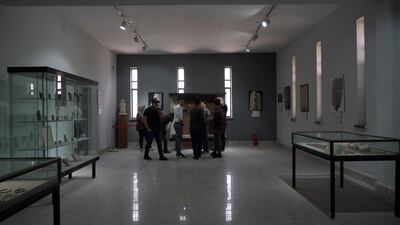
A view inside Thi Qar museum -
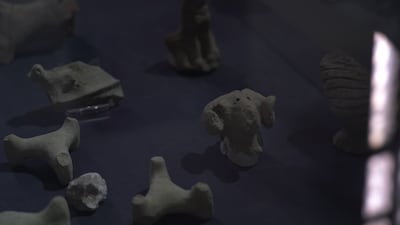
Artifacts inside Thi Qar museum -
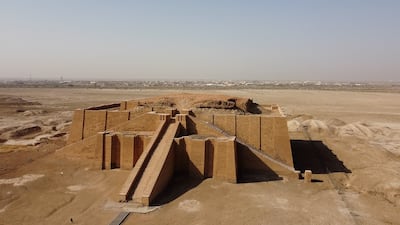
The Great Ziggurat temple, a massive Sumerian stepped mudbrick construction dedicated to the moon god Nanna which dates back to 2100 BC in the ancient city of Ur that falls now in southern Iraq's Dhi Qar province, 375 kilometers southeast of Baghdad. -
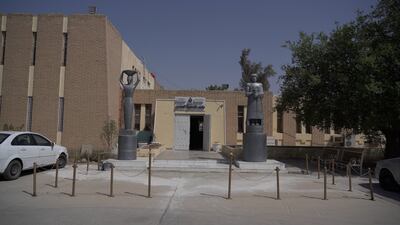
A view of Thi Qar museum entrance -
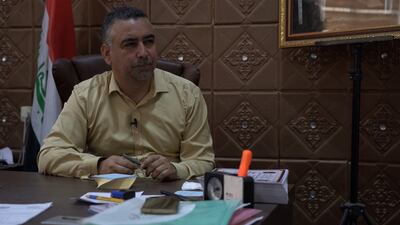
Amir Abdul-Razaq Al Zubaidi the general director of the provincial antiquities department. -
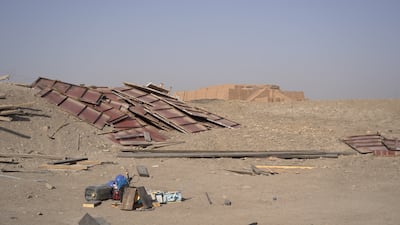
The Great Ziggurat temple, a massive Sumerian stepped mudbrick construction dedicated to the moon god Nanna which dates back to 2100 BC in the ancient city of Ur that falls now in southern Iraq's Dhi Qar province, 375 kilometers southeast of Baghdad. -
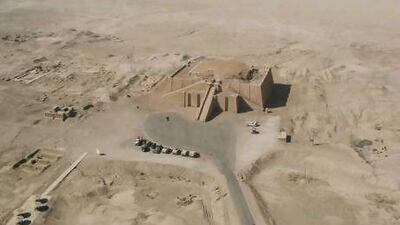
The monumental ziggurat at the ancient city of Ur located in the Thi Qar province, southern Iraq.


“We hope that action will be taken on this issue, especially that the government of Prime Minister Mustafa Al Kadhimi is very supportive of the idea of establishing a large and new Iraqi museum,” he said.
Last month, treasures dating back 2,500 years to the neo-Assyrian empire alongside 9th-Century Islamic antiquities went back on display in the Iraqi Museum, including two winged bulls from the Nimrud site in the palace of Ashurnasirpal II (883-859 BC).
The Iraq Museum was closed three years ago "because of the demonstrations and for security reasons", Mr Hussein said.
Since 2003, only a handful of the palatial residences have been used, often as military bases or public administrations, very rarely as museums.
Large-scale destruction of ancient sites, looting of antiquities and trafficking increased after ISIS’s takeover of large areas of Iraq between 2014 and 2017.
In the past year, Iraq has recovered more than 18,000 artefacts, the vast majority of them from the United States.
In December, Iraqi authorities held a ceremony to celebrate the return of the prized Gilgamesh tablet, which is more than 3,500 years old.
“Although the Iraqi museum is the largest in the country, we need to have another to be able to display the thousands of artefacts that have been found, or a large number of museums across the country,” Mr Hussein said.
He said it is vital that every governorate in Iraq has a museum to display the country’s rich cultural heritage.
Mr Hussein pointed out that the museum in the southern city of Basra, which is in one of the presidential palaces, has become a pivotal point of attraction.
“We are also going to open soon the Nasiriyah Museum and the Maysan Museum. We are in the final stages of placing the collectibles, and we are rehabilitating the presidential palace in Babylon,” he said.

