


Amid the political deadlock that has delayed the formation of Iraq’s new government, Shiite populist cleric Moqtada Al Sadr is wooing independent politicians to join his coalition.
Despite emerging as the clear winner in the October 10 polls, with 73 seats in the 329-member Parliament, Mr Al Sadr's efforts to form a government hit an impasse as his Iran-backed Shiite rivals continue to pose a challenge. Parties need 50 per cent plus one of the seats in parliament — 165 seats — to form the government.
He wants a national majority government formed by the winners, in a departure from the quota-based political system introduced after the 2003 US-led invasion to provide proportional government representation among Iraq’s various ethno-sectarian groups.
For that goal, he has teamed up with influential Kurds and Sunnis who attracted the most votes in their communities and has offered to limit the representation of pro-Iran parties who endured a major blow in the national elections.
Those parties, mainly Tehran-backed Shiite militias, wants a consensus government where they would gain or retain control of ministries.
“Yes, the successive consensus governments didn’t benefit Iraqis and Iraq, but it harmed it year after year,” Mr Al Sadr said in a statement.
“And that we see that we must get out of the consensus bottleneck to the sphere of the majority and from sectarianism to sphere of the nationalism.”
That goal was not able to be achieved in the past, “but today there are independent lawmakers who love their country and are aware of the reasons behind the deteriorated situation in Iraq to this worrying and scary level,” he said.
Iraq’s 2021 election results — in pictures
-
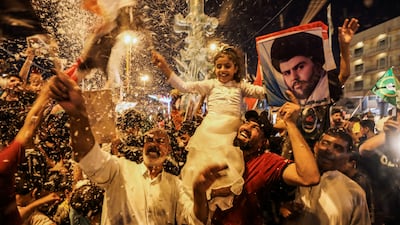
Supporters of the movement of Shiite cleric Moqtada Al Sadr celebrate in Najaf, Iraq, after preliminary results of the country’s parliamentary election were announced. Reuters -

Judge Jalil Adnan Khalaf (C), the chairman of Iraq’s Independent High Electoral Commission, speaks in the capital, Baghdad. AFP -

EU observers of the election hold a press conference in Baghdad. AP -
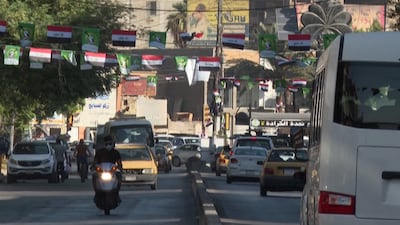
Iraqi flags are strung across a street. -
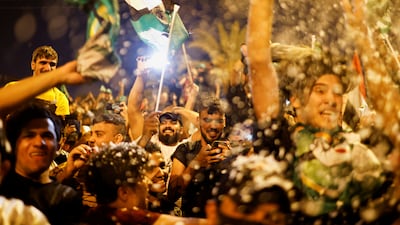
Sadrists celebrate after preliminary results of Iraq’s parliamentary election were announced in Baghdad on October 11. Reuters -
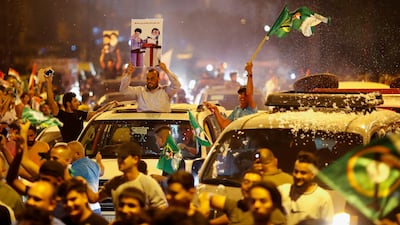
Supporters of Shiite cleric Moqtada Al Sadr celebrate after preliminary results were announced. Reuters -
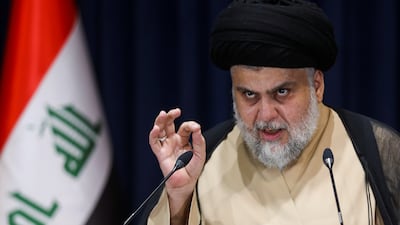
Shiite cleric Moqtada Al Sadr speaks after preliminary results of Iraq’s parliamentary election were announced in Najaf on October 11. Reuters


Pro-reform October protests that overwhelmed central and southern Iraq paved the way for independent candidates to win seats in the legislative body after amending the country’s elections law.
That has encouraged activists to run individually or form political parties. The prominent activist party is Imtidad Movement, which won nine seats, while other independent and smaller parties make up the rest. They hold about 40 seats.
Mr Al Sadr, whose alliance with the Kurds and Sunnis has secured 163 seats, called on independent politicians to join them on Saturday’s session scheduled to elect the President of the Republic.
That session, according to the Federal Supreme Court, needs a two-thirds quorum, or 220 seats.
'We need a courageous stance'
The vote for president, a largely ceremonial role traditionally reserved for Iraq's Kurds in post-Saddam Iraq, primarily pits the two main Kurdish parties, the Kurdistan Democratic Party and Patriotic Union of Kurdistan, against each other.
The step is key in the process of government formation. Government positions, including the cabinet, cannot be formed without the president's nomination of the largest bloc in parliament.
That must occur within 15 days of the new president being elected. The largest post-election bloc can then choose the prime minister, who must form the next government within 30 days.
“We need a courageous stance from you,” Mr Al Sadr told the independent lawmakers, saying it was the “last opportunity” to form the majority government and offering them a share in government.
Former prime minister Nouri Al Maliki’s State of Law bloc makes up the backbone of the Iran-backed Co-Ordination Framework, with 33 seats. Fatah Alliance, made up mainly of Shiite militias, won only 17 seats, compared with 45 in 2018, while the Kurdistan Alliance led by the PUK party won only 17 seats.
They are threatening to boycott Saturday's session if no agreement is reached with Mr Al Sadr.

