
Iranian climber Elnaz Rekabi's apology for competing in South Korea without a headscarf was “forced”, the BBC has claimed.
Rekabi, 33, competed for Iran without a hijab during the International Federation of Sport Climbing's Asia Championships in Seoul last week.
She said her hijab had fallen off.
Authorities threatened to take her family's property if she did not make the statement, a source told BBC Persian.
Opposition to the mandatory headscarf rule has fuelled five weeks of protests across Iran that erupted after the death in police custody of Mahsa Amini last month.
A crowd at Tehran airport on Wednesday greeted Rekabi, who covered her hair with a black baseball cap and hood. The following day, she wore the same clothes at a meeting with the sports minister, leading to suggestions that she had not been allowed to go home.
The BBC source said Rekabi had been detained in a room at Iran's National Olympic Committee building with agents present until she met the minister. She is now under house arrest, but the authorities said she is staying at home because she is in need of rest, the source said.
'It made me ill'
Athletes from Iran have been harassed by the government for supporting the weeks-long protests.
US climber Brooke Raboutou told AP at a World Cup climbing event in Japan on Friday that she had sent a message to Rekabi but had not received a reply.
“It has made me ill, nauseous,” she said of the situation.
“I support her 100 per cent and I’d like to think I can speak on behalf of most of the athletes.
"I’ve reached out to her, just asking if there is anything we can do to help, to support. I know that she’s fighting a really hard battle and doing what she can to represent the women in her country.”
Protests again broke out in south-eastern Iran on Friday as police arrested at least 57 people, described as rioters, after rocks were thrown and banks were attacked in the city of Zahedan, provincial police chief Ahmad Taheri told official news agency Irna.
-
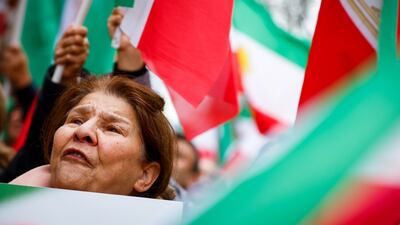
Last month's death in custody of Kurdish-Iranian woman Mahsa Amini has led to protests across Iran. In Brussels, Belgium, people took to the streets in sympathy to call for freedom and democracy in Iran as a two-day meeting of European Council leaders was in session. EPA -
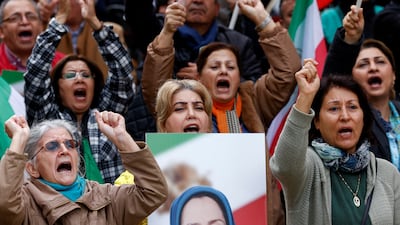
Demonstrators in Brussels, Belgium, raise their voices against the Iranian government. Reuters -

People gather in solidarity with protesters in Iran outside the State Library of Victoria in Melbourne, Australia. EPA -
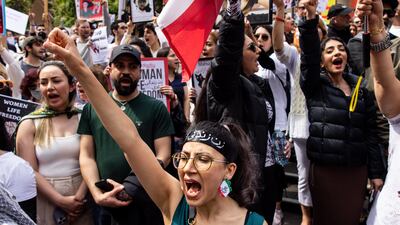
People gather for a rally in solidarity with protesters in Iran, outside the State Library of Victoria in Melbourne, Australia. EPA -
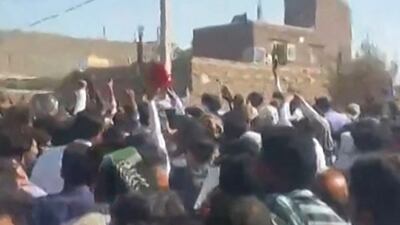
Demonstrators on the streets of the south-eastern Iranian city of Zahedan continues their resistance after Mahsa Amini died on September 16, following her arrest by the morality police in Tehran for failing to observe the state's dress code for women. AFP -

In defiance of Iranian headscarf laws, women offer hugs to passers by on a street in the Ekbatan Town in Tehran. A sign on the wall behind them reads: "Hugs for those who are sorrowful". AFP -
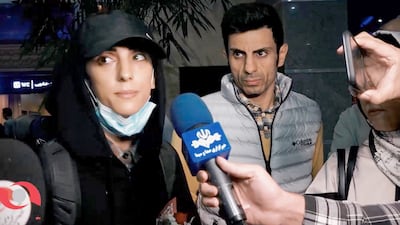
Iranian climber Elnaz Rekabi arrives at the Imam Khomeini International Airport in Tehran after competing in South Korea without wearing a mandatory headscarf. Rekabi said the act was unintentional as she rushed to prepare for competition and apologised. EPA -
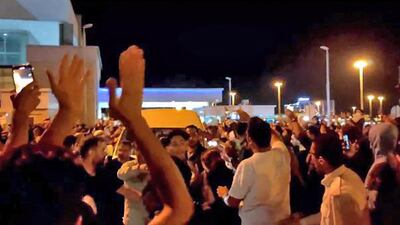
A welcome at Imam Khomeini International Airport in Tehran for climber Elnaz Rekabi, who competed in South Korea without a hijab. AFP -
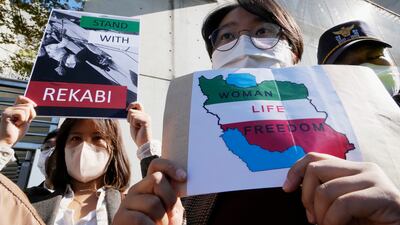
A rally in support of Iranian climber Elnaz Rekabi outside the Iranian embassy in Seoul, South Korea, after she was criticised for competing without a hijab. AP -
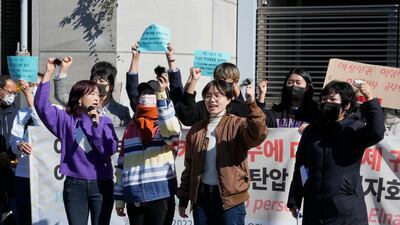
Protesters cut their hair and shout slogans during a rally to support Iranian competitive climber Elnaz Rekabi, outside the Iranian Embassy in Seoul, South Korea. AP -

A demonstrator outside the embassy of Iran in Jakarta, Indonesia, protests against the death in police custody of Mahsa Amini. Reuters -
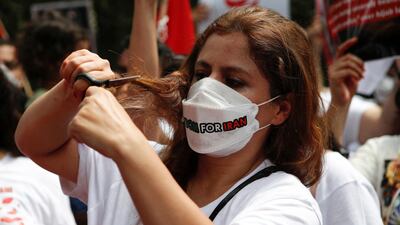
Outside the embassy of Iran in Jakarta, Indonesia, a woman cuts her hair during a protest against the Iranian government the death of Mahsa Amini. Reuters -
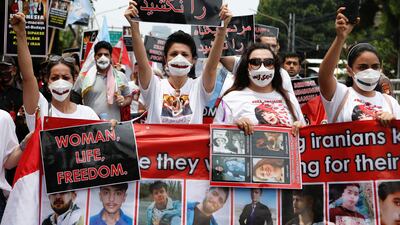
Demonstrators take part in a protest against the Iranian government outside the embassy of Iran in Jakarta, Indonesia. Reuters


A cleric voiced support for the public's right to protest against the government.
“The people have the right to criticise the leader of Muslim society, whether the criticism is justified or not,” Ayatollah Javad Alavi-Boroujerdi was quoted by Shafaqna news agency as saying.
“The people have something to say and they don't agree with what you are doing,” he told authorities.
State television said up to 300 protesters marched in the city after Friday prayers. It showed banks and shops with broken windows.

Videos posted on social media purported to show thousands of protesters chanting “Death to the dictator”, a reference to supreme leader Ayatollah Ali Khamenei, and “Death to Basijis”, in reference to the Basij militia which has been widely used to close down protests.
Zahedan is the capital of south-eastern Sistan and Baluchestan province, which is the home of Iran's Baluch minority. Amnesty International said security forces killed at least 66 protesters there after Friday prayers on September 30.
'For what crime were they killed?'
Zahedan's leading Sunni cleric said on Friday senior Iranian officials had to take responsibility for the September 30 killings.
“For what crime were they killed? Officials, the country's managers, the Islamic Republic's supreme leader [Mr Khamenei] who commands all armed forces are all responsible before God,” said Molavi Abdolhamid in a video posted on his website.
State media said at the time that “unidentified armed individuals” opened fire on a police station, prompting security forces to return fire.
In Tehran, cleric Ahmad Khatami said: “The judiciary should deal with the rioters — who betrayed the nation and poured water into the enemy's watermill — in such a way that others don't again fancy to riot.
“They have told deceived kids if they stay in the streets for a week the regime will fall. Dream on,” Mr Khatami said in a Friday prayers sermon, according to state media.
Iran blames foreign interference for the unrest.
Reuters and AP contributed to this report

