

Iran's supreme leader Ayatollah Ali Khamenei said on Tuesday that negotiations to restore the 2015 nuclear deal were advancing but urged officials not to place all bets on the Vienna talks.
“Work is progressing well in the negotiations,” Mr Khamenei told Iranian officials including President Ebrahim Raisi.
“Do not stop your work to wait for the results of the negotiations,” whatever they may be, he said in remarks published on his website.
Iran has been engaged for a year in talks with France, Germany, Britain, Russia and China directly, and the US indirectly, to revive the nuclear deal, known formally as the Joint Comprehensive Plan of Action.
The 2015 agreement gave Iran sanctions relief in exchange for curbs on its nuclear programme to guarantee that Tehran could not develop a nuclear weapon — something it has always denied wanting to do.
But the US's unilateral withdrawal from the accord in 2018 under Donald Trump's presidency and the reimposition of biting economic sanctions led Iran to break its commitments under the agreement.
-
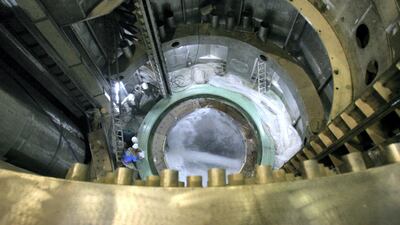
Russian contractors work at the Bushehr nuclear reactor site in 2007. The plant opened four years later. Bloomberg -
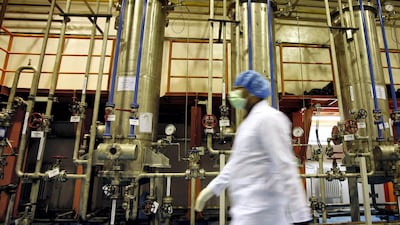
An Iranian technician at the International Atomic Energy Agency inspects the country's Isfahan plant in 2007. Tehran is no longer co-operating with the agency at nuclear sites across the country. EPA -

Workers wait to begin constructing a second reactor at the Bushehr nuclear power plant in 2019. AFP -
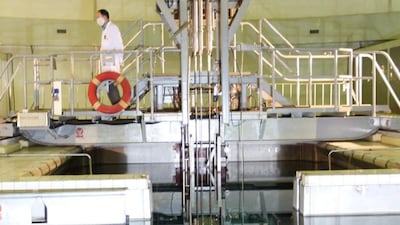
A metal-encased rod with 20 per cent enriched nuclear fuel is inserted into a reactor in Tehran in 2012. AFP -
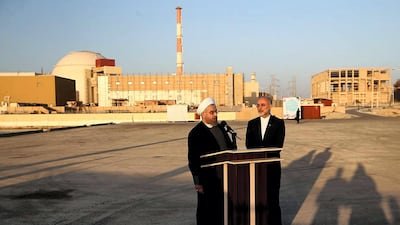
Fomer Iranian President Hassan Rouhani and the country's Atomic Energy Organisation chief Ali Akbar Salehi speak at the Bushehr nuclear site in 2015. AFP -
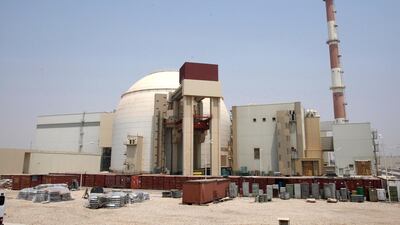
Iran's Bushehr nuclear plant has been restarted. EPA -
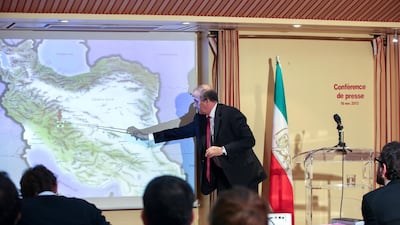
Mehdi Abrichamtchi, chairman of the Peace and Security Committee at the National Council of Resistance of Iran, shows journalists the location of a secret nuclear site in Iran in 2013. AFP -
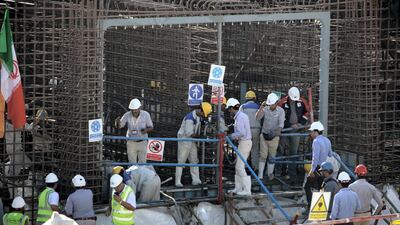
Workers prepare to begin the construction of a second reactor at the Bushehr site. AFP


“Our negotiating team has until now resisted the excessive demands of the other party and will continue doing so,” Mr Khamenei said.
“It is the other party that has broken its promises (by pulling out of the accord) and they have arrived at an impasse,” he said, referring to the US.
On Sunday, Foreign Minister Hossein Amirabdollahian accused Washington of “imposing new conditions” in the negotiations, without going into detail.
Ministry spokesman Saeed Khatibzadeh on Monday questioned Washington's willingness to reach an agreement, as key sticking points remain unresolved.
The talks have been paused since March 11, having progressed most of the way towards reviving the deal, with different parties pointing to the “final phase".
But pending issues are still unresolved, foremost among them Tehran's demand to remove the Islamic Revolutionary Guard Corps, the ideological arm of Iran's military, from a US list of terrorist groups.
The US insisted last week that the IRGC's' elite Quds Force would remain on its designated list of terrorist groups.

