

Iran has told the International Atomic Energy Agency it has stopped production at one of its nuclear centres that was attacked last June and transferred work to another site, the watchdog said Monday.
The move responded to a "security concern" after the attack, with the new site "better protected", a European diplomat told AFP.
The Tesa complex in Karaj, which is near the capital Tehran, hosted a workshop to build parts for centrifuges, which are used to enrich uranium.
Iran said cameras at the site were damaged on June 23, 2021, during what it called an Israeli "sabotage" operation.
Afterwards, the IAEA in Vienna said it did not receive permission to gain access and replace the surveillance equipment damaged in the attack.
The two parties finally struck an agreement in December and new cameras were installed.
But IAEA Director General Rafael Grossi said "Iran had informed the Agency on 19 January that it intended to produce centrifuge rotor tubes and bellows at a new location in Isfahan", according to the UN watchdog.
"The agency could adjust its surveillance and monitoring measures accordingly.
"A few days later, agency inspectors applied seals on all the relevant machines in the Karaj workshop, placed them under containment and then removed the surveillance cameras installed there.
"As a result, the production of centrifuge rotor tubes and bellows at the Karaj workshop had ceased."
-
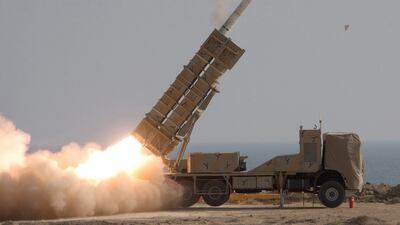
Iranian soldiers fire a missile in Baluchestan, near the shore of the Sea of Oman, during a military exercise on November 8, 2021. Iranian Army via AFP -
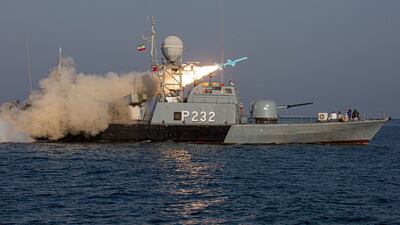
Iranian troops fire a Ghaidr missile during the second day of military exercise in the northern Sea of Oman, on November 8, 2021. Iranian Army via EPA -
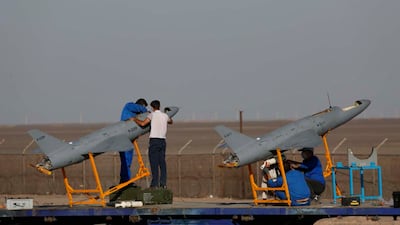
Iranian Army and Air Force personnel work on missile air-defence systems during an exercise at an undisclosed site in Iran on October 21, 2021, when the country began a nationwide air force drill. Iranian Army via EPA -
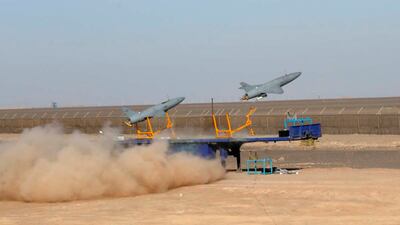
One week earlier, it had conducted a massive air defence exercise, state media reported. Iranian Army via EPA -
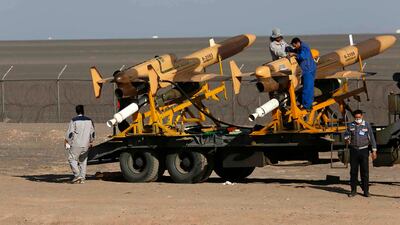
Iranian Air Force personnel work on air defence missiles during a nationwide drill on October 21, 2021. Iranian Army via AP -
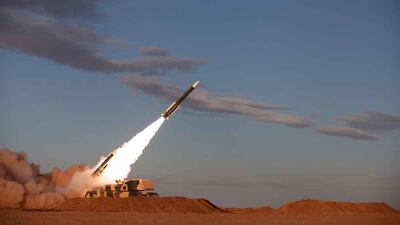
Iran holds a major air defence drill. In this image, made available on October 12, 2021, missiles are launched during a joint exercise between the Iranian Army and the country’s Islamic Revolutionary Guard Corps, in the desert of central Iran. Iranian Army via EPA


On January 24 IAEA inspectors set up cameras at a site in Isfahan "to ensure the machines intended for the production of centrifuge rotor tubes and bellows were under monitoring".
It said the production of the centrifuge equipment at the new workshop had yet to begin.
Iran has sharply accelerated its nuclear activities in the years since 2018, when US president Donald Trump withdrew from the 2015 international nuclear deal and imposed sweeping sanctions on Tehran.
The 2015 deal — struck between Iran and the US, Germany, France, Britain, China and Russia — offered Tehran relief from international sanctions in return for curbs on its nuclear programme.
After President Joe Biden entered the White House in January 2021, talks to revive the nuclear deal began in April in Vienna.
But they stopped for several months as Iran elected a new ultraconservative government.
The talks finally resumed in late November and are now in their final phase, which requires political decisions, parties involved in the talks say.

