March of the mummies: Egypt prepares to parade historical riches


Hamza Hendawi
  • English
  • Arabic

Nearly two dozen mummified pharaonic kings and queens will travel from Cairo’s Egyptian Museum to a new home across the city on Saturday, in a made-for-television parade featuring carriages, motorcycle riders, horses and local film stars.

The earthly remains of some of ancient Egypt’s best-known rulers, including Queen Hatshepsut, kings Ramses II and III, King Seti I and kings Thutmose III and IV, will travel through the Egyptian capital in an hour-long extravaganza.

Billed as a once-in-a-lifetime event, the televised procession is intended to remind the world of Egypt’s historical treasures at a time when the country’s vital tourism industry is being hit hard by the coronavirus pandemic for a second consecutive year.

This is the kind of promotion that you cannot get even if you spend millions of dollars... There will not be a single household in America, Europe and Japan that will not watch the parade on television

There are plans for the parade to be broadcast live in 60 countries. “Our aim is to be simultaneously present in every home across the world,” said Tourism and Antiquities Minister Khaled El Anany.

Zahi Hawass, perhaps the world's best-known Egyptologist, echoed the minister's sentiment with a touch of his trademark hyperbole.

“This is the kind of promotion that you cannot get even if you spend millions of dollars,” he said. “There will not be a single household in America, Europe and Japan that will not watch the parade on television.”

The full details of the parade have not been publicised in an effort to keep everyone guessing, but officials leaked some features of the event.

The mummies will leave the 119-year-old Egyptian Museum in Cairo’s Tahrir Square on vehicles modified to look like large pharaonic chariots.

The procession will circle the square, where a 19-metre-tall obelisk and four sphinx-like statues with lion's bodies and the heads of rams will be revealed for the first time since they were taken there last year.

Horse and motorcycle riders will then lead the parade to the Nile Corniche in the upmarket Garden City district before moving south to Fustat, the site of the country's medieval capital built during the Arab conquest of Egypt 1,400 years ago.

Famed Egyptologist Zahi Hawas pictured at Egypt's Saqqara necropolis south of Cairo. AFP

Fustat is home to the imposing ruins of a Byzantine fort, the ancient Hanging Church, the Coptic Museum and the Amr Ibn Al As Mosque, Egypt’s first mosque, named after the Arab general who led the conquering Muslim army.

More recently, Fustat became home to the National Egyptian Civilisation Museum, a sprawling, 13.5-hectare complex partially opened in 2017 that will now be the final resting place for the 22 mummies. A pavilion there has been set aside for the mummies, which will not go on public display until April 18.

Reflecting ancient Egyptian beliefs about the afterlife, the parade will pass through 12 gates built especially for the occasion.

“They are part of the royal journey to the next world,” said Mustafa Al Waziri, chief of the state Supreme Antiquities Council.

President Abdel Fattah El Sisi is expected to be at the museum when the mummies arrive to a 21-gun salute – a fitting greeting for the earthly remains of Egypt's ancient royals.

Members of the public in Egypt are being urged repeatedly to stay home and watch the parade on television rather than go out into the streets and see it for themselves.

The authorities hope the television coverage planned will be enough to keep Egyptians glued to their screens.

Said to involve nearly 50 cameras set up around the country, the coverage will also include pre-recorded segments featuring some of Egypt’s biggest film stars shot at locations across the country.

"If you go out on the street to watch, you will catch just one minute of the parade," Mr El Waziri said.

The remains of Queen Hatshepsut, one of 22 mummified ancient rulers due to be paraded through Cairo on Saturday. AFP

Egyptian film star Hussein Fahmy, appearing in a slick television promotion for the parade, said: “It is a rare event that happens once in a lifetime.”

Speaking from inside the Egyptian Museum, he said: “It is a historic event taking place on Egypt’s soil – the Egypt with great history and home to the most glorious civilisation known to mankind.”

Bringing Egypt's tourism industry back to life

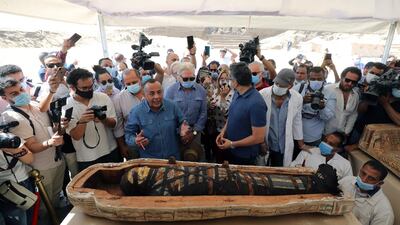
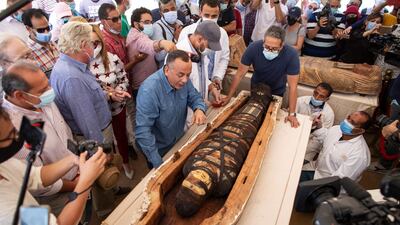
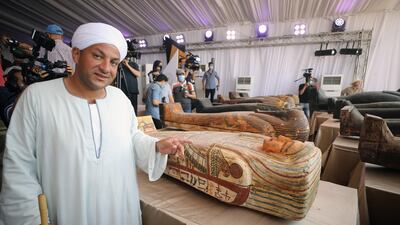
  • Secretary-general of the Supreme Council of Antiquities of Egypt Mostafa Waziri (C-L) speaks next to a sarcophagus discovered at Saqqara Necropolis, Giza, Egypt. An Egyptian archaeological mission uncovered a total of 59 intact and sealed coffins in three burial shafts dozen of meters deep in the Saqqara necropolis. EPA
    Secretary-general of the Supreme Council of Antiquities of Egypt Mostafa Waziri (C-L) speaks next to a sarcophagus discovered at Saqqara Necropolis, Giza, Egypt. An Egyptian archaeological mission uncovered a total of 59 intact and sealed coffins in three burial shafts dozen of meters deep in the Saqqara necropolis. EPA
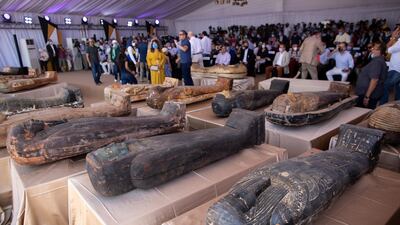
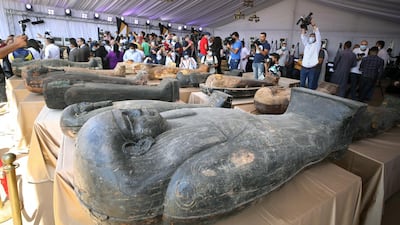
  • Sarcophaguses, excavated by the Egyptian archaeological mission, displayed during a press conference at the Saqqara necropolis, 30 kms south of the Egyptian capital Cairo, which resulted in the discovery of a deep burial well with more than 59 human coffins closed for more than 2,500 years. AFP
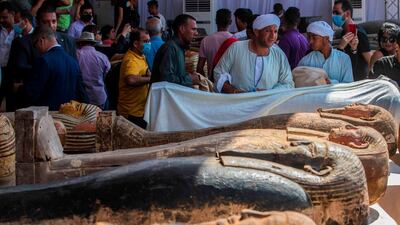
    Sarcophaguses, excavated by the Egyptian archaeological mission, displayed during a press conference at the Saqqara necropolis, 30 kms south of the Egyptian capital Cairo, which resulted in the discovery of a deep burial well with more than 59 human coffins closed for more than 2,500 years. AFP
  • One of the sarcophaguses excavated by the Egyptian archaeological mission which resulted in the discovery of a deep burial well with more than 59 human coffins closed for more than 2,500 years. AFP
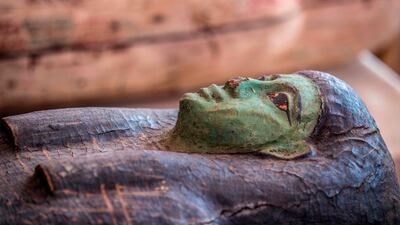
    One of the sarcophaguses excavated by the Egyptian archaeological mission which resulted in the discovery of a deep burial well with more than 59 human coffins closed for more than 2,500 years. AFP
  • Sarcophaguses, excavated by the Egyptian archaeological mission which resulted in the discovery of a deep burial well with more than 59 human coffins closed for more than 2,500 years. AFP
    Sarcophaguses, excavated by the Egyptian archaeological mission which resulted in the discovery of a deep burial well with more than 59 human coffins closed for more than 2,500 years. AFP
  • Khaled El-Enaby, Minister of Tourism and Antiquities, right, and Mostafa Waziri, the secretary-general of the Supreme Council of Antiquities, left, react after opening the sarcophagus is around 2500 years old at the Saqqara archaeological site. AP
    Khaled El-Enaby, Minister of Tourism and Antiquities, right, and Mostafa Waziri, the secretary-general of the Supreme Council of Antiquities, left, react after opening the sarcophagus is around 2500 years old at the Saqqara archaeological site. AP
  • A sarcophagus that is around 2500 years old is displayed at the Saqqara archaeological site, 30 kilometers (19 miles) south of Cairo, Egypt. AP
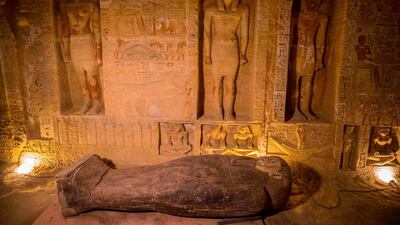
    A sarcophagus that is around 2500 years old is displayed at the Saqqara archaeological site, 30 kilometers (19 miles) south of Cairo, Egypt. AP
  • A sarcophagus that is around 2500 years old at the Saqqara archaeological site is shown, 30 kilometers (19 miles) south of Cairo, Egypt. AP
    A sarcophagus that is around 2500 years old at the Saqqara archaeological site is shown, 30 kilometers (19 miles) south of Cairo, Egypt. AP
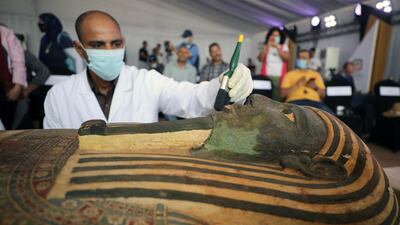
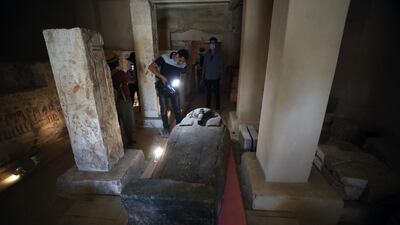
  • Egyptian archeologists work on one of the sarcophagi discovered at Saqqara Necropolis, Giza, Egypt. An Egyptian archaeological mission uncovered a total of 59 intact and sealed coffins in three burial shafts dozen of meters deep in the Saqqara necropolis.EPA
    Egyptian archeologists work on one of the sarcophagi discovered at Saqqara Necropolis, Giza, Egypt. An Egyptian archaeological mission uncovered a total of 59 intact and sealed coffins in three burial shafts dozen of meters deep in the Saqqara necropolis.EPA
  • Members of the press gather around sarcophagus on display after they were discovered at Saqqara Necropolis, Giza, Egypt. An Egyptian archaeological mission uncovered a total of 59 intact and sealed coffins in three burial shafts dozen of meters deep in the Saqqara necropolis. EPA
    Members of the press gather around sarcophagus on display after they were discovered at Saqqara Necropolis, Giza, Egypt. An Egyptian archaeological mission uncovered a total of 59 intact and sealed coffins in three burial shafts dozen of meters deep in the Saqqara necropolis. EPA
  • A man stands near sarcophagus on display after they were discovered at Saqqara Necropolis, Giza, Egypt. An Egyptian archaeological mission uncovered a total of 59 intact and sealed coffins in three burial shafts dozen of meters deep in the Saqqara necropolis. EPA
    A man stands near sarcophagus on display after they were discovered at Saqqara Necropolis, Giza, Egypt. An Egyptian archaeological mission uncovered a total of 59 intact and sealed coffins in three burial shafts dozen of meters deep in the Saqqara necropolis. EPA
  • People inspect the sarcophagus on display after they were discovered at Saqqara Necropolis, Giza, Egypt. An Egyptian archaeological mission uncovered a total of 59 intact and sealed coffins in three burial shafts dozen of meters deep in the Saqqara necropolis. EPA
    People inspect the sarcophagus on display after they were discovered at Saqqara Necropolis, Giza, Egypt. An Egyptian archaeological mission uncovered a total of 59 intact and sealed coffins in three burial shafts dozen of meters deep in the Saqqara necropolis. EPA
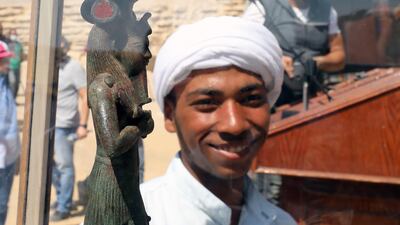
  • A man looks at one of the statues on display after they were discovered at Saqqara Necropolis, Giza, Egypt. An Egyptian archaeological mission uncovered a total of 59 intact and sealed coffins in three burial shafts dozen of meters deep in the Saqqara necropolis. EPA
    A man looks at one of the statues on display after they were discovered at Saqqara Necropolis, Giza, Egypt. An Egyptian archaeological mission uncovered a total of 59 intact and sealed coffins in three burial shafts dozen of meters deep in the Saqqara necropolis. EPA
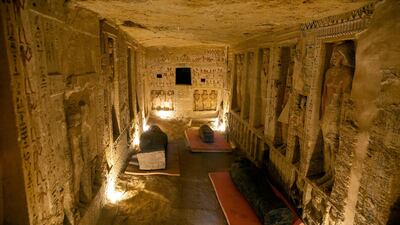
  • epa08717855 A view of one of the sarcophagi discovered at Saqqara Necropolis, Giza, Egypt, 03 October 2020. An Egyptian archaeological mission uncovered a total of 59 intact and sealed coffins in three burial shafts dozen of meters deep in the Saqqara necropolis. The 2500 years old coffins, believed to be belonging to the 26th Dynasty Priests, are expected to be transferred to the Grand Egyptian Museum. EPA/KHALED ELFIQI
    epa08717855 A view of one of the sarcophagi discovered at Saqqara Necropolis, Giza, Egypt, 03 October 2020. An Egyptian archaeological mission uncovered a total of 59 intact and sealed coffins in three burial shafts dozen of meters deep in the Saqqara necropolis. The 2500 years old coffins, believed to be belonging to the 26th Dynasty Priests, are expected to be transferred to the Grand Egyptian Museum. EPA/KHALED ELFIQI
  • People inspect the sarcophagus on display after they were discovered at Saqqara Necropolis, Giza. EPA
    People inspect the sarcophagus on display after they were discovered at Saqqara Necropolis, Giza. EPA
  • People inspect the sarcophagus on display after they were discovered at Saqqara Necropolis, Giza. EPA
    People inspect the sarcophagus on display after they were discovered at Saqqara Necropolis, Giza. EPA

The procession is part of a concerted effort to wow the world and revive the country’s ailing tourism sector, which analysts say made up about 15 per cent of gross domestic product before the pandemic.

Egypt welcomed about 13 million visitors in 2019, earning the country about $1 billion a month. But widespread travel restrictions meant only three million visitors made it to the country last year.

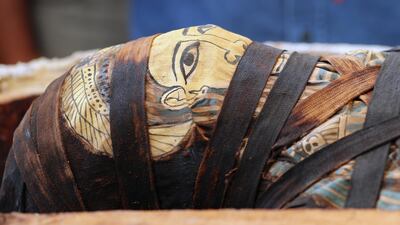
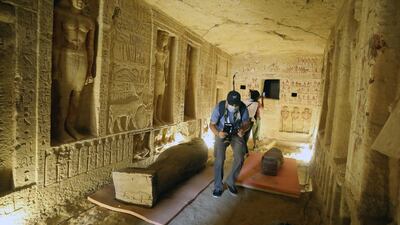
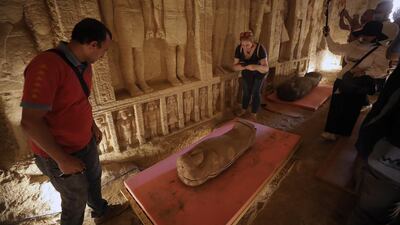
A series of spectacular archaeological finds in recent months, including the discovery of more than 100 pristine sarcophagi and gilded statues of ancient deities in the Saqqara necropolis, attracted intense media attention.

The parade is taking place only days after Egypt was in the news round the clock after an ultra-large container ship ran aground in the Suez Canal, blocking the vital waterway, affecting world trade and hurting the country's image.

The Egyptian Museum at Cairo's Tahrir Square. EPA

The vessel was re-floated on Monday and traffic in the waterway has since resumed, sending the country deep into a self-congratulatory mood not seen in years.

Curiously, the jubilation left everyone from President El Sisi and television talk show hosts down to ordinary Egyptians marvelling about the silver lining in the crisis, with the Egyptian leader saying the incident had helped to dispel talk about alternative sea routes to the canal once and for all.

If it goes off without a hitch, Saturday’s parade will lift the already upbeat mood in this country of 100 million people.

Read more about Ancient Egypt:

You can now take virtual tours of historic Egyptian archaeological sites

Huge archaeological find in Egypt includes 50 mummies and a temple

Egyptology isn't just about what we find, but who finds it – and why

Egypt unearths dozens of 2,500-year-old coffins in major discovery

Ten tax points to be aware of in 2026

1. Domestic VAT refund amendments: request your refund within five years

If a business does not apply for the refund on time, they lose their credit.

2. E-invoicing in the UAE

Businesses should continue preparing for the implementation of e-invoicing in the UAE, with 2026 a preparation and transition period ahead of phased mandatory adoption. 

3. More tax audits

Tax authorities are increasingly using data already available across multiple filings to identify audit risks. 

4. More beneficial VAT and excise tax penalty regime

Tax disputes are expected to become more frequent and more structured, with clearer administrative objection and appeal processes. The UAE has adopted a new penalty regime for VAT and excise disputes, which now mirrors the penalty regime for corporate tax.

5. Greater emphasis on statutory audit

There is a greater need for the accuracy of financial statements. The International Financial Reporting Standards standards need to be strictly adhered to and, as a result, the quality of the audits will need to increase.

6. Further transfer pricing enforcement

Transfer pricing enforcement, which refers to the practice of establishing prices for internal transactions between related entities, is expected to broaden in scope. The UAE will shortly open the possibility to negotiate advance pricing agreements, or essentially rulings for transfer pricing purposes. 

7. Limited time periods for audits

Recent amendments also introduce a default five-year limitation period for tax audits and assessments, subject to specific statutory exceptions. While the standard audit and assessment period is five years, this may be extended to up to 15 years in cases involving fraud or tax evasion. 

8. Pillar 2 implementation 

Many multinational groups will begin to feel the practical effect of the Domestic Minimum Top-Up Tax (DMTT), the UAE's implementation of the OECD’s global minimum tax under Pillar 2. While the rules apply for financial years starting on or after January 1, 2025, it is 2026 that marks the transition to an operational phase.

9. Reduced compliance obligations for imported goods and services

Businesses that apply the reverse-charge mechanism for VAT purposes in the UAE may benefit from reduced compliance obligations. 

10. Substance and CbC reporting focus

Tax authorities are expected to continue strengthening the enforcement of economic substance and Country-by-Country (CbC) reporting frameworks. In the UAE, these regimes are increasingly being used as risk-assessment tools, providing tax authorities with a comprehensive view of multinational groups’ global footprints and enabling them to assess whether profits are aligned with real economic activity. 

Contributed by Thomas Vanhee and Hend Rashwan, Aurifer

How The Debt Panel's advice helped readers in 2019

December 11: 'My husband died, so what happens to the Dh240,000 he owes in the UAE?'

JL, a housewife from India, wrote to us about her husband, who died earlier this month. He left behind an outstanding loan of Dh240,000 and she was hoping to pay it off with an insurance policy he had taken out. She also wanted to recover some of her husband’s end-of-service liabilities to help support her and her son.

“I have no words to thank you for helping me out,” she wrote to The Debt Panel after receiving the panellists' comments. “The advice has given me an idea of the present status of the loan and how to take it up further. I will draft a letter and send it to the email ID on the bank’s website along with the death certificate. I hope and pray to find a way out of this.”

November 26:  ‘I owe Dh100,000 because my employer has not paid me for a year’

SL, a financial services employee from India, left the UAE in June after quitting his job because his employer had not paid him since November 2018. He owes Dh103,800 on four debts and was told by the panellists he may be able to use the insolvency law to solve his issue. 

SL thanked the panellists for their efforts. "Indeed, I have some clarity on the consequence of the case and the next steps to take regarding my situation," he says. "Hopefully, I will be able to provide a positive testimony soon."

October 15: 'I lost my job and left the UAE owing Dh71,000. Can I return?'

MS, an energy sector employee from South Africa, left the UAE in August after losing his Dh12,000 job. He was struggling to meet the repayments while securing a new position in the UAE and feared he would be detained if he returned. He has now secured a new job and will return to the Emirates this month.

“The insolvency law is indeed a relief to hear,” he says. "I will not apply for insolvency at this stage. I have been able to pay something towards my loan and credit card. As it stands, I only have a one-month deficit, which I will be able to recover by the end of December." 

The specs: 2018 Ducati SuperSport S

Price, base / as tested: Dh74,900 / Dh85,900

Engine: 937cc

Transmission: Six-speed gearbox

Power: 110hp @ 9,000rpm

Torque: 93Nm @ 6,500rpm

Fuel economy, combined: 5.9L / 100km