

Live updates: Follow the latest news on Israel-Gaza
Egyptian President Abdel Fattah El Sisi asked an international summit he was hosting on Saturday to immediately work towards a ceasefire in the Gaza war and guarantee sustained humanitarian aid to the enclave's 2.3 million people.
However, the meeting, held in Egypt's new capital in the desert east of Cairo, wrapped up without issuing resolutions or a final communique summing up the day's deliberations. Instead, the Egyptian presidency issued a statement in which it outlined what it hoped the gathering would achieve.
“We meet in Cairo at a difficult time. Our humanity is being tested ahead of our interests, and the depth of our faith in the value of man and his right to live are put to the test,” the president said in his opening remarks at the one-day gathering.
Mr El Sisi spoke just hours after the first shipment of humanitarian aid arrived in Gaza, nearly two weeks after Hamas's war with Israel began. He said the delivery of the aid on Saturday was the result of talks with the US. It was delivered under the supervision of the UN and its Palestinian refugee agency UNRWA, alongside the Palestinian Red Crescent, he added.
“It is an unprecedented crisis that requires our full attention to prevent the conflict from becoming wider and threaten international security and stability,” the President said.
“We need to reach a specific consensus on a road map whose aim is to stop the current humanitarian tragedy and revive the peace process on several tracks.
“This starts with guaranteeing the full, safe, quick and sustained humanitarian aid to the people of Gaza. We then immediately move to negotiations on a ceasefire and we next urgently begin negotiations to revive the peace process.”
The absence of a final communique was possibly because of the divergence of the participants' views on the conflict. There was no news conference at the end of the meeting, which is customary on similar occasions.
Instead, the Egyptian presidency issued a statement that appeared to reflect its disappointment that the meeting fell below expectations.
Egypt, said the statement, wanted the Cairo gathering to “build an international consensus that transcends cultures, ethnicities, religions and political positions."
It also wanted the meeting to “call for the renouncement of violence, terrorism and unlawful killings as well as call for a halt to the ongoing war that claimed the lives of thousands of innocent civilians on the Palestinian and Israeli sides”.
“Egypt also looked to the summit’s participants [to] issue a global call for peace in which they agree on the importance of reassessing the international dealing with the Palestinians' cause over the past decades.”

More than 30 heads of state and prime ministers attended the Cairo Summit for Peace, including UAE President Sheikh Mohamed, Palestinian President Mahmoud Abbas, Jordan's King Abdullah, Qatar's Sheikh Tamim, Bahrain's King Hamad and the prime ministers of Italy, Spain, Greece and Iraq.
Also in attendance were UN Secretary General Antonio Guterres and the foreign ministers of the UK, Germany, France, Japan and Norway, as well as representatives of the EU, African Union and the Arab League.
President Sheikh Mohamed called for an immediate end to hostilities in Gaza.
He made the call in a post on social media site X, formerly known as Twitter, where he shared images from the summit.
President Abbas warned of “any attempts to displace our people from Gaza and we also warn of any attempts to expel Palestinians from their homes or displacing them from Jerusalem or the West Bank, because we will not accept displacement, and we will remain steadfast on our land no matter the challenges.”
“We won't leave, we won't leave,” he said.
Jordan's King Abdullah said Israel's bombardment and siege of Gaza was a war crime and berated the West for what he saw as double standards in dealing with the conflict.
“It has been two weeks since Israel slapped a complete blockade on Gaza. This continues amid international silence from most nations.
“The message we hear loud and clear in the Arab world is that the lives of Palestinians are less important than Israeli lives … our lives are less important than [those] of others, the implementation of international law is selective and human rights have their limits.”
He condemned what he said is “collective punishment of a besieged and helpless population” calling it a “flagrant violation of international humanitarian law. It is a war crime.”

Egypt and Jordan were the first Arab nations to sign peace treaties with Israel, in 1979 and 1994 respectively. They have for decades assumed the role of interlocutors in the Arab-Israeli conflict while maintaining close ties with Palestinian factions.
Jordan is also the official custodian of holy Islamic sites in Jerusalem.
Arab League Secretary General Ahmed Abul Gheit also called for an immediate ceasefire and an end to the “brutal bombardment” of civilians in Gaza, stressing the need for the continued supply of food, medicine and fuel.
Mr Abul Gheit warned against drifting into a religious conflict, which he said would cause a “catastrophe to the whole of mankind”.
Saudi Arabia's Foreign Minister Prince Faisal bin Farhan said his country “stands with the Palestinian people to obtain their rights.”
“We express our disappointment at the inability of the UN Security Council to take a position regarding the current crisis in Gaza so far and we demand the immediate opening of safe humanitarian corridors,” he added.
Britain's Foreign Secretary James Cleverly urged the Israeli military to respect international law and show restraint. His German counterpart, Annalena Baerbock, said Israel's fight against Hamas must be carried out with due concern for the humanitarian situation in Gaza.
But the absence of a high-ranking US official dampened expectations that the summit would produce anything that could change conditions in Gaza. There is currently no US ambassador in Cairo and the mission's charge d'affairs is representing Washington.
Israel was not represented nor was Iran, Hamas's main backer. Britain's Prime Minister, Germany's Chancellor and the French President also stayed away.

The Gaza crisis began when Hamas militants attacked southern Israel on October 7, killing some 1,400 people, including women and children, and taking 200 hostages.
Israel's response constituted the heaviest air campaign on Gaza since its first war with Hamas in 2008. To date, 4,137 Palestinians have been killed, one million displaced and nearly 150,000 homes damaged or destroyed.
Israeli Prime Minister Benjamin Netanyahu has vowed to continue his war until “victory” and to wipe out Hamas.
While preparing for a ground offensive, Israel has blockaded Gaza, denying its residents water, electricity and fuel and creating a major humanitarian crisis.
On Saturday, lorries laden with aid supplies drove through the Rafah border crossing from the Egyptian side and offloaded their cargo on to Palestinian lorries waiting on the Gaza side. The Palestinian lorries were escorted by white SUVs bearing the UN blue logo.
The UN said the 20-lorry convoy included life-saving supplies that would be received by the Palestinian Red Crescent.
The Palestinian group Hamas, which controls the Gaza Strip, said the delivery included medicine and limited amounts of food.
UN officials have said at least 100 lorries a day are needed into Gaza to cover urgent needs, and that any delivery of aid needs to be sustained and at a larger scale.
“The humanitarian situation in Gaza – already precarious – has reached catastrophic levels,” UN humanitarian chief Martin Griffiths said in a statement. “I am confident that this delivery will be the start of a sustainable effort to provide essential supplies.”
-

An Egyptian Red Crescent worker at the Rafah border crossing in North Sinai watches aid convoy lorries cross into Gaza on October 21 to make the first deliveries since the conflict began on October 7. Getty Images -
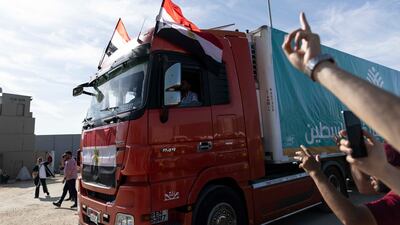
The aid convoy, organised by a group of Egyptian NGOs, had set off on October 14 from Cairo for the Gaza-Egypt border crossing at Rafah. Getty Images -

Volunteers and NGO staff at Rafah celebrate as the first 20 aid lorries start to cross into Gaza, which has been shattered by Israeli air strikes. Getty Images -

The delivery of aid to Gaza will ease the blockade enforced by Israel in the wake of Hamas's attack on October 7 that killed 1,400 people. Getty Images -
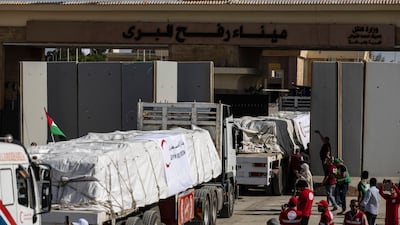
The launch of the aid operation ends more than a week-long wait by about 200 lorries on the Egyptian side of the Rafah crossing. Getty Images -
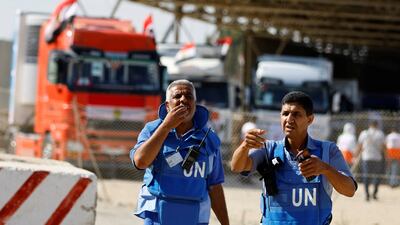
UN workers gesture as lorries carrying aid arrive at the Palestinian side of the border with Egypt on October 21. Reuters -
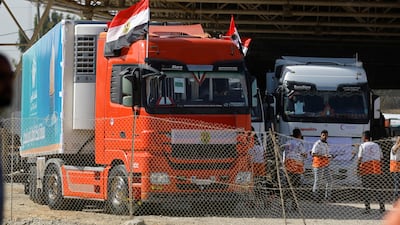
The first cargos of aid arrive in Gaza as the conflict between Israel and Hamas continues. Reuters -
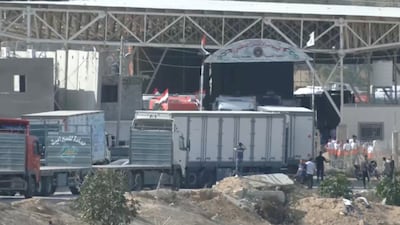
Lorries head to the Egyptian side of the border to be loaded with aid for Palestinians in Gaza. Cargo planes and lorries have been bringing humanitarian aid to Rafah for days. Reuters -
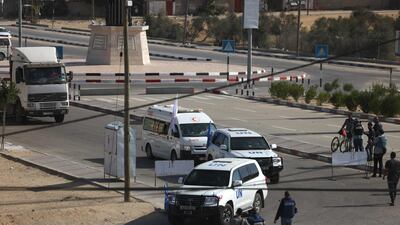
UN vehicles and empty lorries wait on the Palestinian side of the Gaza border at Rafah for humanitarian aid to be delivered. AFP -
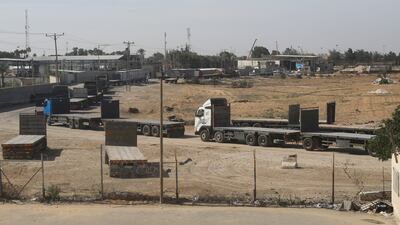
Palestinian lorries line up on the Gaza side of the border with Egypt to receive the aid. The Israeli blockade denied Gazans water, fuel and electricity as its military killed more than 4,000 Palestinians and displaced one million. AP


In his Saturday address, Mr El Sisi reiterated Cairo's growing concern over what it sees as an Israeli plot to force Gaza's Palestinians to escape the bombardment and possible ground offensive to find refuge in Egypt's Sinai Peninsula.
“Egypt emphasised and emphasises again its total rejection of forced eviction of the Palestinians and their migration to Egyptian territory in Sinai,” he said. “That would simply be a final liquidation of the Palestinian cause and an end to the dream of an independent Palestinian state.”
Egypt's position reflects Arab fears that Palestinians could again flee or be forced from their homes as they were during the war surrounding Israel’s creation in 1948 and in the aftermath of the 1967 war when Israel captured Sinai, the Gaza Strip, Syria's Golan Heights and the Jordanian-administered West Bank.
Government-inspired rallies rejecting the eviction of Palestinians were held across Egypt on Friday, with thousands participating.

Independent rallies were also held outside Cairo's ancient Al Azhar mosque – the world's foremost seat of Sunni Islam learning – and the Mustafa Mahmoud mosque in the Mohandiseen district across the Nile.
Protesters at both locations marched on Tahrir Square, the epicentre of the 2011 uprising that toppled autocratic ruler Hosni Mubarak.
Chanting anti-government and pro-Palestinian slogans, the protesters clashed with police on streets leading to the square but managed to reach it.
At least 100 protesters were arrested, according to police.

