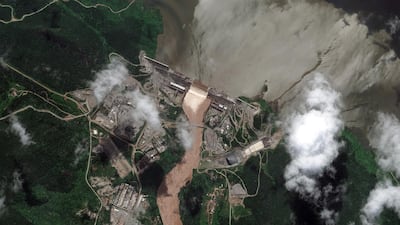
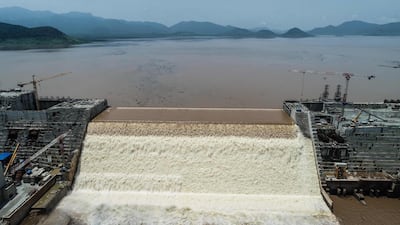
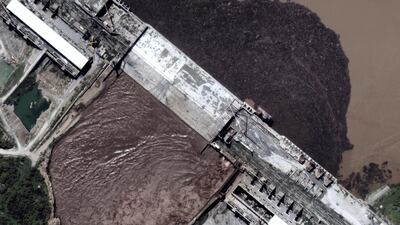
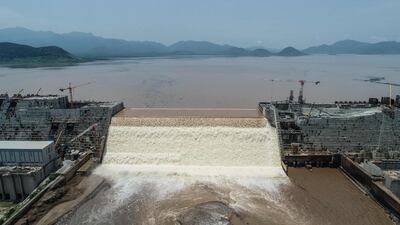
The Grand Ethiopian Renaissance Dam and its reservoir. Its first turbine began operating in the spring. EPA

Egypt protests to UN over Ethiopia's plans for third filling of giant Nile dam


  • English
  • Arabic

Egypt said it had protested to the UN Security Council on Friday against Ethiopia's plans to fill the reservoir of its controversial Nile dam for a third year without agreement from downstream countries.

The multibillion dollar Grand Ethiopian Renaissance Dam on the Blue Nile is designed to be the largest hydroelectric scheme in Africa but it has been at the centre of a dispute with Egypt and Sudan since work began in 2011.

Egypt “received a message from the Ethiopian side on July 26, stating that Ethiopia would continue filling the reservoir of the Renaissance Dam during the current flood season”, a Foreign Ministry statement said.

In response, Egypt wrote to the UN Security Council “to register its objection and complete rejection of Ethiopia's continuation of filling the Renaissance Dam unilaterally without a deal”.

The ministry said that Egypt maintains its “legitimate right … to take all necessary measures to ensure and protect its national security, including against any risks that Ethiopia's unilateral measures may cause in the future”.

Ethiopia deems the dam essential for the electrification and development of Africa's second-most populous country.

But Cairo and Khartoum fear it could threaten their access to Nile waters and they have demanded a written agreement between the three countries on the filling and operation of the dam.

The $4.2 billion complex is expected to produce more than 5,000 megawatts of electricity, more than doubling Ethiopia's output. The first of 13 turbines began generating power in February.

  • A satellite image shows the Grand Ethiopian Renaissance Dam on the Blue Nile river in July, 2020. Maxar Technologies via AP
    A satellite image shows the Grand Ethiopian Renaissance Dam on the Blue Nile river in July, 2020. Maxar Technologies via AP
  • The project - which began in 2011 - has become a flashpoint between Ethiopia and several of its neighbours. Maxar Technologies via Reuters
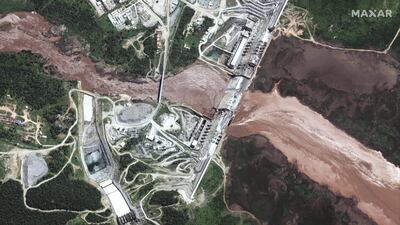
    The project - which began in 2011 - has become a flashpoint between Ethiopia and several of its neighbours. Maxar Technologies via Reuters
  • For Ethiopia, the dam will make a huge difference to power generation, doubling annual output and connecting millions of Ethiopian families to the grid. AFP
    For Ethiopia, the dam will make a huge difference to power generation, doubling annual output and connecting millions of Ethiopian families to the grid. AFP
  • Egypt maintains that the dam on the Blue Nile, the River Nile's main tributary, will jeopardise its water supply. AFP
    Egypt maintains that the dam on the Blue Nile, the River Nile's main tributary, will jeopardise its water supply. AFP
  • The $4 billion is about 90 per cent completed. Maxar Technologies via Reuters
    The $4 billion is about 90 per cent completed. Maxar Technologies via Reuters
  • An aerial view Grand Ethiopian Renaissance Dam on the Blue Nile River in Guba, northwest Ethiopia, on the 20th July. AFP
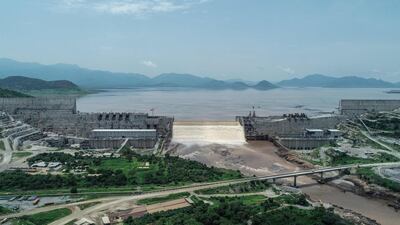
    An aerial view Grand Ethiopian Renaissance Dam on the Blue Nile River in Guba, northwest Ethiopia, on the 20th July. AFP

The process of filling the vast reservoir began in 2020, with Ethiopia announcing in July that year it had hit its target of 4.9 billion cubic metres of water.

The reservoir's total capacity is 74bn cubic metres, and the target for 2021 was to add 13.5bn, a target Ethiopia said it had met.

The new US envoy for the Horn of Africa, Mike Hammer, was in Ethiopia on Friday for talks that were expected to include the dispute over the dam.

The envoy held talks in Egypt on Monday.

“We are engaged in supporting a diplomatic way forward under the African Union's auspices that arrives at an agreement that provides for the long-term needs of every citizen along the Nile,” he said.


The years Ramadan fell in May

1987

1954

1921

1888

THE BIO

Family: I have three siblings, one older brother (age 25) and two younger sisters, 20 and 13 

Favourite book: Asking for my favourite book has to be one of the hardest questions. However a current favourite would be Sidewalk by Mitchell Duneier

Favourite place to travel to: Any walkable city. I also love nature and wildlife 

What do you love eating or cooking: I’m constantly in the kitchen. Ever since I changed the way I eat I enjoy choosing and creating what goes into my body. However, nothing can top home cooked food from my parents. 

Favorite place to go in the UAE: A quiet beach.

Star%20Wars%3A%20Ahsoka%20
%3Cp%3E%3Cstrong%3EDirector%3A%3C%2Fstrong%3E%20Various%20%3Cbr%3E%3Cstrong%3EStarring%3A%3C%2Fstrong%3E%20Rosario%20Dawson%2C%20Natasha%20Liu%20Bordizzo%2C%20Lars%20Mikkelsen%20%3Cbr%3E%3Cstrong%3ERating%3A%3C%2Fstrong%3E%204%2F5%0D%3Cbr%3E%3C%2Fp%3E%0A
Teaching your child to save

Pre-school (three - five years)

You can’t yet talk about investing or borrowing, but introduce a “classic” money bank and start putting gifts and allowances away. When the child wants a specific toy, have them save for it and help them track their progress.

Early childhood (six - eight years)

Replace the money bank with three jars labelled ‘saving’, ‘spending’ and ‘sharing’. Have the child divide their allowance into the three jars each week and explain their choices in splitting their pocket money. A guide could be 25 per cent saving, 50 per cent spending, 25 per cent for charity and gift-giving.

Middle childhood (nine - 11 years)

Open a bank savings account and help your child establish a budget and set a savings goal. Introduce the notion of ‘paying yourself first’ by putting away savings as soon as your allowance is paid.

Young teens (12 - 14 years)

Change your child’s allowance from weekly to monthly and help them pinpoint long-range goals such as a trip, so they can start longer-term saving and find new ways to increase their saving.

Teenage (15 - 18 years)

Discuss mutual expectations about university costs and identify what they can help fund and set goals. Don’t pay for everything, so they can experience the pride of contributing.

Young adulthood (19 - 22 years)

Discuss post-graduation plans and future life goals, quantify expenses such as first apartment, work wardrobe, holidays and help them continue to save towards these goals.

* JP Morgan Private Bank 

Electric scooters: some rules to remember
  • Riders must be 14-years-old or over
  • Wear a protective helmet
  • Park the electric scooter in designated parking lots (if any)
  • Do not leave electric scooter in locations that obstruct traffic or pedestrians
  • Solo riders only, no passengers allowed
  • Do not drive outside designated lanes
ADCC AFC Women’s Champions League Group A fixtures

October 3: v Wuhan Jiangda Women’s FC
October 6: v Hyundai Steel Red Angels Women’s FC
October 9: v Sabah FA

The burning issue

The internal combustion engine is facing a watershed moment – major manufacturer Volvo is to stop producing petroleum-powered vehicles by 2021 and countries in Europe, including the UK, have vowed to ban their sale before 2040. The National takes a look at the story of one of the most successful technologies of the last 100 years and how it has impacted life in the UAE.

Read part three: the age of the electric vehicle begins

Read part two: how climate change drove the race for an alternative 

Read part one: how cars came to the UAE

Updated: June 13, 2023, 5:31 AM