Egyptian engineer Sara Sabry, Egypt's first female analog astronaut, putting on a spacesuit at the LunAres Research Station in Poland. The analog mission, which took place in 2021 at an updated nuclear bunker, was aimed at simulating the conditions of a moon landing. Photo: LunAres Research Station.
Egyptian engineer Sara Sabry, Egypt's first female analog astronaut, putting on a spacesuit at the LunAres Research Station in Poland. The analog mission, which took place in 2021 at an updated nuclea

Egypt's first female analog astronaut on simulating space exploration


Kamal Tabikha
  • English
  • Arabic

Egyptian engineer Sara Sabry stands stock still as her spacesuit is adjusted, running through an extensive checklist of her mission to learn how to collect a lunar surface sample.

But she isn't on the moon or even the International Space Station; she is at a repurposed nuclear bunker in Poland.

Sabry is Egypt's first female analog astronaut.

Analog missions are essentially simulations conducted on Earth at locations that have physical similarities to the extreme conditions that space travellers will have to contend with on their journeys off-planet.

They are a kind of rehearsal that allows space agencies to test out crisis management scenarios, as well as give new kinds of equipment a dry run before using them on space missions.

Earning her bachelor’s degree in mechanical engineering at the American University in Cairo, where she also finished a pre-med minor, Sabry went on to achieve a master’s in biomedical engineering from the Politecnico di Milano in 2020. Her master's was mainly focused on the use of robotics and artificial intelligence in surgery.

This year, Sabry will start a PhD programme in aerospace sciences in the US where her focus will be on space suit design.

Egyptian analog astronaut Sara Sabry along with a colleague on an analog mission at the LunAres Research Station in Poland. As part of her training, Sabry, along with five others, spent three weeks underground at an old nuclear bunker to simulate the conditions of a moon landing. Photo: LunAres Research Station.

“My transition from the biomedical and mechanical engineering fields into aerospace was actually really smooth,” Sabry, 28, tells The National. “What many people don’t know is that a background in medicine and engineering allows one to work in a variety of fields. And when you consider how much the aerospace industry has grown during the past decades, a wide range of expertise now has a role to play in it.”

In 2021, Sabry embarked on her first analog mission, which she attended with five other people at a nuclear bunker just outside the small Polish city Pila. Sabry's group was inside the facility for three weeks, she tells The National from her home in Berlin.

To simulate a mission to the moon accurately, the group had no access to sunlight, food that isn’t freeze-dried or caffeine. They also had minimal contact with the outside world.

A freeze-dried meal at an analog space station in Poland. These kinds of meals are the only kind of food that astronauts can eat while on missions. Analog space stations are locations where astronauts training for space missions are sent to experience simulations of what it's like to go to space. Photo: LunAres Research Station

“The reason we were kept out of the sun is because when astronauts go on a moon mission, one of their top priorities is to protect themselves from radiation,” Sabry says. “During the simulation, we got to do everything that an astronaut would do, so we put on spacesuits and conducted moon walks to collect surface samples and so on.”

The bunker where the mission took place was designed by experienced space architects who made it in the image of housing units off-planet, explains Sabry. The group of astronauts were given a strict schedule to follow, including an hour of vigorous exercise every day. This is mandatory for every astronaut working off-planet.

Egyptian astronaut Sara Sabry leads a group of astronaut trainees on a yoga workout at the LunAres analog space station in Poland. For astronauts, exercise is essentially to combat the drop in bone density and muscle atrophy they experience off-planet. Photo: LunAres Research Station

“When an astronaut is exposed to either low gravity or micro-gravity, which often happens when they are in transit between Earth and their destination off-planet, they lose bone density because of the decreased load on their bones,” Sabry explains. “Muscle atrophy is also a big issue, so to mitigate this, astronauts on the International Space Station have to do two hours of exercise every day.”

While they might not have the lustre of off-planet space missions, analog voyages are an invaluable part of the aerospace industry, explains Sabry. She adds that taking part in the mission and the first-hand experience she gained would be invaluable in her plans to design spacesuits and in any aerospace research missions that she joins.

“When you understand the human body’s needs in that kind of environment, it changes the way you approach the whole thing,” she adds.

Sabry remains hopeful that she will one day go to space, but says that existing laws that mandate that people can take part in off-planet missions only organised by agencies in their home nations have thus far been a hindrance.

Though the Egyptian Space Agency is nascent and its activities limited, Sabry says it is progressing at a decent rate. She says she is excited about the opportunities it plans to afford Egyptians who want to enter the aerospace field.

The aerospace industry is one of the world’s more male-dominated industries, with only 11.2 per cent of the US's aerospace engineers women. Furthermore, Arab involvement in the sector is also markedly low, which has made Sabry’s journey not without its obstacles.

An astronaut trainee simulates gathering a surface sample on the moon. The simulation, also known as an analog mission, trains aspiring astronauts on what it's like to conduct missions off-planet, The three-week training period is spent entirely underground to ensure conditions are as similar to those off-planet as possible. Photo: LunAres Research Station

Despite those challenges, Sabry also recognises that her having been fortunate enough to receive a top-notch education gave her leg-up with achieving her success. Now she wants to open up the industry to other people, even if they haven't been as fortunate.

Her Deep Space Initiative, a non-profit company that works on providing more opportunities in aerospace for applicants anywhere in the world, gives participants the chance to conduct research on space-related topics. Those involved can also present their ideas to some of aerospace’s biggest names, many of whom Sabry met and formed relationships with over her career.

“We are essentially trying to make space research more accessible to everyone and to provide more equitable opportunity in the field,” says Sabry. “Those who join the programme will have the opportunity of studying fields that are only really available in the West and be exposed to knowledge they might have never had access to.”

As part of the community outreach part of her project, Sabry will collaborate with the Egyptian Space Agency on a variety of activities in the near future.

“My efforts are focused on erasing the nationality-based differences in the aerospace field, which are ridiculous in my opinion,” says Sabry. “It’s amazing that we continue to bar people from entering fields that could benefit from their involvement because of some lines on a map drawn by some old men centuries ago.”

Female firsts in space - in pictures:

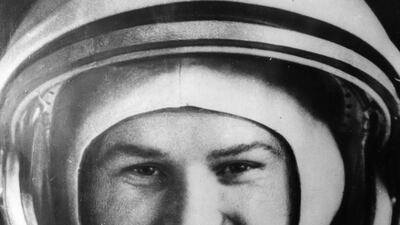
  • Women in space: Valentina Tereshkova, the first woman in space, photographed in her space suit shortly before take off in 1963. Central Press / Getty Images
    Women in space: Valentina Tereshkova, the first woman in space, photographed in her space suit shortly before take off in 1963. Central Press / Getty Images
  • Soviet cosmonaut Valentina Tereshkova during preparations for her flight on Vostok 6 on June 16, 1963. Getty Images
    Soviet cosmonaut Valentina Tereshkova during preparations for her flight on Vostok 6 on June 16, 1963. Getty Images
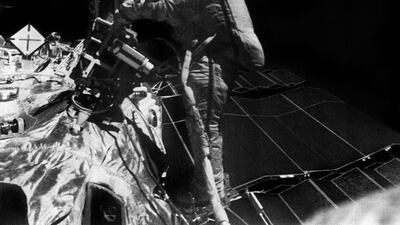
  • Svetlana Savitskaya travelled into space in 1982 and was the first woman to perform a spacewalk. AFP
    Svetlana Savitskaya travelled into space in 1982 and was the first woman to perform a spacewalk. AFP
  • This picture, taken by Soviet commander Vladimir Dzhanibekov, shows the first ever walk into outer space by a woman, Svetlana Savitskaya on July 25, 1984. AFP
    This picture, taken by Soviet commander Vladimir Dzhanibekov, shows the first ever walk into outer space by a woman, Svetlana Savitskaya on July 25, 1984. AFP
  • Sally Ride made her mark as the first American female astronaut in 1983. Nasa
    Sally Ride made her mark as the first American female astronaut in 1983. Nasa
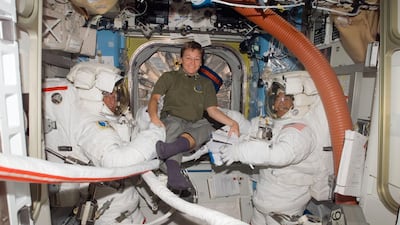
  • US astronaut Peggy Whitson, pictured with astronauts Scott Parazynski (left), STS-120 mission specialist, and Daniel Tani, became the first female commander of the International Space Station in 2007. Nasa
    US astronaut Peggy Whitson, pictured with astronauts Scott Parazynski (left), STS-120 mission specialist, and Daniel Tani, became the first female commander of the International Space Station in 2007. Nasa
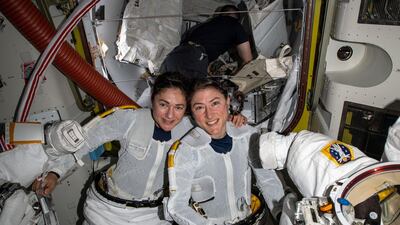
  • Nasa astronauts Jessica Meir (left) and Christina Koch (right) put on their spacesuits as they prepare to leave the hatch of the International Space Station and begin the historical first-ever all-female spacewalk in 2019. Nasa
    Nasa astronauts Jessica Meir (left) and Christina Koch (right) put on their spacesuits as they prepare to leave the hatch of the International Space Station and begin the historical first-ever all-female spacewalk in 2019. Nasa
  • Nasa astronaut Christina Koch conducts maintenance activities aboard the International Space Station. Ms Koch set the record for the single longest spaceflight by a woman, after spending 328 days on the ISS. Nasa
    Nasa astronaut Christina Koch conducts maintenance activities aboard the International Space Station. Ms Koch set the record for the single longest spaceflight by a woman, after spending 328 days on the ISS. Nasa
  • Mae Jemison was the first African American woman to go to space in 1992. Nasa
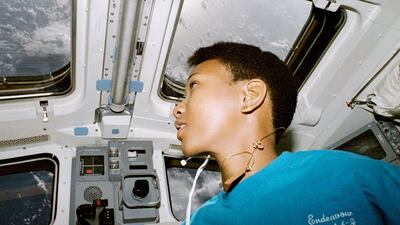
    Mae Jemison was the first African American woman to go to space in 1992. Nasa
Lexus LX700h specs

Engine: 3.4-litre twin-turbo V6 plus supplementary electric motor

Power: 464hp at 5,200rpm

Torque: 790Nm from 2,000-3,600rpm

Transmission: 10-speed auto

Fuel consumption: 11.7L/100km

On sale: Now

Price: From Dh590,000

The biog

Favourite hobby: I love to sing but I don’t get to sing as much nowadays sadly.

Favourite book: Anything by Sidney Sheldon.

Favourite movie: The Exorcist 2. It is a big thing in our family to sit around together and watch horror movies, I love watching them.

Favourite holiday destination: The favourite place I have been to is Florence, it is a beautiful city. My dream though has always been to visit Cyprus, I really want to go there.

Timeline

2012-2015

The company offers payments/bribes to win key contracts in the Middle East

May 2017

The UK SFO officially opens investigation into Petrofac’s use of agents, corruption, and potential bribery to secure contracts

September 2021

Petrofac pleads guilty to seven counts of failing to prevent bribery under the UK Bribery Act

October 2021

Court fines Petrofac £77 million for bribery. Former executive receives a two-year suspended sentence 

December 2024

Petrofac enters into comprehensive restructuring to strengthen the financial position of the group

May 2025

The High Court of England and Wales approves the company’s restructuring plan

July 2025

The Court of Appeal issues a judgment challenging parts of the restructuring plan

August 2025

Petrofac issues a business update to execute the restructuring and confirms it will appeal the Court of Appeal decision

October 2025

Petrofac loses a major TenneT offshore wind contract worth €13 billion. Holding company files for administration in the UK. Petrofac delisted from the London Stock Exchange

November 2025

180 Petrofac employees laid off in the UAE

UAE v Gibraltar

What: International friendly

When: 7pm kick off

Where: Rugby Park, Dubai Sports City

Admission: Free

Online: The match will be broadcast live on Dubai Exiles’ Facebook page

UAE squad: Lucas Waddington (Dubai Exiles), Gio Fourie (Exiles), Craig Nutt (Abu Dhabi Harlequins), Phil Brady (Harlequins), Daniel Perry (Dubai Hurricanes), Esekaia Dranibota (Harlequins), Matt Mills (Exiles), Jaen Botes (Exiles), Kristian Stinson (Exiles), Murray Reason (Abu Dhabi Saracens), Dave Knight (Hurricanes), Ross Samson (Jebel Ali Dragons), DuRandt Gerber (Exiles), Saki Naisau (Dragons), Andrew Powell (Hurricanes), Emosi Vacanau (Harlequins), Niko Volavola (Dragons), Matt Richards (Dragons), Luke Stevenson (Harlequins), Josh Ives (Dubai Sports City Eagles), Sean Stevens (Saracens), Thinus Steyn (Exiles)

How to wear a kandura

Dos

  • Wear the right fabric for the right season and occasion 
  • Always ask for the dress code if you don’t know
  • Wear a white kandura, white ghutra / shemagh (headwear) and black shoes for work 
  • Wear 100 per cent cotton under the kandura as most fabrics are polyester

Don’ts 

  • Wear hamdania for work, always wear a ghutra and agal 
  • Buy a kandura only based on how it feels; ask questions about the fabric and understand what you are buying
Zakat definitions

Zakat: an Arabic word meaning ‘to cleanse’ or ‘purification’.

Nisab: the minimum amount that a Muslim must have before being obliged to pay zakat. Traditionally, the nisab threshold was 87.48 grams of gold, or 612.36 grams of silver. The monetary value of the nisab therefore varies by current prices and currencies.

Zakat Al Mal: the ‘cleansing’ of wealth, as one of the five pillars of Islam; a spiritual duty for all Muslims meeting the ‘nisab’ wealth criteria in a lunar year, to pay 2.5 per cent of their wealth in alms to the deserving and needy.

Zakat Al Fitr: a donation to charity given during Ramadan, before Eid Al Fitr, in the form of food. Every adult Muslim who possesses food in excess of the needs of themselves and their family must pay two qadahs (an old measure just over 2 kilograms) of flour, wheat, barley or rice from each person in a household, as a minimum.

Why it pays to compare

A comparison of sending Dh20,000 from the UAE using two different routes at the same time - the first direct from a UAE bank to a bank in Germany, and the second from the same UAE bank via an online platform to Germany - found key differences in cost and speed. The transfers were both initiated on January 30.

Route 1: bank transfer

The UAE bank charged Dh152.25 for the Dh20,000 transfer. On top of that, their exchange rate margin added a difference of around Dh415, compared with the mid-market rate.

Total cost: Dh567.25 - around 2.9 per cent of the total amount

Total received: €4,670.30 

Route 2: online platform

The UAE bank’s charge for sending Dh20,000 to a UK dirham-denominated account was Dh2.10. The exchange rate margin cost was Dh60, plus a Dh12 fee.

Total cost: Dh74.10, around 0.4 per cent of the transaction

Total received: €4,756

The UAE bank transfer was far quicker – around two to three working days, while the online platform took around four to five days, but was considerably cheaper. In the online platform transfer, the funds were also exposed to currency risk during the period it took for them to arrive.

The bio

Studied up to grade 12 in Vatanappally, a village in India’s southern Thrissur district

Was a middle distance state athletics champion in school

Enjoys driving to Fujairah and Ras Al Khaimah with family

His dream is to continue working as a social worker and help people

Has seven diaries in which he has jotted down notes about his work and money he earned

Keeps the diaries in his car to remember his journey in the Emirates

Updated: May 26, 2022, 7:58 PM