


Spiking global food and energy prices, including a steep hike in wheat prices caused by the war in Ukraine, are piling pressure on Egypt's poorest.
Egypt is the world’s largest wheat importer, with Russia and Ukraine providing a combined 80 per cent of its supply.
Most of the wheat is used to make bread, a main staple cheaply available to 60 million Egyptians holding state food cards entitling them to a range of basic food items, including rice, cooking oil and pasta.
Besides the bread, Egypt is experiencing a wave of other price increases that have driven up inflation.
“I didn't just feel the price hikes, I was devastated by them,” father of two Hany Taghyan told The National.
-
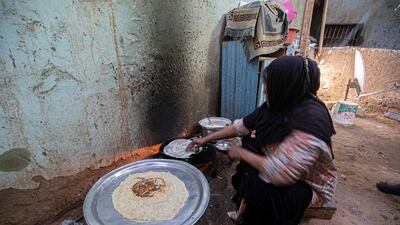
Umm Abdo prepares bread for the family in her home on the west bank of the Nile, by Egypt's southern city of Aswan. All photos: AFP -
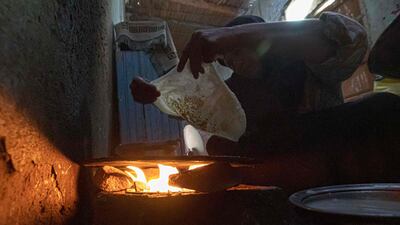
Russia's invasion of Ukraine has disrupted wheat imports to many countries, fuelling fears of higher prices and shortages. -

With global supply chains already under strain due to the Covid-19 pandemic, a wheat-buying frenzy in Egypt, Libya, Tunisia, Algeria and Morocco – all of which depend heavily on imported wheat to feed their populations – lays bare the magnitude of the challenge governments face amid sharp rises in food prices. -
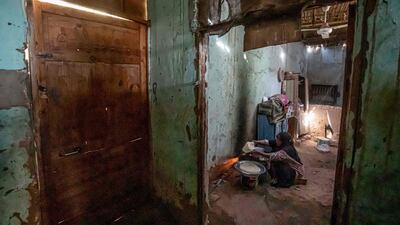
The crisis was highlighted by the UN food agency, which this week predicted that poorer countries in northern Africa, Asia and the Middle East that depend heavily on wheat imports risk suffering significant food insecurity because of the war in Ukraine. -
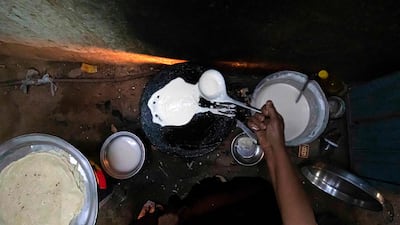
Of the five nations in northern Africa, Egypt’s wheat predicament is perhaps the gravest. The world’s largest wheat importer with a population of 102 million, Egypt relies on Russia and Ukraine for 80 per cent of its supply. -
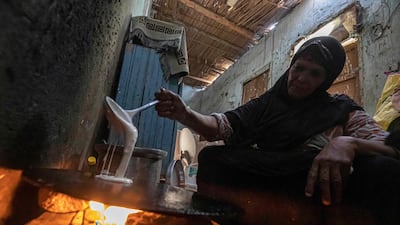
Egypt’s wheat is chiefly used to make the flatbreads provided for about 60 million citizens who are entitled to subsidised food.


Mr Taghyan said he argued with his local grocer last week, after the store owner hiked prices on essential goods, citing the war in Ukraine as the reason.
At the outdoor market he frequents to buy fresh goods, the private sector employee said his weekly shop would usually cost around 100 EGP ($6.37). But in the last three weeks, the same items have risen in cost to 180 EGP.
“I really do not know how we can manage with these prices, which are likely to go even higher as the war goes on,” he said,
Restaurateur Salah El Khateib has had to close three of his outlets in recent years because of rising operational costs and the fallout from the coronavirus pandemic. He said he is experiencing the quickest price rises in ingredients he has ever seen.
“I am talking about 30-40 per cent,” he said. “The small loaf of balady bread used to cost 50 piastres (0.50 pounds). This week, I paid 75 piastres. A kilogram of chicken breasts now sells for 83 pounds ($5.28). I paid 62 pounds a month ago.”
The price of bread sold outside the state subsidy system, on which millions depend, has gone up this week by up to 50 per cent, depending on the loaf’s size, according to residents.
The importance of bread to Egyptians is perhaps best illustrated by the name it is known by in colloquial Egyptian Arabic — “eish balady” — which means local livelihood or life.
The subsidised variety comes in a round, flat loaf to which bran is added. The free market type, bigger and more expensive, is something of a fixture on most Egyptian streets, and is sold in bakeries, grocery stores, outdoor markets, on sidewalks and, in Cairo, outside metro stations.
The sight of a bakery worker navigating Cairo’s notorious vehicular traffic on a bicycle with a large wicker tray of bread balanced on his head is perhaps Egypt’s most iconic street image.
Calls for cuts to food subsidies
In the middle of a costly, high-octane modernisation drive, Egypt has been removing state subsidies from fuel and basic food items since it agreed on a reform plan with the International Monetary Fund in 2016.
The plan won accolades from international financial agencies and donors, but the price hikes and new taxes it entailed have hit the poor and middle classes hard.
Egypt’s poor — about 30 per cent of Egyptians live under the poverty line — rely on bread to satisfy their hunger.
President Abdel Fattah El Sisi, the engine behind the reform programme and its most outspoken advocate, recently suggested that it was time to remove bread subsidies, which cost the treasury around $3 billion a year.
Already, the global rise in wheat prices will cost Egypt up to $950 million more in the current fiscal budget (July 1-June 30) than previously planned, according to Finance Minister Mohamed Maiit. The current rate of population growth — 2 million annually — is repeatedly cited by Mr El Sisi to be eroding the benefits of his economic reforms.
Removing bread subsidies, nonetheless, remains a highly charged issue nearly half a century after the late president Anwar Sadat retracted his decision to raise bread prices after deadly riots in 1977.
The government has for years sought to reduce the bill for bread subsidies, reducing the size of the loaf or declaring millions no longer eligible for the state food cards.
“They will at the end try to remove the subsidies on bread one way or another,” said a 70-year-old Cairo retiree who requested anonymity because of the sensitivity of the subject. “Neither me nor my husband eat much bread, but a lot of people will be upset if its price is raised.”

