
Egypt's skateboarding and rollerblading craze was born of lockdown boredom, but has quickly spread from town to town as one of the nation's fastest growing trends and looks like it will outlive Covid-19.
Thanks to Facebook groups and inspiration from skateboarding's debut at the Tokyo Olympics, thousands of Egyptians are learning flip tricks, grinds and grabs, along with dozens of other tricks and moves.
21
It all started when Nasr Atef, from Alexandria, posted an old video in a Facebook group of him skating. People were sharing their memories of the city before the lockdown was imposed for a few months in March 2020.
The video received more than 2,000 likes, 200 shares and many encouraging comments.
The positive feedback prompted Mr Atef, 24, to take skating more seriously.
He had just finished his mandatory military service and searching for a job. But the pandemic put his plans on hold, as no one was hiring because of the virus-linked economic crunch. That’s when he started to practise skating more often and posting more videos online.
“If it weren’t for the pandemic, I would have been a regular employee right now and skating would have stayed just a hobby,” said Mr Atef, who is also known as Nasr Skater.
-
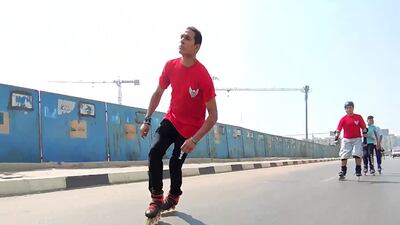
Mohamed Elsayed, co-founder of Cairo Skaters. All photos video screen grab -

Mohamed Elsayed, co-founder of Cairo Skaters and his team. -
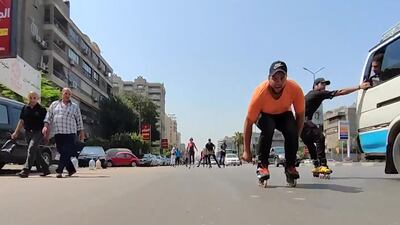
Mohamed Elsayed, co-founder of Cairo Skaters and his team. -
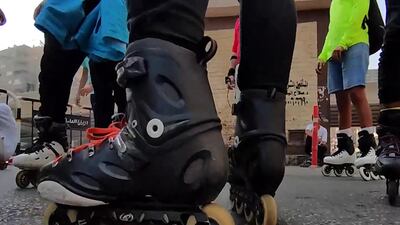
Mohamed Elsayed, co-founder of Cairo Skaters and his team. -

Mohamed Elsayed, co-founder of Cairo Skaters and his team. -
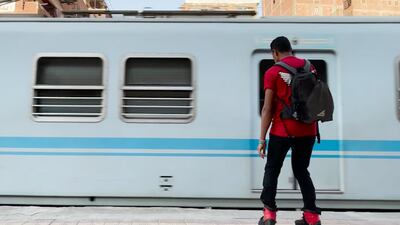
Mohamed Elsayed, co-founder of Cairo Skaters and his team. -
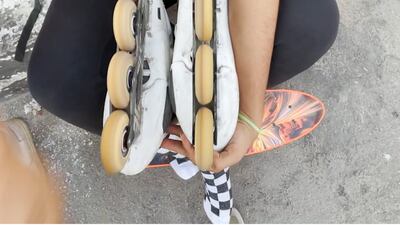
Mohamed Elsayed, co-founder of Cairo Skaters and his team. -
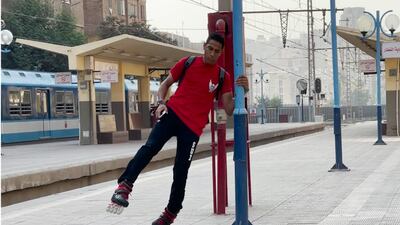
Mohamed Elsayed, co-founder of Cairo Skaters and his team.


Mr Atef has secured a job as an inline skating coach at a private skate park in Cairo. He is also the leader of the Alexandria Skaters team.
Mr Atef said that after his skating video was widely shared he started searching for other skaters online. That’s how he found three other skilled skaters from Cairo, Suez, and Mansoura. Together they launched the Skate in Egypt Facebook group in May 2020.
“Our aim was to create a space for skaters to get together,” said Ahmed Hamam, 21, a skating team leader from Mansoura, and a co-founder of the Skate in Egypt group.
Now the group has over 200,000 members and says its aim is to spread the activity in Egypt, in the hope of encouraging the state to create public skate parks.
Mr Hamam said the group had played an essential role in the emergence of other skating groups around the country.
Whenever someone wanted to skate somewhere, he or she would ask the group to find fellow skaters in the same area.
They would then get in touch, start skating together and eventually form a team, Mr Hamam said.
There are now more than 15 skating communities around Egypt with a presence on social media.
In the absence of appropriate venues to practise, Egypt’s skaters are using the streets as open-air skating arenas.
Skating gives us freedom
-
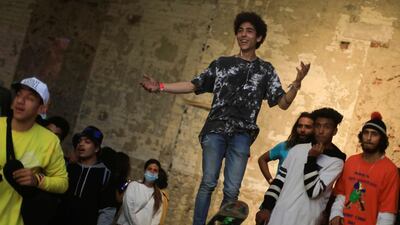
A skateboarder gestures as he prepares to compete at the Red Bull Mind The Gap skateboarding event at Townhouse Gallery, near Tahrir Square, in Cairo, Egypt. Reuters -
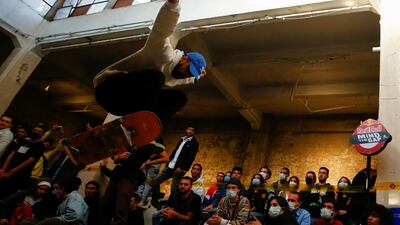
Spectators, some wearing face masks, watch a skateboarder compete at the Red Bull Mind The Gap skateboarding at Townhouse Gallery, near Tahrir Square, in Cairo, Egypt. Reuters -
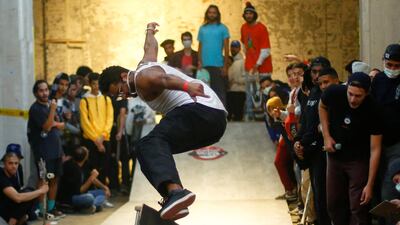
A skateboarder competes at the Red Bull Mind The Gap skateboarding event at Townhouse Gallery, near Tahrir Square, in the Egyptian capital Cairo. Reuters -
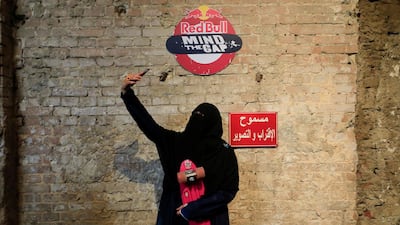
Nour Mohamed, 27, an Egyptian woman skateboarder wearing a full veil, takes a selfie with her board during the Red Bull Mind The Gap skateboarding event at Townhouse Gallery, near Tahrir Square, in the Egyptian capital Cairo. Reuters -
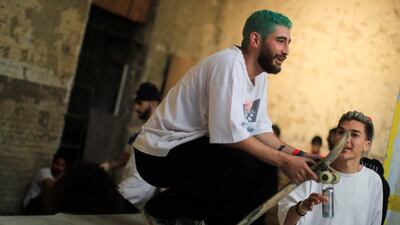
Egyptian skateboarder, Yassin El Attar, looks on before the start of the Red Bull Mind The Gap skateboarding event at Townhouse Gallery, near Tahrir Square, in the Egyptian capital Cairo. Reuters -
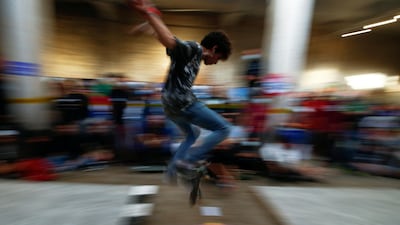
A skateboarder competes at the Red Bull Mind The Gap skateboarding event at Townhouse Gallery, near Tahrir Square, in the Egyptian capital Cairo. Reuters -
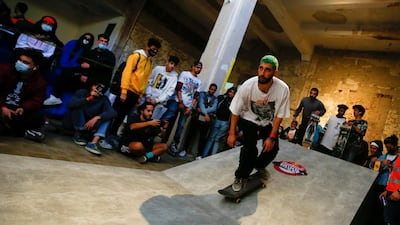
Egyptian skateboarder, Yassin El Attar, competes at the Red Bull Mind The Gap skateboarding event at Townhouse Gallery, near Tahrir Square, in the Egyptian capital Cairo. Reuters -
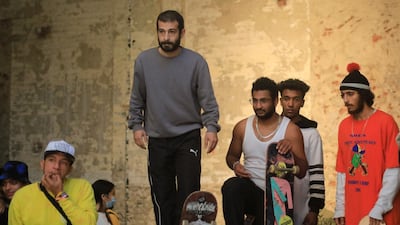
Egyptian skateboarders wait for the Red Bull Mind The Gap skateboarding event to start at Townhouse Gallery, near Tahrir Square, in the Egyptian capital Cairo. Reuters


“The average age of skaters ranges between 15 and 25. It’s really difficult to tell our numbers because there is a daily increase. However, I believe that there are more females than males,” said Yomna Othman, 24, one of the first young women to join the Alexandria Skaters team.
Ms Othman joined the team last September after watching Mr Atef’s skating videos. “Skating gives us a sense of freedom. I feel like I am flying when I skate,” she said.
She believes that skating is gaining popularity among young women because of the videos that female skaters post online.
It’s also a sport that women can practise without having to change the way they dress, enabling veiled women like Ms Othman, and even niqab-wearing women to join.
Rowan Abdelwahed, 19, started skating this summer after coming across several videos on social media.
She says there is nothing wrong with niqab-wearing women like herself skating. Yet, she has faced an online backlash and accusations of disrespecting the niqab when she posted a skating video.
“I didn’t care to reply to those people because Allah almighty doesn’t prevent us from living our lives,” Ms Abdelwahed said.
Ms Abdelwahed said she also faced verbal harassment while skating in the street.
But this experience is not unique to her. Other skaters say that such harassment is common and is faced by both male and female skaters.
“People don’t understand what we’re doing. It’s making some of them feel uncomfortable around us because they see that it’s not where we belong. Sometimes car drivers get close to us to limit us in a narrow space,” Mr Hamam said.
“Others don’t trust our skills. They think we will fall or bump into them and hurt them.”
Olympic dreams?
However, the picture is not always that bleak. Sometimes people in the street show their support for the young skaters.
“It’s really nice when people praise our skills or wonder if we were in Europe when they see us skating together. We love those vibes,” Ms Othman says.
Egypt’s young skaters hope that the growing appeal of the game will make street skating a more acceptable public scene or lead to having public skating parks, where they can practise safely without the dangers posed by irregular roads, as the smallest pothole can pose a great risk.
“There is a very small number of skate parks in Egypt. They are all private and are either limited in space or in remote areas. Now there are better chances for the sport because the numbers are way bigger than before,” said Mohamed Kamal, 28, an experienced “aggressive” inline skater – a form of the sport that involves difficult tricks and moves.
“Everyone saw the sport in the Olympics for the first time this year. So, why don’t we participate and teach the new generation the game properly in well-designed skate parks,” said Mr Kamal, who has been skating since 2005.
Mr Atef said the Olympics had motivated Egyptian skaters to practise harder. “It’s inspiring to see something that belongs to the streets getting [international] recognition. This is a goal that we are trying to reach. It’s not just about playing.”
This story was produced in collaboration with Egab.

