

When Robert Mardini threw his hat into the ring for the role of director general of the International Committee of the Red Cross, he was under no illusion about the long and rigorous process that lay ahead.
Yet somehow he was still stunned into silence from the outset when a stern interviewer asked point-blank: “Mr Mardini, why should we select you?”
Fortunately, the brain freeze occurred in front of a ‘’recruitment panel’’ convened by his 10-year-old daughter, allowing him to test, fail and learn in the same way that he has encouraged staff to do throughout a long career with the organisation.
“The little one, six, did not realise then what was really at stake so no big deal for her,” the Lebanese-Swiss civil engineer and humanitarian, 51, tells The National. “For our eldest daughter, however, it was tricky. There was excitement and pride because she loves the ICRC but she was enjoying New York.
“The prospect of family separation and moving back to Geneva was not great so we involved her in the process of grilling me. She was demanding. The answers to her first iteration of questioning were not, I think, very convincing. I had to improve the delivery and pitch,” he adds indulgently.
Mardini, then the ICRC’s permanent observer to the UN, couldn’t help an inward smile when confronted with the same “mother of all questions’’ posed by the real adjudicators a little while later.

On that occasion, he was more lucid about the desire to give back by leading from the front after more than two decades in various guises from water habitat engineer in Kigali to regional director of the Near and Middle East.
His overriding objective as the next director general was for the ICRC to remain relevant to all those affected by armed conflict and violence by continuing to play an essential role “even in the darkest of times”.
Back then, though, Mardini could not have known just how grim things were about to become. “You plan, and then life happens,” he says. “I got the job. I accepted a start date of April [2020] before the end of the school year, with the possibility to come back as often as possible … maybe work a couple of days from New York.”
Instead, he caught the last Swiss Airlines flight from Newark to Geneva, arriving on the first day of lockdown a week after the World Health Organisation characterised the outbreak of Covid-19 as a pandemic.
In spite of concerns about leaving his family stuck with a stay-at-home order in an apartment with no balcony, Mardini had to knuckle down to oversee the activities of the ICRC’s 20,000 staff in more than 100 countries and a budget of $2.5 billion.

His Skype, Teams and Zoom calls were punctuated by the recurrent sirens of ambulances transporting coronavirus patients to the Les Hôpitaux universitaires de Genève (HUG), where he is now looking forward to taking up a new job at the helm in September.
Perfect storm of needs
As the pandemic eased its grip, a perfect storm of rising humanitarian needs converged with shrinking aid budgets: a massive cyber attack targeting the personal data of more than half a million people receiving services from the International Red Cross and Red Crescent Movement; the Russia-Ukraine war; dramatic upsurges of violence in Sudan, Nagorno Karabakh, and Israel and the Occupied Palestinian Territories; food and fuel crises; and the accelerating impact of climate change.
“ICRC director general is a fascinating role because you're kind of a conductor,” Mardini says, listing the need to empower teams and acquire talents, garner political support vis à vis the Geneva Conventions, and secure funds as well as ensuring a culture of innovation and lessons learnt.
“It's an organisation that has a great mandate because it's basically about being the ultimate safety net to protect dignity in the worst of circumstances for people and communities, and making the best possible use of limited resources. At the end of the day, you cannot do everything.”
Mardini credits his heritage for shaping who he is and the way he operates. His adaptation skills were honed as a war child in Lebanon, where evading the constant threats from snipers, looters, shelling and car bombs required both self-reliance and collaboration with others.

Juxtaposed with the Levantine culture of hospitality and openness, the young boy began to understand diversity and the necessity for building bridges across divides, whether sectarian or political.
“I consciously rewire my brain to put myself in someone else’s mindset and perspective so I can better understand where they are coming from and comprehend what they are dealing with, their red lines, their fault lines, their triggers and what makes them click. There’s always room for engagement.”
Safe haven amid the devastation
Born in Tripoli in 1972, Mardini comes from a middle-class family that was well-educated and whose values were always at the core of any decisions.
He and his younger sibling, Charles, now a wealth and asset manager, were raised by their stay-at-home mother, Gisèle, who endured many challenges, including a series of miscarriages and the loss of her first son from an accident at the age of two.
Mardini’s father, Emile, would, he thinks, have made a wonderful professor but after a head injury from a horse-riding accident set up the first colour photography lab in the city. Not shrewd enough to thrive in a war-torn economic landscape, Emile was, however, known for being a bibliophile who had read every book in his own vast library.

“I held him in high regard, for his stoicism amidst adversity, lack of security and instability. He was always true to his principles.’’
The stakes were high so young Robert was "one of those serious guys'' at school at the private Lycée Franco-Libanais Alphonse de Lamartine, making time for Tintin comics or the adventures of Jules Verne for escapism when at home and, later, French literature or Arabic classics and poetry to cultivate himself.
“We were relatively lucky because there were moments where school was closed but I did not lose any full academic year, which I think is a blessing.
“Education is the most important investment that one can ever make. Money comes and goes, but education stays. I heard my parents say this repeatedly. At the end of the day, it's your passport, to quote my mother-in-law.”
Throughout it all, the ambulances of the Lebanese Red Cross were ever-present and before long the ICRC opened an office next door to its headquarters near the Mardini family home.
Out of curiosity, a precocious Robert began researching how the distinct organisations within the same movement shared similar principles and worked hand in hand in situations of armed conflict such as the one on his doorstep and around the world. “That was the beginning,’’ he says.
The same spirit of inquiry compelled him years later to approach a booth at the École Polytechnique Fédérale de Lausanne’s annual jobs fair because it bore an instantly recognisable international emblem of neutrality.
'I felt the calling'
Having recently graduated with a master's in civil engineering, he observed at the time that the 1996 Forum EPFL had attracted the usual corporate suspects vying for acquisitions from the research university but why a humanitarian organisation?
“The recruiter explained that, yes, the ICRC hires engineers because access to water and sanitation is critical to public health, that it’s part and parcel of what they do in war-torn countries. After all the blessings I had during early childhood through to graduating from a very renowned school, I felt the calling."
Mardini had also come to realise that devoting years to sophisticated dam and hydraulic projects in Switzerland that might never be built was far less appealing than designing and implementing solutions to critical problems faced by the most vulnerable.

“That's a great incentive, to see the impact of your work. At the same time, you're not just a technical engineer, you have to do it all with your team.
Connecting the dots
“It's not coming in with the arrogance of the technician and saying: ‘I know what's best for you’, digging a hole and calling it a day. It's about connecting the dots between different things – understanding the context and where people are coming from, their deep-seated grievances, misgivings, their hopes and trying to engage first to co-create solutions with them and for them.
“And that is why 27 years passed like this,” he says with a snap of his fingers.
Aside from job satisfaction, the ICRC also brought Mardini deep fulfilment in his personal life. He would meet his future wife, Carla Haddad, a fellow compatriot, in Baghdad towards the end of 2002, where she was supervising repatriation operations of prisoners detained during the war with Iran.
Asked whether becoming parents gave the couple extra motivation to make the world a safer place, Mardini begins by conceding that it can be overwhelming to see the magnitude of conflicts, the disruption they create and the level of suffering.

He talks about people being killed, maimed or forced to move, sexual violence used as a weapon of war, and the mental health and psychosocial issues that were taboo in the humanitarian sector 20 years ago but for which victims now desperately seek support.
Beautiful moments in the field
“Despite all the misery that we were confronted with, Carla and I also had the chance in our respective worlds at ICRC to see vibrant communities. Even in the midst of war, you have people who thrive, who innovate to overcome the challenges and they are so inspiring that we were more on the edge of: ‘Yes, we're confident in life and in better times.’
“Working for ICRC is not something that should make you pessimistic. There are so many reasons for hope in this work despite all that you see on TV and sometimes in desperate situations. There are still, in my personal experience, much more positives.
“The most beautiful moments in the field visits are when you sit and listen to people's stories. Just spend time – sometimes over a cup of tea, sometimes you get invited to share their meals – to understand what is really at stake and what matters for people. This is the only recipe to shape how you can help them best to uphold their dignity.”
Such personal interactions were critical for renewing his own faith in humanity and motivation to continue even in situations where options were limited such as when access to prisoners of war, an obligation under international humanitarian law, was refused.
-

Robert Mardini during a visit to Al Shahama camp in Tikrit, Iraq. Mr Mardini served as director general of the International Committee of the Red Cross, spending 27 years with the humanitarian organisation. All photos: ICRC -
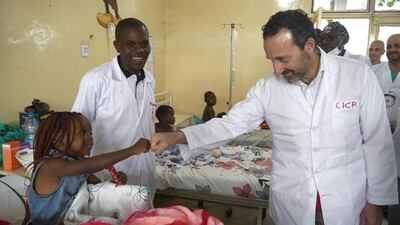
Mr Mardini visits Ndosho Hospital, Goma, eastern DRC, in March this year -

Meeting a beneficiary of an ICRC cash assistance programme in Nova Buda village, Ukraine, in August 2022 -

Mr Mardini visits a hospital in Kandahar province in 2022 to observe the new challenges after regime change in Afghanistan -

During a visit to South Sudan in 2021, Mr Mardini speaks to a patient who lost her leg when she was five years old, in Rumbek. The Rumbek Centre has provided her with a prosthesis and financial support from the ICRC has enabled her to open a tea shop -

Listening to the story of a Gaza resident in 2021 -

Mr Mardini speaks to a patient at a hospital in Al Tal, Syria, in 2017 -

Meeting children in Dumayr, Syria, in 2017 -

Mr Mardini visits a collective kitchen in Homs, Syria, in 2015


“We don't have armies and we cannot force our way through. Our job is to try and try and try again, and never take no for an answer. This is the perseverance and determination that is expected from any humanitarian, and at the ICRC there is a premium on these people who will never let go and give up or give in to please any party to the conflict. The only bias we have is for the people affected by armed conflict, and that's the North Star for us."
These days, his two daughters, 15 and 11, provide the light relief. As Mardini tells it, the girls use a mix of humour and charm in their tactics to “get to yes” that often test him more than what he encounters in his professional environment. “They were actively trained by my wife who is known for her negotiation skills,” he points out.
A challenging new chapter
Mardini is now just past the midway point of a break between the end of his four-year tenure as director general at the ICRC and the start of his new demanding D-G role with Geneva University Hospitals.
Some of the time is spent as executive in residence at the IMD Business School engaging with students. The rest he is using to reconnect with family members, recharge the batteries and read through a daunting-sounding pile of books on everything from geopolitics to medicine and hospital management.
Before getting breakfast ready and the school drop-off, he fits in a 5km run around the neighbourhood, an essential part of “the daily hygiene’’, while listening to either opera (“energising”) or Bach (“helps me structure my day”).
“I'm now pivoting from a very global role to a very local role. Leading the largest university hospital in the country is a big honour and a very exciting prospect. What this hospital is able to contribute to the local community and to global health, in terms of innovation, in terms of initiatives, is really inspiring.”
It has not, however, been easy to close the ICRC chapter after almost three decades of commitment and all the emotional investment. There are still wars raging and issues that Mardini feels a deep connection with – not least the hundreds of thousands of missing people, including colleagues, who constitute "the less visible side of conflicts'' – but he gave a solemn pledge in the last week of the job not to meddle after his departure.
“It takes discipline to say: ‘No, this is not me any more’ but there are other people in charge. As I built on the shoulders of my predecessors, I hope they will build on the shoulders of their predecessor. They will steer it maybe differently, which is how organisations evolve, and this is as it should be.
“I think I have a great challenge ahead that will require 150 per cent brain power and attention,” he concludes.
Our time up, Mardini leaves the Zoom, gets on his bike and heads off for the latest in a series of informal lunch meetings with the hospital’s executive team to make good the transition. After all, there’s always room for a little more engagement.

