


Live updates: Follow the latest news on Israel-Gaza
In the months leading up to the UN Security Council's vote on the Gaza ceasefire resolution, key Arab countries consistently advocated for an end to the fighting in the Palestinian enclave.
Qatar hosted indirect negotiations between Israel and Hamas, the UAE's mission in New York was vocal in its calls for a ceasefire, while Egypt and Jordan frequently communicated with the administration of US President Joe Biden urging to back the resolution.
This co-ordination reflects a multifaceted approach by Arab states, each using their unique diplomatic channels and relationships to bring about a truce in the Gaza Strip, where more than 32,400 Palestinians have been killed since the war broke out on October 7.
The Security Council's vote on took place on Monday, just days after US Secretary of State Antony Blinken travelled to Cairo for talks with officials from the UAE, Egypt, Qatar, Jordan and Saudi Arabia.
Officials from Egypt and Jordan have told senior members of the Biden administration, including National Security Council Co-ordinator for the Middle East and North Africa Brett McGurk, that Israeli Prime Minister Benjamin Netanyahu “had to be restrained”, sources told The National.
The White House was warned that Mr Netanyahu had become too unpredictable since the war began, and his actions could jeopardise stability in Jordan and Egypt.
“The Americans got the message that once Rafah is invaded there is no longer a way to control the course of the war,” one source said.
Israel has repeatedly voiced its intention to launch an incursion into Rafah, Gaza's southernmost city, where more than a million displaced Palestinians have sought refuge. Egypt is particularly concerned that such an operation could result in people attempting to cross the border into the Sinai peninsula, which would exacerbate an already tense and complex situation.
-

More than one million displaced Palestinians are living in makeshift camps in Rafah, only metres from the border fence with Egypt. Reuters -

The border looms large in the everyday lives of Palestinians in Rafah. AFP -
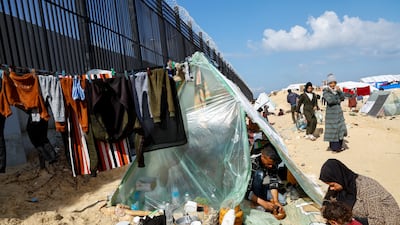
Conditions on the border are dire as Palestinians living in tents not only face starvation, but also lack fuel and electricity. Reuters -
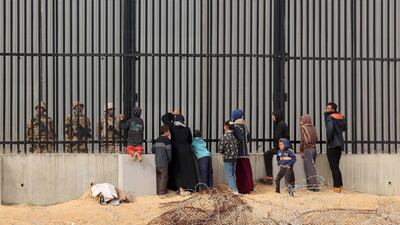
Egyptian authorities fear that an Israeli assault on the border city could force increasingly desperate Palestinians to seek safety by entering Egypt. AFP -
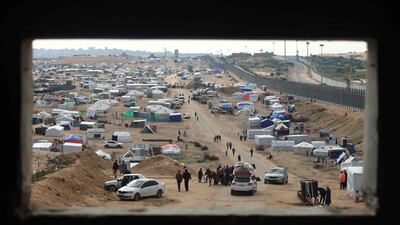
More than half of Gaza's population of 2.3 million people is already pushed up against the border. AFP -

Rafah is the main entry point for aid into Gaza, as the enclave's only border crossing that does not involve travel to or from Israel. Reuters -
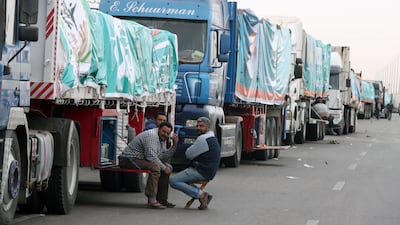
Large convoys of lorries carrying aid are frequently stuck at Rafah as a result of Israeli restrictions on how much aid can enter Gaza since the outbreak of the war in October. EPA -

Egyptian authorities have ordered the construction of a logistics zone they say is to receive aid in Rafah. Reuters -
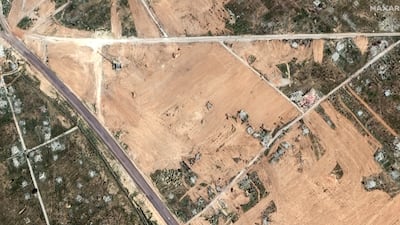
Satellite images show construction on the Egyptian side of the border. Maxar Technologies via Reuters -

Sources say authorities are constructing a walled area on the Egyptian side of the border to prepare for a potential influx of Palestinians. Reuters -
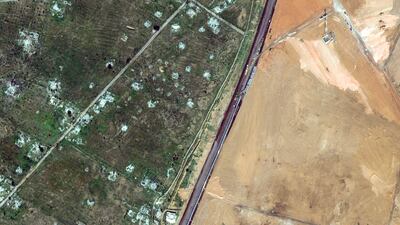
A satellite image shows the construction of a new wall along the Egypt-Gaza border. Maxar Technologies via Reuters -

Egyptian President Abdel Fattah El Sisi has repeatedly said that Egypt will not readily accept the displacement of Palestinians into Egypt. Reuters


In Jordan, the threat of a direct refugee crisis is perceived as less severe, as long as the neighbouring occupied West Bank remains stable. However, with much of Jordan's population being of Palestinian origin, there is widespread anger towards Israel.
“Biden had to try to trim the claws of Israel, for his own considerations and for the sake of America's allies,” one source said.
During a visit to Amman on Monday, UN Secretary General Antonio Guterres said any ground operation in Rafah “would be a catastrophic humanitarian disaster”.
The Security Council's ceasefire resolution passed with 14 votes in favour and one abstention from the US. It was the first time the council has passed a resolution calling for a ceasefire in the Israel-Gaza war.
Last month, the council adopted a resolution aiming to increase the delivery of aid to Gaza and setting the conditions for a reduction in violence. After four postponements, the resolution, which was drawn up by the UAE, received 13 votes in favour and two abstentions from the US and Russia.
“It is certain that Qatar, the Gulf states and the countries participating in the negotiations to stop the war in Gaza made diplomatic efforts and pressed for this decision,” a Qatari source said, referring to the ceasefire resolution.
“The UN Security Council praised the diplomatic efforts undertaken by the State of Qatar, along with the United States of America and the Arab Republic of Egypt, to achieve a cessation of hostilities in the Gaza Strip, release detainees, and expand the scope of relief aid.”

