


Youssef Hamidi was a central defender in the Aleppo University football team before he had to flee Syria to Turkey a decade ago, whereafter much of his home city was reduced to rubble by Syrian and Russian bombing.
His athletic physique helped him cope with the demands of a job he found as a clothes presser on a ready-wear production line in the southern Turkish city of Gaziantep.
The hard work was the first step in his transformation from an engineering student unable to complete his degree, to the owner of an unregistered, underground clothes factory.
-
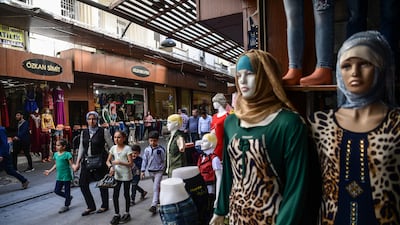
A Syrian and her children in Gaziantep, south-western Turkey, in May 2018. AFP -

A Syrian who fled the war in his homeland outside Syrian-run shops in Ankara, Turkey. Reuters -

A Syrian coffee shop owner in Ankara, Turkey, sits down for a break from work. Reuters -

Syrian refugees find work and wages at a textile shop in Istanbul, Turkey. Reuters -
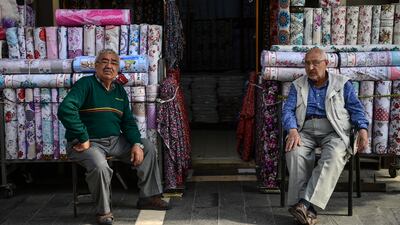
Syrian merchants in Gaziantep, Turkey, in May 2018. AFP -

Arabic letters on shop signs in Gaziantep, Turkey. AFP -
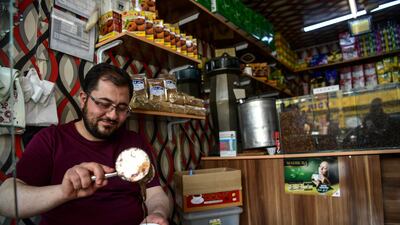
The proprietor of Syrian coffee shop in Gaziantep brews up. AFP -
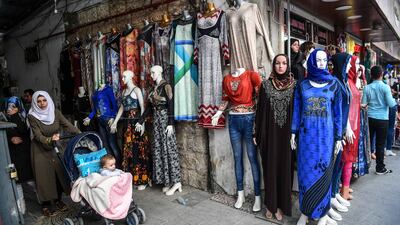
In Gaziantep, some garment shops cater to Syrian tastes. AFP


He is one of many Syrian refugees who form a large proportion of the black economy of Gaziantep. Some have unlicensed businesses, while most work as labourers.
“Low cost is a major reason why I charge less and receive enough orders,” says Mr Hamidi from his factory, just outside the old centre of Gaziantep. The city, one of Turkey’s industrial centres, was historically part of the hinterland of the famed Silk Road metropolis of Aleppo.
who left Syrian in 2013
Mr Hamidi's factory does mainly subcontract work for large Turkish factories and employs 30 Syrians. But lack of official paperwork has curbed potential for expansion and deprived the workers of benefits.
Political uncertainty over the fate of the refugees has increased since an earthquake struck south Turkey in February and prompted increased resentment against them as economic pressures rose and the value of the lira plummeted.
Turkey stopped letting in new refugees from Syria in 2016, having taken in 3.5 million after the crackdown on the 2011 revolt against President Bashar Al Assad, and the ensuing civil war. Businesses can employ Syrian refugees, if a ratio is maintained with Turkish workers.
After his election victory In May, President Reccep Tayep Erdogan repeated a promise to return one million Syrian refugees to areas held by opponents of Mr Al Assad on the border with Turkey.

Mr Hamidi says that he feels stuck, having learnt Turkish and built a network that could help him grow his business.
Even if he registers his factory, employment restrictions will not allow him to keep all his Syrian staff, whom he says are afraid to be officially identified. Taxes and contributions he would have to pay on behalf of the workers would also deprive him of a crucial cost advantage, he says.
“The Turkish government knows about us and is leaving us be. I don’t know till when,” he says.
Two-hand advantage
For almost a year after he arrived in Turkey, Mr Hamidi ironed finished clothes before the packaging stage on the production line.
He advanced to work with an electric blade that cuts cloth in bulk, and can inflict serious injuries to the person operating it at the slightest slip.
One day, the workshop owner saw Mr Hamidi operating the machine by switching between his two hands, which made him faster than other workers.
“Co-ordination is a skill I got from football,” says the bald, bespectacled Mr Hamidi, who is 31.
He ended up learning all aspects of ready-wear manufacturing, even mastering design, using a computer programme. Large factories in Gaziantep have mass produced dresses and sportswear of his own design.
He and his staff work in cramped conditions in the large basement of a building, cutting and joining textiles for bigger manufacturers in the city.
“I love my work so much that I don’t feel that I am spending 12 hours a day here,” says Mr Hamidi, who does not take any days of the week off and still has time to play football.
He also coaches children in a programme run by a nearby municipality.
About half of the of 2.2 million working-age Syrian refugees in Turkey last year had some form of work, mostly informally in menial jobs, figures by the International Labour Organisation show.
Some refugees, however, have gone into more high-tech businesses.
Among them is Ahmad Haykal, who was supposed to sit for his high school exam in 2013, when the half of the city he lives in fell to rebels. He fled to Turkey after Russian intervention allowed the regime to recapture Aleppo in 2016.
Business model
While growing up in Aleppo, Mr Haykal used to go to a workshop owned by his family and tinker with large inverters and other electrical equipment.
His late father used to import electrical parts for industrial infrastructure as scrap from factories that went out of business in Europe and resell them after repairing and overhauling the equipment.
In Gaziantep he opened a similar business after putting together a network of scouts who would identify disused factories in Turkey or those on the verge of closing.
“I don’t think that such a business model existed before I came to Turkey,” says Mr Haykal, at his shop on a busy street in Gaziantep.
He is surrounded by piles of giant electrical equipment, made by Schneider, ABB and Siemens. The parts look as good as new after being overhauled by Mr Haykal and his team of Syrian technicians.
One part costs $3,000 new. Mr Haykal sells it for $300. Apart from the lure of the price, Mr Haykal says the old parts are better made.
He wants to obtain Turkish citizenship because it would enable him to travel to Europe to buy stock, similar to his father.
But he says obtaining a second nationality is becoming a distant dream, with the threat of deportation rising.
“I cannot invest to streamline the business in these conditions,” he says. "It has been one step forward, two steps back."
Over the past several weeks, Turkey has forcibly returned hundreds of refugees, according to reports by Syrian media opposed to Mr Al Assad.
Saad, a Syrian businessman who owns, with Turkish partners, a licensed processed food factory in Gaziantep, says an underground mentality has been instilled in Syrians since the Assad family took power in 1970.
Saad, who did not want to his last name revealed, is also contracted by a western aid organisation to encourage Syrian business owners in Turkey to register with the government.
He says legitimising the Syrian businesses would shield workers and owners against deportation.
"All their life in Syria they have been afraid that an arbitrary power will come after them if they declare what they have," he says. "I don't think this is the case in Turkey."

