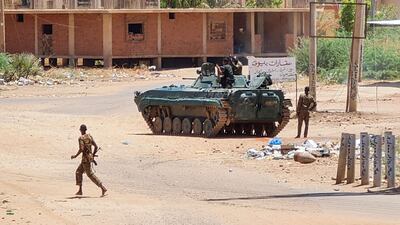
An armoured vehicle belonging to the Sudanese military on the streets of southern Khartoum. AFP

Sudan’s much-heralded ceasefire breached within minutes


  • English
  • Arabic

A week-long ceasefire in Sudan got off to a shaky start on Monday as witnesses in the capital Khartoum reported fighter jets flights over the city and continued fighting in some areas.

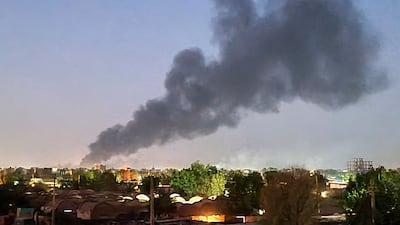
Heavy bombardments could be heard in east Khartoum, witnesses said, and one resident shared a picture of thick black smoke rising into the sky.

In Omdurman and Bahri, Khartoum's twin cities, people said they heard sounds of weapons firing.

After five weeks of fierce battles between the army and the paramilitary Rapid Support Forces, the warring factions on Saturday agreed to a seven-day truce starting at 9.45pm on Monday, which was intended to allow for the delivery of aid.

It would be the latest in a series of ceasefires, all unsuccessful, declared since the fighting began on April 15.

Each side has blamed the other for breaches of the agreements.

The latest truce, according to a joint Saudi-US statement, could be extended, subject to the agreement of both sides.

The Sudanese Armed Forces and the RSF said they would honour the truce.

In a statement carried by the official Saudi Press Agency, Riyadh acknowledged the many broken ceasefires in Sudan since fighting began.

But the Saudi Foreign Ministry said that “unlike previous ceasefires, the deal reached in Jeddah was signed by the parties and will be supported by a US-Saudi and internationally backed monitoring mechanism".

Latest from the crisis in Sudan - in pictures

  • Khartoum burns amid fighting between the forces of two rival generals in Sudan. AFP
    Khartoum burns amid fighting between the forces of two rival generals in Sudan. AFP
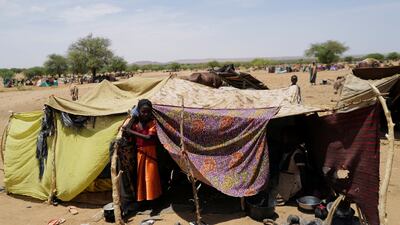
  • A Sudanese girl at her family's makeshift shelter across the border in Koufroun, Chad. Reuters
    A Sudanese girl at her family's makeshift shelter across the border in Koufroun, Chad. Reuters
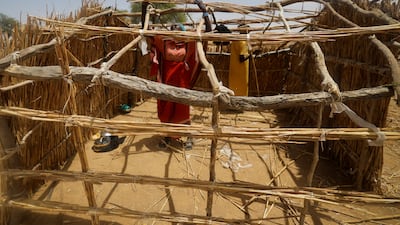
  • Sudanese refugee women build a makeshift shelter in Koufroun, Chad. Reuters
    Sudanese refugee women build a makeshift shelter in Koufroun, Chad. Reuters
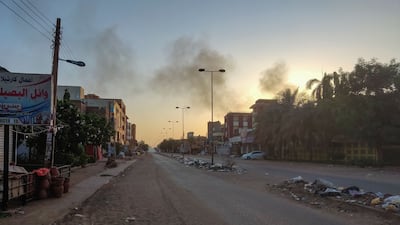
  • Air strikes battered Khartoum as fighting entered a fourth week. AFP
    Air strikes battered Khartoum as fighting entered a fourth week. AFP
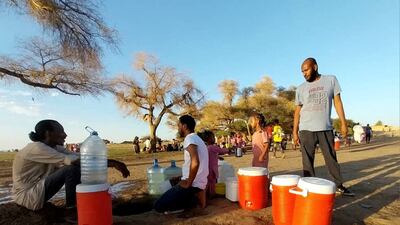
  • People dig holes to get pure water at the banks of the White Nile in Khartoum. Reuters
    People dig holes to get pure water at the banks of the White Nile in Khartoum. Reuters
  • Army sodliers and tanks on a street in Khartoum. AFP
    Army sodliers and tanks on a street in Khartoum. AFP
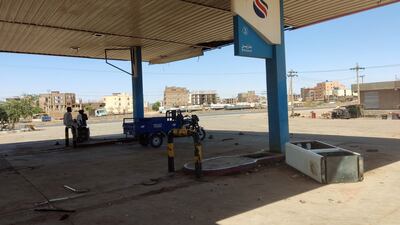
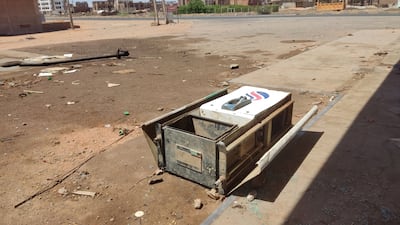
  • A looted petrol station in southern Khartoum. AFP
    A looted petrol station in southern Khartoum. AFP
  • Sudan's warring generals have repeatedly failed to honour multiple agreed ceasefires. AFP
    Sudan's warring generals have repeatedly failed to honour multiple agreed ceasefires. AFP
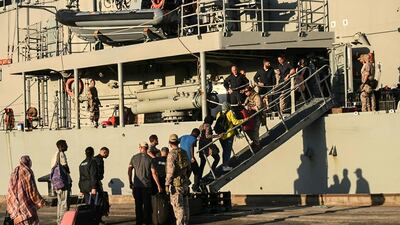
  • People board the Spanish frigate Reina Sofia during an evacuation from Port Sudan to Saudi Arabia. AFP
    People board the Spanish frigate Reina Sofia during an evacuation from Port Sudan to Saudi Arabia. AFP
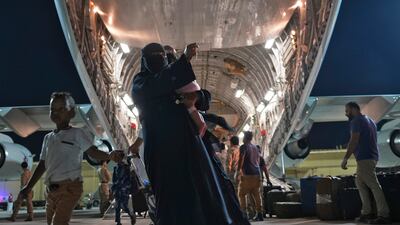
  • Evacuees disembark at Al Udeid Air Base in Qatar. AP
    Evacuees disembark at Al Udeid Air Base in Qatar. AP

In the hours before the ceasefire went into effect, the army conducted heavy air strikes across the capital Khartoum.

Artillery, rocket launchers and heavy machineguns were reportedly being used in the fighting in Khartoum and two cities across the Nile, Omdurman and Bahri.

There were also strikes by army aircraft on RSF positions.

The outbreak of fighting on Monday began during the morning hours, residents said. It died down before resuming in the afternoon and again shortly before sunset.

Army chief Gen Abdel Fattah Al Burhan and Gen Mohamed Dagalo of the RSF appear determined to win the conflict outright, something that is mainly viewed by analysts as unlikely given the nature of the urban warfare, now entering its sixth week.

In New York, the UN envoy to Sudan, Volker Perthes, warned of the increasing “ethnicisation” of the conflict and the possible effects on neighbouring nations.

“The growing ethnicisation of the conflict risks engulfing the country in a prolonged conflict, with implications for the region,” Mr Perthes told the UN Security Council on Monday.

“In West Darfur, clashes between the Sudanese Armed Forces and the Rapid Support Forces spiralled into ethnic violence on April 24. Tribal militias joined the fight and civilians took up arms to defend themselves.”

Such incidents have grown in recent weeks, he said.

“In parts of the country, fighting between the two armies or the two armed formations has sharpened into communal tensions, or triggered conflict between communities,” Mr Perthes said.

“Warning signs of tribal mobilisation are also reported in other parts of the country, particularly in South Kordofan.”

Sudan's Al Burhan makes second public appearance since fighting began - video

The RSF and Gen Dagalo have their roots in the western region of Darfur, while the army's top brass traditionally come from the prosperous north of Sudan.

Darfur has been the scene of fierce fighting between the army and the RSF since last month.

The region was torn by civil war in the 2000s, when the RSF's forerunner, the Janjaweed militia, fought on the government's side against ethnic African rebels.

The Janjaweed, mostly drawn from local Arab tribes, regard themselves as victims of the perceived discrimination by Khartoum's political and military elite.

Fighting has killed at least 1,000 people and displaced more than one million, internally and into neighbouring countries such as Egypt, Chad and South Sudan.

Millions are trapped in Khartoum with little or no access to water, electricity or medicine. Most of the city’s healthcare centres have closed.

Much of the sprawling and dusty Nile-side city is deserted. Many residents have left while others are taking shelter in their homes.

Looting is widespread. Homes, banks, relief aid warehouses, stores and factories have all been hit by criminal gangs or possibly RSF fighters who have lost their bases or are left without supplies.

Here's what a Dubai doctor saw happening in Sudan before he escaped - video

Many of the RSF fighters have taken refuge in densely populated neighbourhoods, turning residents into human shields.

With most banks in Khartoum shut, warehouses and factories looted or burnt, and fuel in scarce supply, food has become increasingly difficult to obtain.

Aid agencies have increased their response to the crisis despite the challenges. Currently, 25 million people, more than half of Sudan’s population, are in need of assistance.

On Sunday, Martin Griffiths, UN undersecretary general for humanitarian affairs and the emergency relief co-ordinator, called for the “safe delivery of aid” and the restoration of essential services.

The warring parties signed an agreement in Jeddah on May 12 to protect civilians and let in aid shipments in.

Darfur has also suffered some of the worst violence. The UN said that hundreds of people have been killed there.

On Sunday, it said that all 86 gathering sites for displaced people in west Darfur’s city of Geneina “have reportedly been burnt to the ground”.

Darfur is still reeling from the conflict that began there in the early 2000s. At least 300,000 people died and 2.5 million were displaced during the war.

A 2021 coup staged by Gen Al Burhan and Gen Dagalo has created a security vacuum that sparked ethnic and tribal fighting in Darfur, claiming hundreds of lives and forcing tens of thousands to flee their homes.

The coup also upended Sudan's democratic transition and plunged the country into its worst economic crisis in living memory.


The Birkin bag is made by Hermès. 
It is named after actress and singer Jane Birkin
Noone from Hermès will go on record to say how much a new Birkin costs, how long one would have to wait to get one, and how many bags are actually made each year.

FROM%20THE%20ASHES
%3Cp%3EDirector%3A%20Khalid%20Fahad%3C%2Fp%3E%0A%3Cp%3EStarring%3A%20Shaima%20Al%20Tayeb%2C%20Wafa%20Muhamad%2C%20Hamss%20Bandar%3C%2Fp%3E%0A%3Cp%3ERating%3A%203%2F5%3C%2Fp%3E%0A
UAE%20SQUAD
%3Cp%3E%0DJemma%20Eley%2C%20Maria%20Michailidou%2C%20Molly%20Fuller%2C%20Chloe%20Andrews%20(of%20Dubai%20College)%2C%20Eliza%20Petricola%2C%20Holly%20Guerin%2C%20Yasmin%20Craig%2C%20Caitlin%20Gowdy%20(Dubai%20English%20Speaking%20College)%2C%20Claire%20Janssen%2C%20Cristiana%20Morall%20(Jumeirah%20English%20Speaking%20School)%2C%20Tessa%20Mies%20(Jebel%20Ali%20School)%2C%20Mila%20Morgan%20(Cranleigh%20Abu%20Dhabi).%3C%2Fp%3E%0A
Gertrude Bell's life in focus

A feature film

At one point, two feature films were in the works, but only German director Werner Herzog’s project starring Nicole Kidman would be made. While there were high hopes he would do a worthy job of directing the biopic, when Queen of the Desert arrived in 2015 it was a disappointment. Critics panned the film, in which Herzog largely glossed over Bell’s political work in favour of her ill-fated romances.

A documentary

A project that did do justice to Bell arrived the next year: Sabine Krayenbuhl and Zeva Oelbaum’s Letters from Baghdad: The Extraordinary Life and Times of Gertrude Bell. Drawing on more than 1,000 pieces of archival footage, 1,700 documents and 1,600 letters, the filmmakers painstakingly pieced together a compelling narrative that managed to convey both the depth of Bell’s experience and her tortured love life.

Books, letters and archives

Two biographies have been written about Bell, and both are worth reading: Georgina Howell’s 2006 book Queen of the Desert and Janet Wallach’s 1996 effort Desert Queen. Bell published several books documenting her travels and there are also several volumes of her letters, although they are hard to find in print. Original documents are housed at the Gertrude Bell Archive at the University of Newcastle, which has an online catalogue.
 

Mercer, the investment consulting arm of US services company Marsh & McLennan, expects its wealth division to at least double its assets under management (AUM) in the Middle East as wealth in the region continues to grow despite economic headwinds, a company official said.

Mercer Wealth, which globally has $160 billion in AUM, plans to boost its AUM in the region to $2-$3bn in the next 2-3 years from the present $1bn, said Yasir AbuShaban, a Dubai-based principal with Mercer Wealth.

Within the next two to three years, we are looking at reaching $2 to $3 billion as a conservative estimate and we do see an opportunity to do so,” said Mr AbuShaban.

Mercer does not directly make investments, but allocates clients’ money they have discretion to, to professional asset managers. They also provide advice to clients.

“We have buying power. We can negotiate on their (client’s) behalf with asset managers to provide them lower fees than they otherwise would have to get on their own,” he added.

Mercer Wealth’s clients include sovereign wealth funds, family offices, and insurance companies among others.

From its office in Dubai, Mercer also looks after Africa, India and Turkey, where they also see opportunity for growth.

Wealth creation in Middle East and Africa (MEA) grew 8.5 per cent to $8.1 trillion last year from $7.5tn in 2015, higher than last year’s global average of 6 per cent and the second-highest growth in a region after Asia-Pacific which grew 9.9 per cent, according to consultancy Boston Consulting Group (BCG). In the region, where wealth grew just 1.9 per cent in 2015 compared with 2014, a pickup in oil prices has helped in wealth generation.

BCG is forecasting MEA wealth will rise to $12tn by 2021, growing at an annual average of 8 per cent.

Drivers of wealth generation in the region will be split evenly between new wealth creation and growth of performance of existing assets, according to BCG.

Another general trend in the region is clients’ looking for a comprehensive approach to investing, according to Mr AbuShaban.

“Institutional investors or some of the families are seeing a slowdown in the available capital they have to invest and in that sense they are looking at optimizing the way they manage their portfolios and making sure they are not investing haphazardly and different parts of their investment are working together,” said Mr AbuShaban.

Some clients also have a higher appetite for risk, given the low interest-rate environment that does not provide enough yield for some institutional investors. These clients are keen to invest in illiquid assets, such as private equity and infrastructure.

“What we have seen is a desire for higher returns in what has been a low-return environment specifically in various fixed income or bonds,” he said.

“In this environment, we have seen a de facto increase in the risk that clients are taking in things like illiquid investments, private equity investments, infrastructure and private debt, those kind of investments were higher illiquidity results in incrementally higher returns.”

The Abu Dhabi Investment Authority, one of the largest sovereign wealth funds, said in its 2016 report that has gradually increased its exposure in direct private equity and private credit transactions, mainly in Asian markets and especially in China and India. The authority’s private equity department focused on structured equities owing to “their defensive characteristics.”

Dengue%20fever%20symptoms
%3Cul%3E%0A%3Cli%3EHigh%20fever%3C%2Fli%3E%0A%3Cli%3EIntense%20pain%20behind%20your%20eyes%3C%2Fli%3E%0A%3Cli%3ESevere%20headache%3C%2Fli%3E%0A%3Cli%3EMuscle%20and%20joint%20pains%3C%2Fli%3E%0A%3Cli%3ENausea%3C%2Fli%3E%0A%3Cli%3EVomiting%3C%2Fli%3E%0A%3Cli%3ESwollen%20glands%3C%2Fli%3E%0A%3Cli%3ERash%3C%2Fli%3E%0A%3C%2Ful%3E%0A%3Cp%3EIf%20symptoms%20occur%2C%20they%20usually%20last%20for%20two-seven%20days%3C%2Fp%3E%0A
Prop idols

Girls full-contact rugby may be in its infancy in the Middle East, but there are already a number of role models for players to look up to.

Sophie Shams (Dubai Exiles mini, England sevens international)

An Emirati student who is blazing a trail in rugby. She first learnt the game at Dubai Exiles and captained her JESS Primary school team. After going to study geophysics at university in the UK, she scored a sensational try in a cup final at Twickenham. She has played for England sevens, and is now contracted to top Premiership club Saracens.

----

Seren Gough-Walters (Sharjah Wanderers mini, Wales rugby league international)

Few players anywhere will have taken a more circuitous route to playing rugby on Sky Sports. Gough-Walters was born in Al Wasl Hospital in Dubai, raised in Sharjah, did not take up rugby seriously till she was 15, has a master’s in global governance and ethics, and once worked as an immigration officer at the British Embassy in Abu Dhabi. In the summer of 2021 she played for Wales against England in rugby league, in a match that was broadcast live on TV.

----

Erin King (Dubai Hurricanes mini, Ireland sevens international)

Aged five, Australia-born King went to Dubai Hurricanes training at The Sevens with her brothers. She immediately struck up a deep affection for rugby. She returned to the city at the end of last year to play at the Dubai Rugby Sevens in the colours of Ireland in the Women’s World Series tournament on Pitch 1.

Updated: May 23, 2023, 6:12 AM