Palestinians fear an earthquake closer to their territory could have devastating consequences. AP

Palestinians fear potential devastation of future earthquake


Thomas Helm
  • English
  • Arabic

Follow the latest news on the earthquake in Turkey

The devastating events in Turkey and Syria have reignited Palestinian concerns that they are at risk in the event of another earthquake in the Middle East.

Palestinian engineers, academics and politicians are highlighting a lack of preparedness that could lead to thousands of deaths in the earthquake-prone region.

The region has consistently seen major earthquakes every 100 years. The 1927 Jericho Earthquake killed at least 500 people and heavily damaged cities including Jericho, Jerusalem and Nablus.

Jalal Al Dabbeek, Director of the Centre for Urban Planning and Disaster Reduction at An-Najah University, believes that a worst-case scenario today could cause ten times that number of casualties.

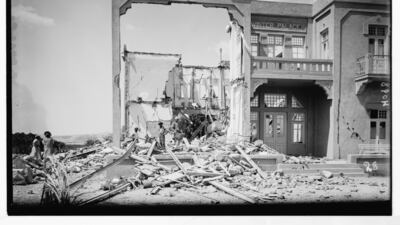
  • The ruins of Winter Palace Hotel in Jericho, in the occupied West Bank, after an earthquake shook Palestine in July 1927. All photos: Library of Congress
    The ruins of Winter Palace Hotel in Jericho, in the occupied West Bank, after an earthquake shook Palestine in July 1927. All photos: Library of Congress
  • The 6.25 magnitude quake, which lasted about five seconds, caused massive structural damage, leaving survivors homeless
    The 6.25 magnitude quake, which lasted about five seconds, caused massive structural damage, leaving survivors homeless
  • Children at a camp for people affected by the quake, which killed about 500 people and injured 700
    Children at a camp for people affected by the quake, which killed about 500 people and injured 700
  • Israel sits along the Syrian-African fault line, part of the Great Rift Valley that extends from northern Syria to Mozambique
    Israel sits along the Syrian-African fault line, part of the Great Rift Valley that extends from northern Syria to Mozambique
  • The quake damaged buildings at the Russian Monastery of Ascension on the Mount of Olives
    The quake damaged buildings at the Russian Monastery of Ascension on the Mount of Olives

“An emergency response from Palestine to an earthquake in our region would be very complicated. The main reason: [neighbouring] Jordan and Israel would be too busy with their own fallout to help. Jordan has an army, infrastructure and an airport. So does Israel. Palestine has none of these,” Mr Dabbeek said.

“At the core of the issue is the seismic vulnerability of buildings. The exposure and density of Palestinian cities and refugee camps is very high. This could spell disaster.”

On Monday, Israeli Prime Minister Benjamin Netanyahu ordered his national Security Council to assess Israel’s preparedness for an earthquake.

The decision came after the earthquake that hit Turkey and Syria which killed more than 17,000 people, with the numbers expected to rise.

It would take more than a decade for the country to prepare adequately, an anonymous top Israeli official was quoted in The Jerusalem Post.

Nazareth resident and Palestinian citizen of Israel Suheil Diab expressed concern about what that means for Palestinians, both inside and outside Israel.

“If Israelis aren’t prepared, the situation is even worse for Palestinian residents of Israel. Let alone Palestinians in the Occupied Territories,” he said.

Basem Hazzan, a specialist earthquake engineer, believes that the continuing Israeli control over planning permission for Palestinians is putting lives at risk. “Palestinians living in old buildings are having to build unsafely on top of existing structures because there is no land on which they can build. The occupation prevents it,” Hazzan said.

Israel retains planning control in the majority of the West Bank, despite plans to transfer such powers gradually to the Palestinian Authority as part of the 1993-95 Oslo Accords.

Monday's earthquake is also stoking fears about the safety of cultural heritage sites. On Tuesday, the UN’s cultural agency Unesco said it was providing assistance after two sites on its World Heritage list were damaged, Syria’s old city of Aleppo and Turkey’s Diyarbakir Fortress.

Palestinian politician and activist Hanan Ashrawi said the chance of similar damage to Palestinian sites would “strike at the heart of our identity”.

Israel's 'Olive Branches' humanitarian aid delegation to Turkey. IDF handout via Reuters

In recent years there have been concerns that Israeli archaeological excavations are endangering the Al Aqsa mosque, the third holiest site in Islam. “Should there be any tremor there, the whole area might collapse,” Ms Ashrawi told The National.

For now, however, she believes the primary tragedy in Turkey and Syria for Palestinians is the human one.

“Every Palestinian I talk to has empathy about the depth of suffering that Turkey and Syria are currently going through. I felt a genuine identification with the suffering, and a sense of helplessness. Some medical teams are being sent from Palestine, but they are minuscule compared to the need on the ground.”

On Tuesday night, the US Geological Survey recorded a 4.1-magnitude earthquake near the Palestinian city of Nablus.


Ten tax points to be aware of in 2026

1. Domestic VAT refund amendments: request your refund within five years

If a business does not apply for the refund on time, they lose their credit.

2. E-invoicing in the UAE

Businesses should continue preparing for the implementation of e-invoicing in the UAE, with 2026 a preparation and transition period ahead of phased mandatory adoption. 

3. More tax audits

Tax authorities are increasingly using data already available across multiple filings to identify audit risks. 

4. More beneficial VAT and excise tax penalty regime

Tax disputes are expected to become more frequent and more structured, with clearer administrative objection and appeal processes. The UAE has adopted a new penalty regime for VAT and excise disputes, which now mirrors the penalty regime for corporate tax.

5. Greater emphasis on statutory audit

There is a greater need for the accuracy of financial statements. The International Financial Reporting Standards standards need to be strictly adhered to and, as a result, the quality of the audits will need to increase.

6. Further transfer pricing enforcement

Transfer pricing enforcement, which refers to the practice of establishing prices for internal transactions between related entities, is expected to broaden in scope. The UAE will shortly open the possibility to negotiate advance pricing agreements, or essentially rulings for transfer pricing purposes. 

7. Limited time periods for audits

Recent amendments also introduce a default five-year limitation period for tax audits and assessments, subject to specific statutory exceptions. While the standard audit and assessment period is five years, this may be extended to up to 15 years in cases involving fraud or tax evasion. 

8. Pillar 2 implementation 

Many multinational groups will begin to feel the practical effect of the Domestic Minimum Top-Up Tax (DMTT), the UAE's implementation of the OECD’s global minimum tax under Pillar 2. While the rules apply for financial years starting on or after January 1, 2025, it is 2026 that marks the transition to an operational phase.

9. Reduced compliance obligations for imported goods and services

Businesses that apply the reverse-charge mechanism for VAT purposes in the UAE may benefit from reduced compliance obligations. 

10. Substance and CbC reporting focus

Tax authorities are expected to continue strengthening the enforcement of economic substance and Country-by-Country (CbC) reporting frameworks. In the UAE, these regimes are increasingly being used as risk-assessment tools, providing tax authorities with a comprehensive view of multinational groups’ global footprints and enabling them to assess whether profits are aligned with real economic activity. 

Contributed by Thomas Vanhee and Hend Rashwan, Aurifer

Avatar: Fire and Ash

Director: James Cameron

Starring: Sam Worthington, Sigourney Weaver, Zoe Saldana

Rating: 4.5/5

'Laal Kaptaan'

Director: Navdeep Singh

Stars: Saif Ali Khan, Manav Vij, Deepak Dobriyal, Zoya Hussain

Rating: 2/5

The Voice of Hind Rajab

Starring: Saja Kilani, Clara Khoury, Motaz Malhees

Director: Kaouther Ben Hania

Rating: 4/5

Walls

Louis Tomlinson

3 out of 5 stars

(Syco Music/Arista Records)

Updated: February 09, 2023, 3:32 PM