

The Israeli army has killed two young Palestinian men in a dawn raid in the occupied West Bank.
Six others were wounded in the raid on Kafr Dan on Monday, near the Palestinian city of Jenin, said the official Wafa news agency, citing hospital officials in the city.
The men were shot during violence that broke out after the army arrived to demolish the homes of two other men killed last year, it said.
The Palestinian Health Ministry confirmed the deaths and said three others were wounded, with one in a critical condition.
Israel said its forces were in the area to demolish the homes of the alleged killers of an Israel Defence Force commander shot dead near Jenin in October.
It did not immediately confirm the death toll.
The raid comes a few days after Israel swore in a new government, poised to be the most right-wing in its history.
Prime Minister Benjamin Netanyahu emerged victorious in November's election, with the help of ultra-Orthodox and far-right parties.
His government is expected to entrench Israel's occupation in the West Bank and expand illegal settlements.
-
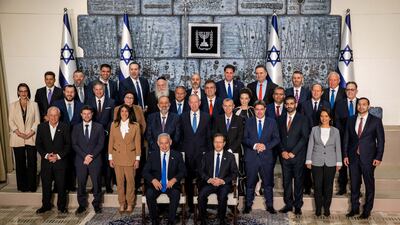
President Isaac Herzog and Prime Minister Benjamin Netanyahu with members of the new Israeli government. Reuters -
Prime Minister Benjamin Netanyahu and his wife Sara attend a toast for the new speaker of Israel's parliament. Reuters -

Benjamin Netanyahu after the traditional group photo with Israel's new government. EPA -

Benjamin Netanyahu during the first cabinet meeting of his new government in Jerusalem. AFP -

New Knesset speaker Amir Ohana, centre, with his partner Alon, left, their children, and Benjamin Netanyahu at the Knesset in Jerusalem. AFP -
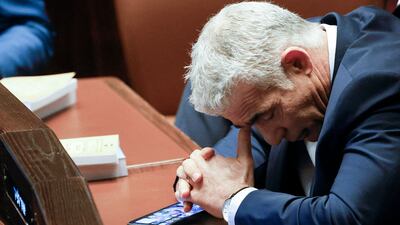
Outgoing Prime Minister Yair Lapid attends a special session of Israel's parliament, the Knesset, to swear in a new government. AFP -
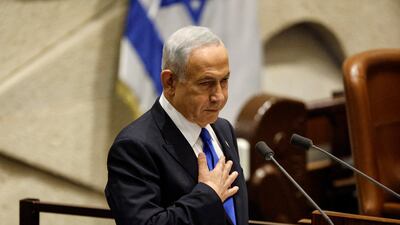
Israeli Prime Minister-designate Benjamin Netanyahu speaks at the special session. EPA -
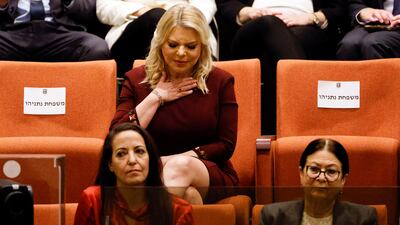
Sara Netanyahu, centre top, Benjamin Netanyahu's wife, Lihi Lapid, centre left, Yair Lapid's wife, and Esther Hayut, President of the Supreme Court of Israel. Reuters -

Designated Minister of National Security Itamar Ben Gvir, left, and designated Israeli Minister of Finance Bezalel Smotrich, right, at the session in parliament. Getty Images -

Member of Knesset Aryeh Deri attends a special session of the Knesset, Israel's parliament, to approve and swear in a new right-wing government, in Jerusalem. AP -

Designated Minister of National Security Itamar Ben Gvir speaks at the swearing-in session. Getty Images -

Protesters against the new Netanyahu government outside the Knesset, Israel's parliament, as it is sworn in. EPA -

Israelis protest against the new government. EPA


Israeli forces often demolish the homes of Palestinians who carry out attacks in Israel and against its soldiers in the Palestinian territories.
Orders were issued in October to demolish the homes of the two men accused of killing the IDF commander with the elite Nahal unit at a West Bank checkpoint.
It said the commander died during a gun battle as Palestinian militants attempted to storm the checkpoint.
Last year was the deadliest in the Israel-Palestinian conflict since 2005, with more than 200 Palestinians killed, mostly in the occupied West Bank.
Jenin was a particular hotspot and suffered almost-daily raids.
The army said its targets were Palestinian militants behind a wave of attacks in Israel that left more than 30 dead throughout the year.
Most of the perpetrators come from Jenin and Nablus, it said.

