

Jordanian soldiers in armoured vehicles patrol the border with Syria, speeding past a mangled and rusted pipeline on the parched landscape.
It is the Tapline, an engineering feat made by American companies in the 1940s that carried crude oil exports from the inner Arabian Peninsula to Lebanon’s Mediterranean coast.
The 1,200-kilometre pipeline died slowly, undermined by Lebanese divisions and regional disputes. It last carried Saudi oil to Jordan at about the time Saddam Hussein invaded Kuwait in 1990.
University of Jordan
In some ways, it is the derelict wreck of an ideal: that energy interconnection in the Middle East could enhance Arab security and prosperity in the region.
Jordan sought to revive its Middle East energy role, and the political clout that comes with it, when King Abdullah II became the first Arab head of state to meet US President Joe Biden in July.
In Washington, King Abdullah advocated a proposal for Egyptian gas and Jordanian electricity to flow through Syria to Lebanon, paid for by World Bank loans, although the Syrian regime is under US sanctions for human rights breaches and has been accused of backing extremist groups.
With US support, an agreement was first reached between the four regional governments in October last year.
Power shortages in Lebanon were worsening as its economy imploded, and the government could not pay for fuel oil to generate electricity.
-
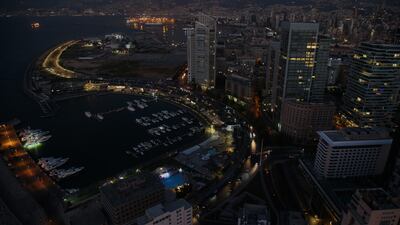
A view of Lebanon's capital, Beirut, with the lights on only in some buildings. Lebanese rely on highly polluting diesel generators run by private neighbourhood operators to make up for shortfalls in electricity supply from the state utility. EPA -

A fisherman uses a headlamp at the seaside corniche in Beirut, Lebanon. EPA -

A vendor sells LED balloons in full darkness at the corniche in Beirut. EPA -
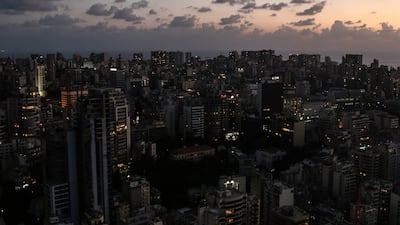
The near collapse of the national grid has increased the duration of power cuts across Lebanon. EPA -
Residents of Beirut are experiencing power cuts of up to 20 hours a day. EPA


But no Egyptian or Jordanian exports started as Lebanon failed to introduce reforms demanded by the World Bank to finance the deals.
The conditions were aimed at curbing corruption at Lebanon's state-owned electricity monopoly, solving its inability to collect its bills and incentivising private investment — reducing the cost burden on the cash-strapped government.
A US State Department representative tells The National that Washington will "assess and address any possible sanctions concerns" over the gas deal after the World Bank approves the financing.
Washington wants Lebanon to introduce the World Bank demands "to move forward" with the gas agreement, said the representative, who did not address the electricity part of the deals.
The failure of the agreements to materialise highlights the risk of dealing with a barely functioning Lebanese state and a largely isolated regime in Syria, amid geopolitical changes in the Middle East since the Russian invasion of Ukraine in February.
Lebanese Energy Minister Walid Fayad has said the caretaker government in the country has implemented most World Bank measures and will soon meet all of them.
But fulfilling the conditions does not guarantee the financing because it also depends on political circumstances "that go beyond Lebanon", he said.
He said the government, which has been raising electricity tariffs, may still be able to provide eight to 10 hours of electricity a day without the imports — four times the current rations — even if the World Bank financing falls through.
This, which the minister described as a back-up plan, would theoretically provide power similar to what Lebanon is expected to produce with the boost from the energy deals.
Jordanian and Egyptian officials expected the electricity and gas exports to start in about March this year, with the government of Syrian President Bashar Al Assad taking a cut of both.
The plan appeared to be a win-win for a host of players in the Middle East.
Russia has urged Arab League members to reintegrate Syria, which was largely ostracised for the Assad regime's use of deadly violence during the 2011 uprising.
Washington viewed the Arab energy exports as a way to counter Iranian attempts to fill the power vacuum in Lebanon by sending fuel oil.
This was balanced with the risk that Mr Al Assad, one of Iran's main regional allies, would strengthen his strategic position through the deals.
Jordan aimed to restore some of the regional clout it lost during former US president Donald Trump's administration, which pursued normalisation between Arab states and Israel.
The kingdom has been producing more electricity than it consumes for years without finding a client for the excess capacity.
Although Egypt is a significant exporter of gas, extending the exports to Lebanon would help to reassert Egypt's pan-Arab role, particularly in the Levant, after a decade of internal instability and the pursuit of other interests in Africa.
Still, Jordan and Egypt wanted to make sure they would be paid, and to minimise the political uncertainties of the deals.
They demanded clearances and waivers from US sanctions, especially the Caesar Act.
The act, passed in 2020, increased penalties on foreign governments and businesses with ties to the Syrian regime and its associates.
American focus in the Middle East, however, has broadened over the past year to lessen tension between Hezbollah and Israel.
Last month, the US brokered a maritime border treaty between Lebanon and Israel.
The agreement eased a dispute between the two countries about offshore gas exploration rights.
Regional rivalries inter-connect
But Washington has been frosty towards moves by Jordan and other Arab countries to accommodate the Assad regime.
Moscow favours the reintegration of Damascus, but also deepened its ties to Tehran after the start of the Ukraine war.
After a meeting between King Abdullah and Russian President Vladimir Putin in August last year, Jordan embarked on a rapprochement with the Syrian regime.
Jordan hoped Moscow would rein in Hezbollah and other pro-Iranian militias in southern Syria in return for improving economic ties with Damascus.
Jordanian officials blame the militias, along with the Syrian military, for smuggling narcotics into the kingdom through southern Syria.
The Assad regime recaptured the area in 2018, with Russian support, from rebel forces.
Hassan Al Momani, a professor at the international relations and regional studies department at the University of Jordan, says that after Tehran provided Moscow with drones and other weapons to use in Ukraine, Russia has balked at the idea of putting pressure on Iran over Syria.
The new approach by Jordan towards the regime in Damascus has not been paying off, he says.
Prof Al Momani says the US, Egypt and Jordan may not be as keen on the deals as they were a year ago, although the gas and electricity could still flow if Lebanon meets the World Bank conditions.
“There is a linkage problem. These deals are tied to regional conflicts in which priorities have changed," he says.

