
Israeli police arrested at least three Palestinians on Sunday in connection with a deadly shooting at a Jerusalem checkpoint.
A large force of officers, soldiers and Shin Bet security agency operatives were involved in the search to apprehend the attacker, AP reported, citing the police.
The shooter had opened fire on a military checkpoint in east Jerusalem late on Saturday, killing a female Israeli soldier and wounding three other soldiers, one of them seriously.
The Israeli military identified the soldier as 18-year-old Noa Lazar.
It was the latest bloodshed in the deadliest violence in the region in seven years and came less than a day before Israel was to begin celebrating the week-long Sukkot holiday, when tens of thousands of Jews visit the holy city.
-

Palestinians search a house to retrieve the bodies of three Palestinians killed by Israeli troops during a raid in the West Bank city of Nablus. EPA -
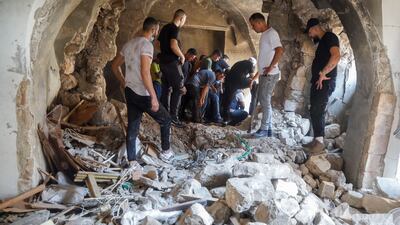
Palestinians inspect a building damaged during clashes with Israeli forces in Nablus. Reuters -

Palestinians carry the body of Islam Sabouh. Israeli police said forces encircled the home of Ibrahim Al Nabulsi, who they say was wanted for a string of shootings in the West Bank earlier this year, and that Al Nabulsi and Sabouh were killed in a shootout. AP Photo -

Palestinians evacuate the bodies of three Palestinians killed by Israeli troops. EPA -
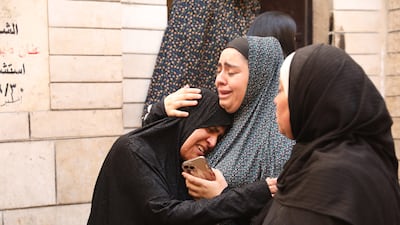
Palestinians grieve for those killed during the raid. EPA -
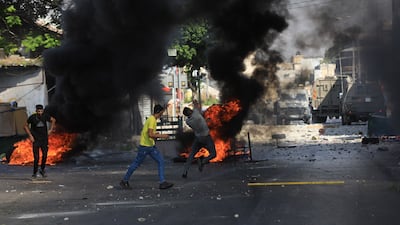
Palestinians clash with Israeli troops. EPA -
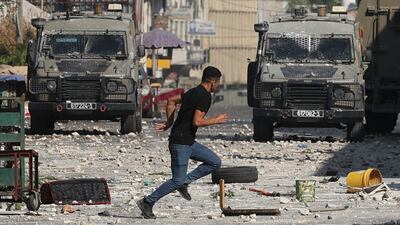
A Palestinian protester runs during clashes with Israeli security forces' vehicles. AFP -
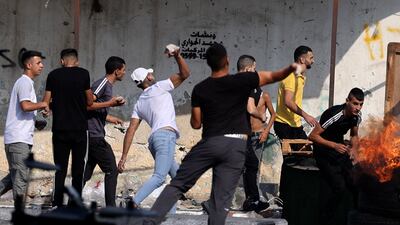
Protesters hurl rocks at Israeli security forces' vehicles. AFP -
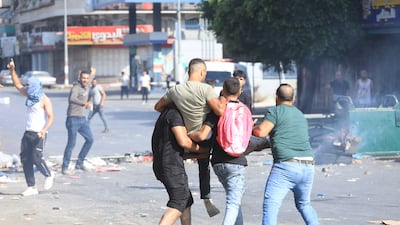
A wounded man is carried during the clashes with Israeli troops. EPA -
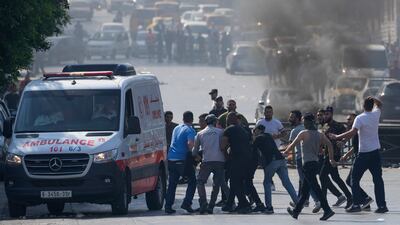
Palestinian health officials said three people were killed and at least 40 people wounded in the gun battle. AP Photo -
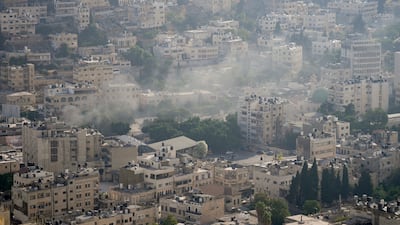
Smoke rises above buildings during the Israeli army operation in Nablus. AP Photo
Israeli Prime Minister Yair Lapid offered his condolences to Lazar’s family.
“We will not be silent and we will not rest until we bring the abominable killers to justice,” he said.
The attack came hours after two Palestinian teenagers were killed during an Israeli military raid in the occupied West Bank.
A day earlier, two other Palestinian teenagers, aged 14 and 17, were killed by Israeli fire in separate incidents elsewhere in the West Bank.
Rights groups accuse Israeli forces of using excessive force in their dealings with the Palestinians, particularly young men, without being held accountable.
The military says it contends with complex, life-threatening scenarios.
Israel captured East Jerusalem, along with the West Bank and Gaza Strip, in the 1967 Six-Day War and annexed the area in a move that is not recognised internationally.
It considers the entire city, including East Jerusalem, home to the city’s most important holy sites, to be its capital.
The Palestinians claim East Jerusalem for the capital of a future state with the West Bank and Gaza Strip.

Dubai Bling season three
Cast: Loujain Adada, Zeina Khoury, Farhana Bodi, Ebraheem Al Samadi, Mona Kattan, and couples Safa & Fahad Siddiqui and DJ Bliss & Danya Mohammed
Rating: 1/5
if you go
The flights
Air Astana flies direct from Dubai to Almaty from Dh2,440 per person return, and to Astana (via Almaty) from Dh2,930 return, both including taxes.
The hotels
Rooms at the Ritz-Carlton Almaty cost from Dh1,944 per night including taxes; and in Astana the new Ritz-Carlton Astana (www.marriott) costs from Dh1,325; alternatively, the new St Regis Astana costs from Dh1,458 per night including taxes.
When to visit
March-May and September-November
Visas
Citizens of many countries, including the UAE do not need a visa to enter Kazakhstan for up to 30 days. Contact the nearest Kazakhstan embassy or consulate.
Mercer, the investment consulting arm of US services company Marsh & McLennan, expects its wealth division to at least double its assets under management (AUM) in the Middle East as wealth in the region continues to grow despite economic headwinds, a company official said.
Mercer Wealth, which globally has $160 billion in AUM, plans to boost its AUM in the region to $2-$3bn in the next 2-3 years from the present $1bn, said Yasir AbuShaban, a Dubai-based principal with Mercer Wealth.
“Within the next two to three years, we are looking at reaching $2 to $3 billion as a conservative estimate and we do see an opportunity to do so,” said Mr AbuShaban.
Mercer does not directly make investments, but allocates clients’ money they have discretion to, to professional asset managers. They also provide advice to clients.
“We have buying power. We can negotiate on their (client’s) behalf with asset managers to provide them lower fees than they otherwise would have to get on their own,” he added.
Mercer Wealth’s clients include sovereign wealth funds, family offices, and insurance companies among others.
From its office in Dubai, Mercer also looks after Africa, India and Turkey, where they also see opportunity for growth.
Wealth creation in Middle East and Africa (MEA) grew 8.5 per cent to $8.1 trillion last year from $7.5tn in 2015, higher than last year’s global average of 6 per cent and the second-highest growth in a region after Asia-Pacific which grew 9.9 per cent, according to consultancy Boston Consulting Group (BCG). In the region, where wealth grew just 1.9 per cent in 2015 compared with 2014, a pickup in oil prices has helped in wealth generation.
BCG is forecasting MEA wealth will rise to $12tn by 2021, growing at an annual average of 8 per cent.
Drivers of wealth generation in the region will be split evenly between new wealth creation and growth of performance of existing assets, according to BCG.
Another general trend in the region is clients’ looking for a comprehensive approach to investing, according to Mr AbuShaban.
“Institutional investors or some of the families are seeing a slowdown in the available capital they have to invest and in that sense they are looking at optimizing the way they manage their portfolios and making sure they are not investing haphazardly and different parts of their investment are working together,” said Mr AbuShaban.
Some clients also have a higher appetite for risk, given the low interest-rate environment that does not provide enough yield for some institutional investors. These clients are keen to invest in illiquid assets, such as private equity and infrastructure.
“What we have seen is a desire for higher returns in what has been a low-return environment specifically in various fixed income or bonds,” he said.
“In this environment, we have seen a de facto increase in the risk that clients are taking in things like illiquid investments, private equity investments, infrastructure and private debt, those kind of investments were higher illiquidity results in incrementally higher returns.”
The Abu Dhabi Investment Authority, one of the largest sovereign wealth funds, said in its 2016 report that has gradually increased its exposure in direct private equity and private credit transactions, mainly in Asian markets and especially in China and India. The authority’s private equity department focused on structured equities owing to “their defensive characteristics.”
On the menu
First course
▶ Emirati sea bass tartare Yuzu and labneh mayo, avocado, green herbs, fermented tomato water
▶ The Tale of the Oyster Oyster tartare, Bahraini gum berry pickle
Second course
▶ Local mackerel Sourdough crouton, baharat oil, red radish, zaatar mayo
▶ One Flew Over the Cuckoo’s Nest Quail, smoked freekeh, cinnamon cocoa
Third course
▶ Bahraini bouillabaisse Venus clams, local prawns, fishfarm seabream, farro
▶ Lamb 2 ways Braised lamb, crispy lamb chop, bulgur, physalis
Dessert
▶ Lumi Black lemon ice cream, pistachio, pomegranate
▶ Black chocolate bar Dark chocolate, dates, caramel, camel milk ice cream
Day 1 results:
Open Men (bonus points in brackets)
New Zealand 125 (1) beat UAE 111 (3)
India 111 (4) beat Singapore 75 (0)
South Africa 66 (2) beat Sri Lanka 57 (2)
Australia 126 (4) beat Malaysia -16 (0)
Open Women
New Zealand 64 (2) beat South Africa 57 (2)
England 69 (3) beat UAE 63 (1)
Australia 124 (4) beat UAE 23 (0)
New Zealand 74 (2) beat England 55 (2)
Also on December 7 to 9, the third edition of the Gulf Car Festival (www.gulfcarfestival.com) will take over Dubai Festival City Mall, a new venue for the event. Last year's festival brought together about 900 cars worth more than Dh300 million from across the Emirates and wider Gulf region – and that first figure is set to swell by several hundred this time around, with between 1,000 and 1,200 cars expected. The first day is themed around American muscle; the second centres on supercars, exotics, European cars and classics; and the final day will major in JDM (Japanese domestic market) cars, tuned vehicles and trucks. Individuals and car clubs can register their vehicles, although the festival isn’t all static displays, with stunt drifting, a rev battle, car pulls and a burnout competition.
Read more about the coronavirus
You might also like
More from Neighbourhood Watch:
More from Neighbourhood Watch
Company%20profile
SM Town Live is on Friday, April 6 at Autism Rocks Arena, Dubai. Tickets are Dh375 at www.platinumlist.net
Specs
Ten tax points to be aware of in 2026
1. Domestic VAT refund amendments: request your refund within five years
If a business does not apply for the refund on time, they lose their credit.
2. E-invoicing in the UAE
Businesses should continue preparing for the implementation of e-invoicing in the UAE, with 2026 a preparation and transition period ahead of phased mandatory adoption.
3. More tax audits
Tax authorities are increasingly using data already available across multiple filings to identify audit risks.
4. More beneficial VAT and excise tax penalty regime
Tax disputes are expected to become more frequent and more structured, with clearer administrative objection and appeal processes. The UAE has adopted a new penalty regime for VAT and excise disputes, which now mirrors the penalty regime for corporate tax.
5. Greater emphasis on statutory audit
There is a greater need for the accuracy of financial statements. The International Financial Reporting Standards standards need to be strictly adhered to and, as a result, the quality of the audits will need to increase.
6. Further transfer pricing enforcement
Transfer pricing enforcement, which refers to the practice of establishing prices for internal transactions between related entities, is expected to broaden in scope. The UAE will shortly open the possibility to negotiate advance pricing agreements, or essentially rulings for transfer pricing purposes.
7. Limited time periods for audits
Recent amendments also introduce a default five-year limitation period for tax audits and assessments, subject to specific statutory exceptions. While the standard audit and assessment period is five years, this may be extended to up to 15 years in cases involving fraud or tax evasion.
8. Pillar 2 implementation
Many multinational groups will begin to feel the practical effect of the Domestic Minimum Top-Up Tax (DMTT), the UAE's implementation of the OECD’s global minimum tax under Pillar 2. While the rules apply for financial years starting on or after January 1, 2025, it is 2026 that marks the transition to an operational phase.
9. Reduced compliance obligations for imported goods and services
Businesses that apply the reverse-charge mechanism for VAT purposes in the UAE may benefit from reduced compliance obligations.
10. Substance and CbC reporting focus
Tax authorities are expected to continue strengthening the enforcement of economic substance and Country-by-Country (CbC) reporting frameworks. In the UAE, these regimes are increasingly being used as risk-assessment tools, providing tax authorities with a comprehensive view of multinational groups’ global footprints and enabling them to assess whether profits are aligned with real economic activity.
Contributed by Thomas Vanhee and Hend Rashwan, Aurifer
Company%20profile
While you're here
Con Coughlin: To survive, Nato must renew its sense of common purpose
Gavin Esler: Nato summit failed for making news more than it made deals
Simon Waldman: Nato continues to be Ankara’s best security guarantor
While you're here
Breast cancer in men: the facts
1) Breast cancer is men is rare but can develop rapidly. It usually occurs in those over the ages of 60, but can occasionally affect younger men.
2) Symptoms can include a lump, discharge, swollen glands or a rash.
3) People with a history of cancer in the family can be more susceptible.
4) Treatments include surgery and chemotherapy but early diagnosis is the key.
5) Anyone concerned is urged to contact their doctor
