


Discussions on a draft capital control law were suspended on Tuesday, amid protests outside Lebanon’s parliament building and sharp disagreement over the proposed legislation.
A capital control law ― which limits the flow of foreign capital in and out of the country ― is one of a handful of reforms demanded by the International Monetary Fund to unlock an aid package that would help Lebanon to work its way out of an economic crisis now in its fourth year.
The disputed draft law, which would standardise informal capital controls imposed by Lebanon’s commercial banks in 2019, is the latest of several iterations.
Once agreed on at the committee level, it would be referred to Parliament’s General Assembly, which would then vote on it.
But disagreement among MPs in the joint committee — some of whom echoed the displeasure of demonstrators protesting outside the Parliament building — halted the process.
The discussions on the draft law will be suspended until a comprehensive reform package — including a financial recovery plan — can be submitted, a state news agency quoted Deputy Speaker Elias Bou Saab as saying.
“There are people who are of the view that this law comes in the interest of the depositor and others are of the view that it comes in the interest of the banks,” Mr Bou Saab said, summarising the disagreement.
The suspension alleviates some fears financial experts and activists have voiced over the draft law.
Why the controversy over the draft law?
Henri Chaoul, a former adviser to Lebanon’s finance ministry, said Parliament was "putting the cart before the horse”.
“A capital control law is supposed to come as a supplement to an overall macro-finance policy," he said.
Last year, Mr Chaoul resigned from the advisory team assisting in IMF negotiations, citing institutional resistance and “no genuine will” to reform.
The discussion of a draft capital control law before the foundation for financial recovery is put in place made the proposal an “ill-timed, ill-written piecemeal approach that would have nefarious impacts on Lebanon’s economy,” Mr Chaoul said.
Signs of Lebanon’s economic implosion began to show in 2019.
Over the past three years, as the downturn worsened, the country’s leaders have argued over details of a financial rescue plan and struggled to enact the reforms necessary to receive the bailout from the International Monetary Fund.
Meanwhile Lebanon loses millions of dollars for every day in which the reforms are delayed.
The local currency has declined steeply since 2019, losing about 95 per cent of its value.
More than two-thirds of Lebanon’s population live in poverty. The public sector has all but collapsed, state-generated electricity is nearly non-existent and most citizens struggle to make ends meet.
-

November 1, 2019: Banks implement capital controls after shutting for two weeks. Reuters -
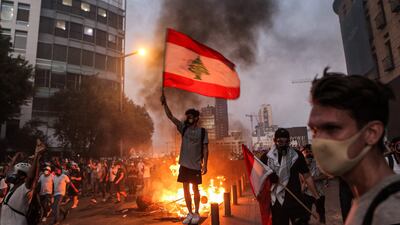
March 2020: Lebanon defaults on its sovereign debt for the first time in its history, amid protests in the country. AFP -
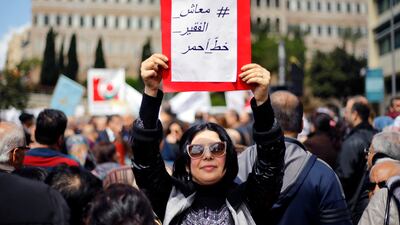
April 2020: The government of Hassan Diab, prime minister at the time, pictured with President Michel Aoun, approves a financial recovery plan. Reuters -
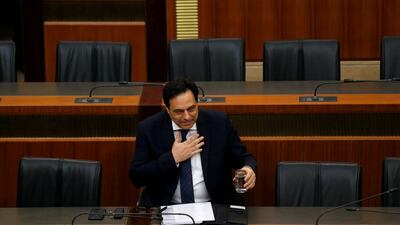
May 1, 2020: Mr Diab's government requests assistance from the International Monetary Fund. The Association of Banks in Lebanon rejects the plan. Reuters -
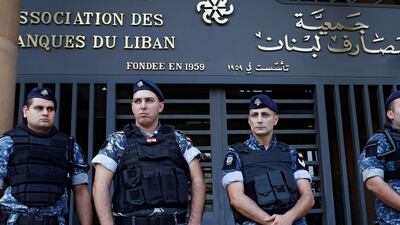
May 20, 2020: the ABL presents an alternative plan. Reuters -
July 1, 2020: a Parliamentary fact-finding committee backs the ABL. The IMF suspends negotiations with Lebanon. AP -
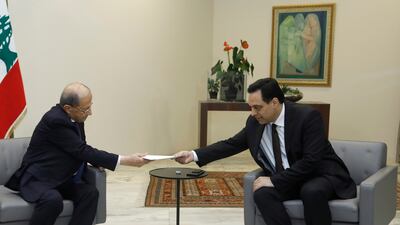
August 10, 2020: Mr Diab resigns following a devastating explosion at Beirut’s port, in which at least 232 people died and 7,000 were injured. AP -
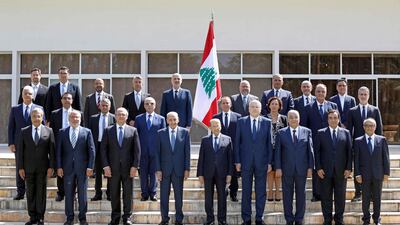
September 10, 2021: Najib Mikati, fourth from right, forms a government. AFP -
January 2022: Lebanon re-starts negotiations with the IMF. Reuters -
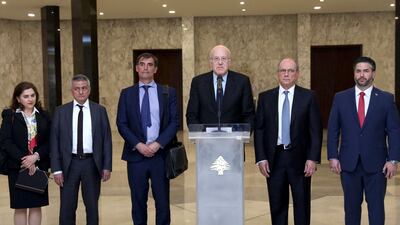
April 7, 2022: The IMF and Lebanon reach a staff-level agreement. AFP -
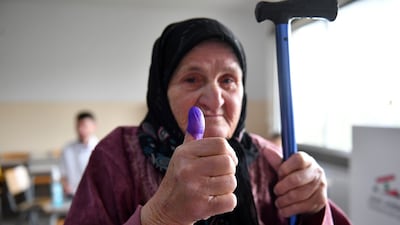
May 15, 2022: Lebanon holds parliamentary elections. EPA -
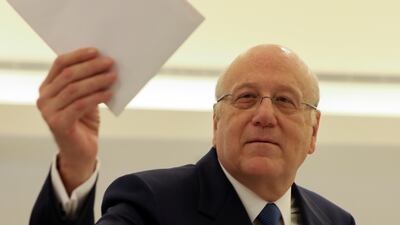
May 20, 2022: Mr Mikati’s government approves a new financial recovery plan. Reuters -
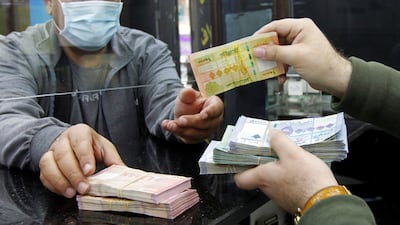
May 24, 2022: The ABL rejects the plan. The local currency hits the record low of 34,000 Lebanese pounds to the dollar – 95 per cent lower than the official rate. Reuters


Mr Bou Saab’s announcement that discussions on a capital control law would be halted until a full financial recovery plan could be implemented is seen as a partial win for members of civil society who advocate for a fair protection of people’s deposits.
Despite this, fears remain that Lebanon’s leaders are not committed to real reform.
Fouad Debs, co-founder of the Lebanese Depositors Union, which advocates for protecting the bank savings of ordinary citizens, said a capital control law should have been introduced years ago.
At the same time, he’s concerned that the law in its proposed form will do little to protect small depositors.
Although he and other advocates desire a financial plan and a capital control law that would unlock IMF aid, he fears it will benefit political oligarchs and financial elites rather than ordinary citizens.
Mr Debs cited amendments that were made before the latest draft of the capital control law went to the committee, which grant exceptional powers to Riad Salameh — Lebanon’s Central Bank governor, widely seen as the architect of the monetary policy that brought the nation to this crisis.
The capital control law would pave the way for the formation of a committee that would dictate the terms for withdrawals in Lebanese pounds and foreign currency.
The fate of depositors’ money would lie in the hands of “the same people who caused the crisis,” said Mr Debs.
The existence of such a committee would also cripple the independence of Lebanon’s judiciary.
“Instead of having a judge in a court of law we’d have a committee headed by the Central Bank Governor who would be given the power to grant exceptions,” when it comes to lawsuits by depositors, Mr Chaoul explained.
A major sticking point for Lebanon’s Depositor’s Union is the preservation of social assistance provided by the National Social Security Funds and various syndicates.
“They’re not putting any special provisions in this law for money and savings for syndicates and national social security,’ Mr Debs said. “This money funds hundreds of thousands of people.”
“That money is there as a safeguard to ensure their future, their healthcare.”

Time is of the essence
Lebanon’s reserves continue to shrink as political leaders bicker over what a capital control law should look like.
In June the central bank governor said reserves had fallen to only about $11 billion — a third of the sum held in 2019.
Preserving small deposits will become less viable as time passes.
In March 2020 the government, assisted by US investment bank Lazard, approved a financial recovery plan.
The plan was intended to protect most deposits while prioritising small and mid-sized accounts: deposits under $500,000 could have been preserved at the time.
Lebanon in May submitted a request for assistance from the IMF.
But the plan was scuppered by Lebanon’s Association of Banks — backed by a parliamentary fact-finding mission — who argued that the state should absorb the brunt of the losses. The government, led by then-Prime Minister Hassan Diab, was essentially pitted against parliamentary oligarchs and financial elites.
IMF negotiations subsequently unravelled, causing two members of Lebanon’s negotiating team — one of whom was Dr Chaoul — to quit in protest.
“Whatever was possible in 2020 is no longer possible. What is possible today, will not be possible tomorrow,” Mr Chaoul told The National.
With reserves having steadily depleted since, only accounts with $100,000 or less can potentially be preserved.
Until a comprehensive and transparent financial recovery package is enacted, “time is killing us,” Dr Chaoul emphasised.

