• An aerial photo of the Palestinian Gharib family's house, centre, in between Israeli army barriers, which is at the heart of the Jewish settlement of Givon Hahadasha, north of Jerusalem. All photos by AFP
    An aerial photo of the Palestinian Gharib family's house, centre, in between Israeli army barriers, which is at the heart of the Jewish settlement of Givon Hahadasha, north of Jerusalem. All photos by AFP
  • Palestinian Saadat Sabri Gharib, centre, walks with family members between Israeli army barriers that lead to his house.
    Palestinian Saadat Sabri Gharib, centre, walks with family members between Israeli army barriers that lead to his house.
  • Mr Gharib poses with members of his family in front of his house.
    Mr Gharib poses with members of his family in front of his house.
  • Children of the Gharib family are pictured between Israeli army barriers.
    Children of the Gharib family are pictured between Israeli army barriers.
  • Children of the Gharib family play between Israeli army barriers.
    Children of the Gharib family play between Israeli army barriers.
  • Since Israel seized the territory in the 1967 war, an Israeli settlement has sprung up on surrounding land claimed by the family, leaving them isolated in their single-storey house on the edge of the Palestinian village of Beit Ijza.
    Since Israel seized the territory in the 1967 war, an Israeli settlement has sprung up on surrounding land claimed by the family, leaving them isolated in their single-storey house on the edge of the Palestinian village of Beit Ijza.
  • The Gharib family has fought numerous legal battles in Israeli courts, in 2012 winning the right to a small strip of the land they claim.
    The Gharib family has fought numerous legal battles in Israeli courts, in 2012 winning the right to a small strip of the land they claim.
  • Palestinian Saadat Sabri Gharib (3-R) is pictured with family members between Israeli army barriers, that lead to his house which is an enclave at the heart of the Jewish settlement of Givon Hahadasha, north of Jerusalem, bordering the West Bank Palestinian village of Beit Ijza, on July 19 2022. - For years the family home stood amid swathes of farmland dotted with olive trees, but now it lies behind a yellow gate, controlled by Israeli soldiers, who also patrol a narrow bridge overlooking the eight-metre (26-foot) fence. The Gharib family has fought numerous legal battles in Israeli courts, in 2012 winning the right to around three percent of the land they claim. (Photo by MENAHEM KAHANA / AFP)
    Palestinian Saadat Sabri Gharib (3-R) is pictured with family members between Israeli army barriers, that lead to his house which is an enclave at the heart of the Jewish settlement of Givon Hahadasha, north of Jerusalem, bordering the West Bank Palestinian village of Beit Ijza, on July 19 2022. - For years the family home stood amid swathes of farmland dotted with olive trees, but now it lies behind a yellow gate, controlled by Israeli soldiers, who also patrol a narrow bridge overlooking the eight-metre (26-foot) fence. The Gharib family has fought numerous legal battles in Israeli courts, in 2012 winning the right to around three percent of the land they claim. (Photo by MENAHEM KAHANA / AFP)
  • The Jewish settlement of Givon Hahadasha borders the West Bank Palestinian village of Beit Ijza.
    The Jewish settlement of Givon Hahadasha borders the West Bank Palestinian village of Beit Ijza.

Meet the Palestinian family whose home is surrounded by Israeli settlements


  • English
  • Arabic

An eight-metre fence surrounds the Gharib family home in the occupied West Bank. To reach it they must pass through a gate controlled remotely by Israeli security forces.

Since Israel seized the territory in the 1967 war, an Israeli settlement has sprung up on surrounding land claimed by the family, leaving them isolated in their single-storey house on the edge of the Palestinian village of Beit Ijza.

“I don't know when this will end,” Saadat Gharib said with a sigh. “No one knows the pain my children are suffering.”

For years the family home stood on farmland, but now it lies behind a yellow gate, controlled by Israeli soldiers, who also patrol a narrow bridge overlooking the towering fence.

“During these years we've had a tough life,” said Mr Gharib, 40, who works for the Palestinian Authority in nearby Ramallah.

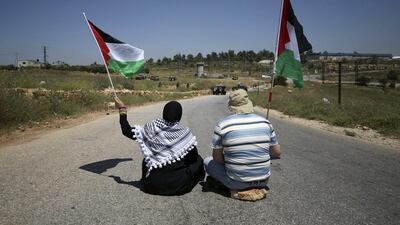
  • Palestinian protesters wave flags as Israeli troops take position during a protest against Jewish settlements in the West Bank village of Nabi Saleh, near Ramallah. Reuters
    Palestinian protesters wave flags as Israeli troops take position during a protest against Jewish settlements in the West Bank village of Nabi Saleh, near Ramallah. Reuters
  • Now that Prime Minister Benjamin Netanyahu has secured a new term in office, there’s little to prevent him from annexing large parts of the West Bank as early as this summer. AP
    Now that Prime Minister Benjamin Netanyahu has secured a new term in office, there’s little to prevent him from annexing large parts of the West Bank as early as this summer. AP
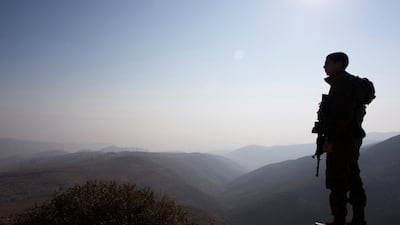
  • An Israeli soldier stands guard during a tour made by Israeli parliament members in the Jordan Valley near the Jewish settlement of Maale Efrayim. Reuters
    An Israeli soldier stands guard during a tour made by Israeli parliament members in the Jordan Valley near the Jewish settlement of Maale Efrayim. Reuters
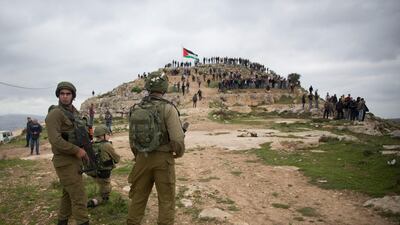
  • Israeli soldiers take position as Palestinian demonstrators gather during a protest against expansion of Israeli settlements in the West Bank. AP
    Israeli soldiers take position as Palestinian demonstrators gather during a protest against expansion of Israeli settlements in the West Bank. AP
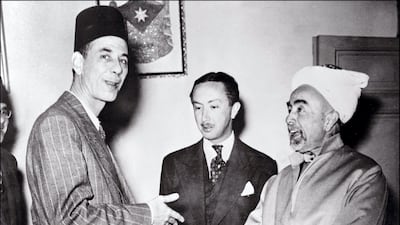
  • King Abdullah (r) of Transjordan on May 13, 1948 in Amman with Abed Al Rahman Azzam, the secretary general of the Arab League and Abd Al Elah Ibn Ali, the Prince Regent of Iraq, the day before the beginning of the first Arab-Israeli War. AFP
    King Abdullah (r) of Transjordan on May 13, 1948 in Amman with Abed Al Rahman Azzam, the secretary general of the Arab League and Abd Al Elah Ibn Ali, the Prince Regent of Iraq, the day before the beginning of the first Arab-Israeli War. AFP
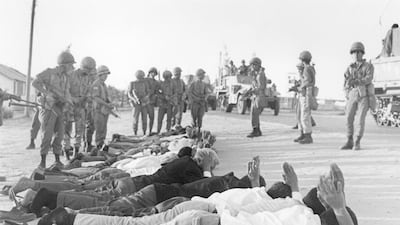
  • Palestinians surrender to Israeli soldiers in June 1967 in the occupied territory of the West Bank after Israel launched a pre-emptive attack on Egypt and Syria and seized the Gaza Strip, Sinai Peninsula and the Golan Heights in Syria as well as the West Bank and Arab East Jerusalem. AFP
    Palestinians surrender to Israeli soldiers in June 1967 in the occupied territory of the West Bank after Israel launched a pre-emptive attack on Egypt and Syria and seized the Gaza Strip, Sinai Peninsula and the Golan Heights in Syria as well as the West Bank and Arab East Jerusalem. AFP
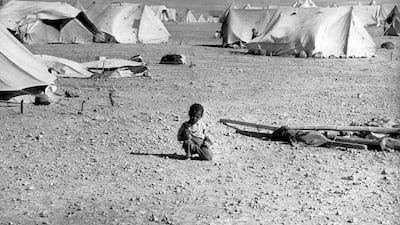
  • A Palestinian child plays in a refugee camp in Jordan on June 23, 1967. AFP
    A Palestinian child plays in a refugee camp in Jordan on June 23, 1967. AFP
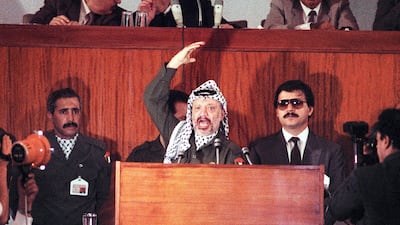
  • PLO chairman Yasser Arafat delivers a speech to the Palestine National Council meeting to make the historic proclamation of a Palestinian state in the Israeli-occupied territories and to recognize Israel in the Palace of Nations conference hall on November 12, 1988, in Algiers. AFP
    PLO chairman Yasser Arafat delivers a speech to the Palestine National Council meeting to make the historic proclamation of a Palestinian state in the Israeli-occupied territories and to recognize Israel in the Palace of Nations conference hall on November 12, 1988, in Algiers. AFP
  • US President Bill Clinton stands between PLO leader Yasser Arafat and Israeli Prime Minister Yitzahk Rabin as they shake hands for the first time on September 13, 1993 at the White House. AFP
    US President Bill Clinton stands between PLO leader Yasser Arafat and Israeli Prime Minister Yitzahk Rabin as they shake hands for the first time on September 13, 1993 at the White House. AFP
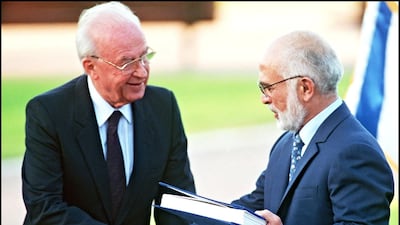
  • Hussein Ibn Talal, King of Jordan and Israeli Premier Yitzhak Rabin shake hands after they exchanged the documents of the Peace Treaty at Beit Gabriel conference centre on November 10, 1994 on the southern shore of the Sea of Galilee. AFP
    Hussein Ibn Talal, King of Jordan and Israeli Premier Yitzhak Rabin shake hands after they exchanged the documents of the Peace Treaty at Beit Gabriel conference centre on November 10, 1994 on the southern shore of the Sea of Galilee. AFP
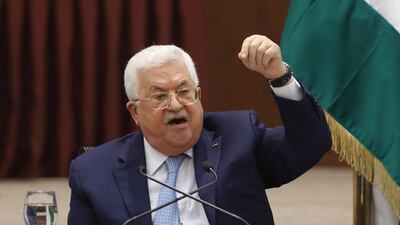
  • Palestinian President Mahmoud Abbas speaks during the Palestinian leadership meeting and threatened to end security coordination with Israel and the United States, saying Israeli annexation would ruin chances for peace. AFP
    Palestinian President Mahmoud Abbas speaks during the Palestinian leadership meeting and threatened to end security coordination with Israel and the United States, saying Israeli annexation would ruin chances for peace. AFP
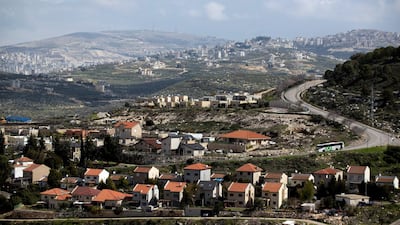
  • Houses in the Israeli settlement of settlement of Kedumim are seen in the foreground as part of the Palestinian city of Nablus is seen in the background (far left) in the Israeli-occupied West Bank. Reuters
    Houses in the Israeli settlement of settlement of Kedumim are seen in the foreground as part of the Palestinian city of Nablus is seen in the background (far left) in the Israeli-occupied West Bank. Reuters
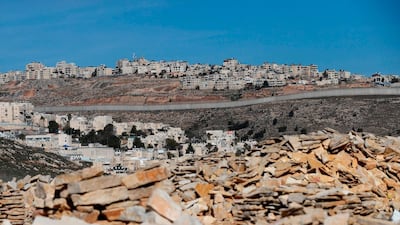
  • Israel's controversial concrete barrier (C) separating the Jewish settlement of Neve Yaakov (foreground) in the northern part of east Jerusalem and the Palestinian area of al-Ram (background) in the occupied West Bank. AFP
    Israel's controversial concrete barrier (C) separating the Jewish settlement of Neve Yaakov (foreground) in the northern part of east Jerusalem and the Palestinian area of al-Ram (background) in the occupied West Bank. AFP
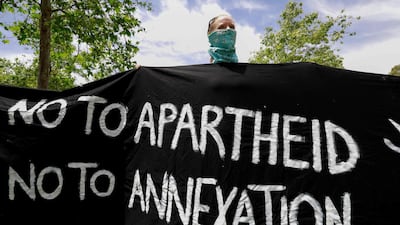
  • An Israeli activist holds a banner during a protest against the US peace plan for the Middle East, in front of the US ambassador's residence in Jerusalem, on May 15, 2020, as Palestinians commemorate the 72nd anniversary of the 1948 Nakba or "catastrophe". AFP
    An Israeli activist holds a banner during a protest against the US peace plan for the Middle East, in front of the US ambassador's residence in Jerusalem, on May 15, 2020, as Palestinians commemorate the 72nd anniversary of the 1948 Nakba or "catastrophe". AFP
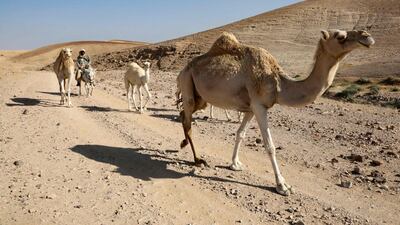
  • A Palestinian shepherd tends to his camels on arid land considered to be in "Area C" (under Israeli security and administrative control), southeast of Yatta town in the southern West Bank district of Hebron. AFP
    A Palestinian shepherd tends to his camels on arid land considered to be in "Area C" (under Israeli security and administrative control), southeast of Yatta town in the southern West Bank district of Hebron. AFP
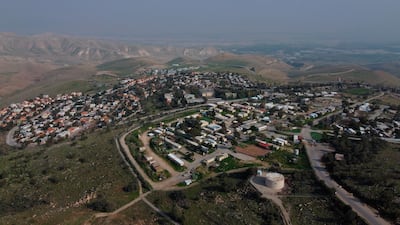
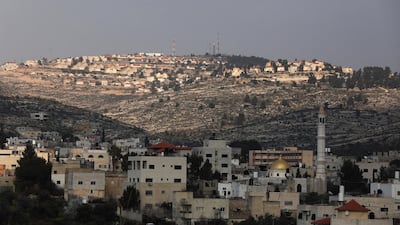
  • A general view of the Israeli settlement of Elon Moreh, as seen from the Palestinian village of Azmout near the West Bank City of Nablus. EPA
    A general view of the Israeli settlement of Elon Moreh, as seen from the Palestinian village of Azmout near the West Bank City of Nablus. EPA
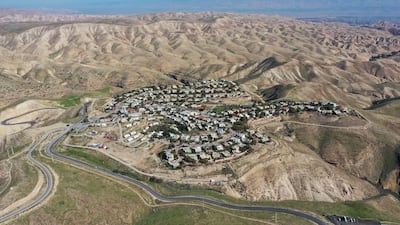
  • The West Bank Jewish settlement of Maale Michmash. AP
    The West Bank Jewish settlement of Maale Michmash. AP

When he was a child, the Jewish settlement of Givon Hahadasha was built partially on land he says belonged to his family.

Decades on, the high fence separates the Gharib house from the Israelis' red-roofed homes and gardens. A communal space for the settlers, with a children's slide, has been placed a few metres away.

Settlements are considered illegal by most of the international community, a judgment Israel rejects.

The Gharib family has fought numerous legal battles in Israeli courts, in 2012 winning the right to a small strip of the land they claim.

“The settlers built a car park and a park, and we've needed the security forces to implement [the decision] and retrieve it for 10 years,” Mr Gharib said.

The yellow gate leading to the house was installed in 2008, Mr Gharib said, and at one point the family had to hold up their IDs to security cameras to cross the threshold.

“[We] appealed to the high court … and the court permitted us to have the gate open all the time,” Mr Gharib said.

“Disputes have broken out between us and the settlers,” said Mr Gharib, who lives with his wife and four children, and his mother.

Avi Zipory, a resident of the settlement, said he would prefer it if the “unpleasant” fence around the house was not there.

“Two courts unanimously decided that the area and his house are within Jewish land,” the 70-year-old said.

“We didn't want to destroy his house … [he is] not ready to accept any alternative plan, [even] other land and a lot of money, that's why we had to continue this separation fence,” he said.

Mr Gharib has hung blue tarpaulins to create a screen between his home and the Givon Hahadasha settlement. “So that the kids can play without being bothered by the settlers and fearing them,” he said.

Mr Gharib said the situation has affected his children, particularly when there are clashes between Palestinians and Israeli forces near by.

“My daughter couldn't sleep all night, for five hours, and she was afraid of the security forces that were stationed at the door of the house,” Mr Gharib said, recalling one incident.

Despite the difficulties, he still works to harvest the family's olive trees.

To do so, he said he has to co-ordinate with the Israeli security forces and take a circuitous route through the neighbouring Palestinian village of Bayt Duqu. Once there, Mr Gharib said he must wait “an hour or two” for soldiers to open another gate.

Mr Gharib is determined to stay on his land: “This is our land, which my father inherited from my grandfather. We will not sell it to anyone for all the money in the world.”


Updated: August 01, 2022, 8:43 AM