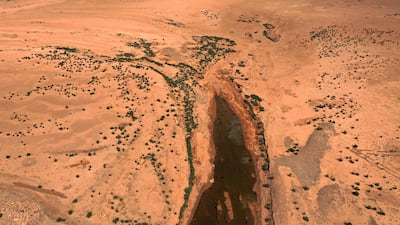
A satellite image of Khan Younis in Gaza taken in 1968 by a Cold War US military satellite imagery programme known as Corona. The images were declassified in 1995 following an executive order by former president Bill Clinton. Photo: Center for Advanced Spatial Technologies, University of Arkansas / US Geological Survey
A satellite image of Khan Younis in Gaza taken in 1968 by a Cold War US military satellite imagery programme known as Corona. The images were declassified in 1995 following an executive order by forme

Drought and desertification: satellite images reveal the Middle East's changing landscape


  • English
  • Arabic

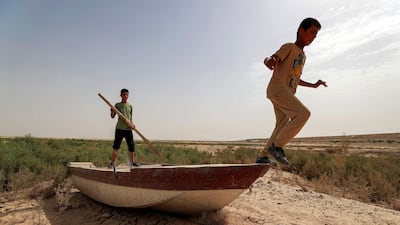
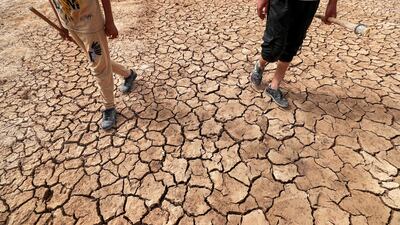
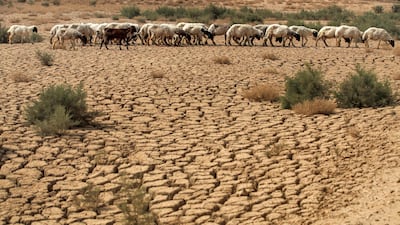
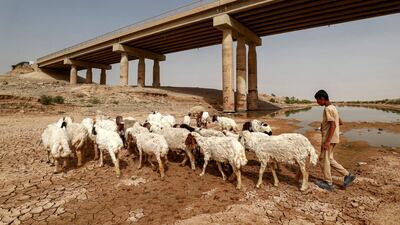
The Middle East is one of the most vulnerable regions when it comes to climate change.

US military satellite imagery from the 1960s and 1970s from the declassified Corona reconnaissance programme starkly illustrates this challenge, showing a landscape that has changed a great deal over the decades.

A 2019 study by the World Resources Institute showed that 12 of the 17 most “water stressed” countries in the world are in the region.

In particular, the images highlight demographic pressure — defined by the Fragile States Index, a conflict monitor, as “pressures upon the state deriving from the population itself or the environment around it”.

Some of these countries — including Yemen, Syria and Iraq — are experiencing water scarcity, climate change, conflict and mismanagement, which combined create a multi-sided crisis, worsening the impact of drought and desertification.

Rapidly growing populations have compounded the problem — even countries that have not been directly affected by war such as Jordan and Saudi Arabia face a challenge to maintain water security.

Images from the US Centre for Advanced Spatial Technologies show the many changes in the region since the 1970s, when the Middle East’s population was estimated to be about 120 million.

The World Bank estimates the region's population rose to more than 420 million in 2020 and could cross 700 million by 2050 if current demographic trends continue.

Comparing the Corona programme imagery with recent satellite images shows the changes in land use during this demographic boom.

In a 1969 image of Buraydah, Saudi Arabia, the Prince Naif bin Abdulaziz International Airport, built in 1964, is barely visible in the centre of the photo. Along with roads, it is the only recognisable feature of a landscape now transformed by new villages, a university and the distinctive circular fields of centre-pivot irrigation.

Images of such development emerging in arid environments point to coming challenges to national water strategies and show what is at stake for these communities facing a future of reduced water supplies.

In the case of Iraq and Jordan, national strategies call for repairing leaking and ageing water infrastructure, investing in more efficient irrigation methods, rationing groundwater and enacting a tariff programme to encourage water saving.

Harsh recent droughts as well as pressure to raise agricultural production amid the food crisis sparked by the Ukraine war have given urgency to these plans.

Jawad Al Bakri, an agriculture professor at the University of Jordan, says a large reduction in water quotas for farmers will affect yields significantly this year, on top of generally bad harvests in 2021.

He suggests that the government should grant groundwater licences in the northern Jordan Valley, one of the country’s main farming regions. Jordan receives more than half of its water from underground aquifers, but some experts fear they are dangerously depleted.

Mr Al Bakri believes there is little choice.

“Some wells must be drilled to compensate for the water deficit,” he told The National.

To alleviate the competition for water between the agriculture, domestic and industrial sectors, focus has moved to recycling wastewater and repairing or replacing old and leaking infrastructure.

From the Jordanian government side, a plan to jump-start the economy unveiled this month said agricultural production consumes half of the water resources in the kingdom while contributing 5 per cent to GDP and 6 per cent to exports.

The plan did not go into specifics, unlike a recent master plan to overhaul farming in Jordan devised by the German Corporation for International Co-operation, which reduces the size of irrigated areas while increasing yields.

For cities such as Zarqa in one of Jordan's poorest governorates, the struggle will be to reduce groundwater use, a report published last year by the US Proceedings of the National Academy of Sciences showed.

The EU last year announced that the Zarqa-Amman area would receive €60 million ($63m) in grants and loans to build a state-of-the-art wastewater treatment plant.

That would be in addition to a nearly $300m project funded by the US aid agency Millennium Challenge Corporation to improve water treatment and efficiency in Zarqa, completed over five years in 2016.

Time is a luxury however — the study said Jordan “must enact an ambitious portfolio of interventions that span supply- and demand-side measures” as soon as possible.

Expanding cities

Satellite images show urban sprawl taking over large parts of the desert and farmland, as seen in Samawa, southern Iraq — one of Iraq’s most water-stressed cities, and Zarqa, a governorate whose population has swelled as generations of Palestinian refugees from the Arab-Israeli conflict settled in its largest city.

50 years of change in Zarqa, Jordan

A comparison of Gaza following the 1967 war and today shows vast areas of rolling sand dunes becoming agricultural land and the expanding city of Khan Younis — all dependent on an aquifer, the strip’s main source of water.

Now there are fears that the desert will reclaim these irrigated areas, turning the heavily populated area into a dust bowl.

Gaza has some seawater desalination plants that provide drinking water for about 70,000 of the two million residents and the World Bank plans a much larger facility that will provide water for more than 800,000 people.

But desalination is energy intensive, raising the question of how sustainable it would be in a territory that struggles to produce enough power.

Gaza's parched future

In addition to climate-related challenges, Gaza has been under Israeli blockade for 15 years, sometimes described as the world’s largest “open air prison."

The densely populated strip of land also suffers from a severe fuel shortage due to Israel’s blockade and a high daily demand of power.

“Gaza suffers from reduced rainfall, annual seawater level rises and more extreme heat events already as a result of climate change,” Amira Aker, a postdoctoral fellow at Canada’s Universite Laval, told The National.

“Hundreds of years ago, Gaza was considered an oasis due to the abundance of water it had.

“Today, its aquifers are over-drafted, and its sea contaminated with sewage waste which seeps into the fresh water supplies.

“Combine those factors with Israel’s uprooting of trees along its border with Gaza, which causes the soil to lose organic material and contain less roots with which to hold on to water, contributing to desertification.”

Less rain has also motivated farmers to use more chemicals to get higher yields from their crops.

“This also leads to problems in the soil like soil degradation and loss of biodiversity,” Ms Aker said.

50 years of change in Khan Younis, Gaza

Iraq on the brink

Like much of Iraq, Samawa has struggled to sustain crumbling water infrastructure. Households compete for water with agriculture — local authorities say 1,000 illegal wells have been dug for farming during a recent period of drought — and industry.

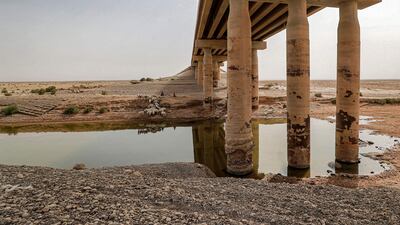
Compounding this problem, upriver dam construction on the Euphrates River and a succession of severe droughts has reduced available water over the decades, leading to rising salinity in the river — the town's main source of freshwater.

Water flows in Iraq's two biggest rivers, the Tigris and Euphrates, have dropped by about two thirds since major dam projects in Turkey, Syria and Iran began in the 1970s.

At the same time, Samawa has expanded rapidly.

50 years of change in Samawa, Iraq

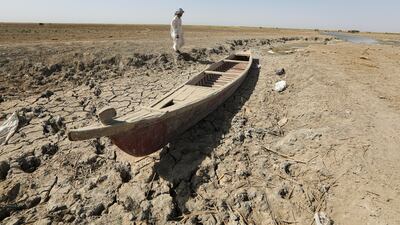
Authorities blame illegal wells and overuse of water by cement plants and salt factories for the drying up of a lake near the town, Lake Sawa, which had been a tourist destination as recently as the 1990s.

During the 1990s, the population of the province where Samawa is located, Al Muthanna, swelled due to an influx of refugees following an uprising against Saddam Hussein in 1991.

At the same time, Iraq's rapidly growing population was placing increasing pressure on vital services that were failing due to international sanctions.

Samawa has relied on World Bank assistance to launch a series of water projects since around 2010. One of them is near completion but was delayed due to a lack of Iraqi government funds during the Covid-19 pandemic.

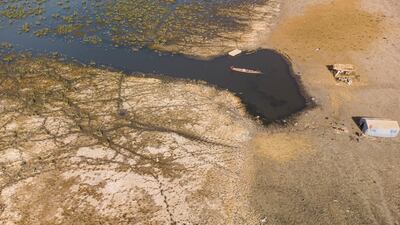
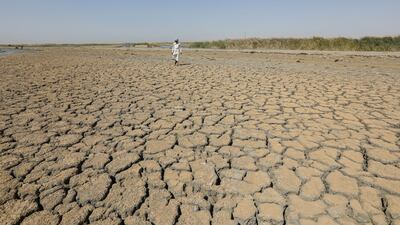
Lake Sawa, near Samawa in Iraq's Al Muthanna province, has dried up as a result of illegal wells and over-use of water by industries. AFP

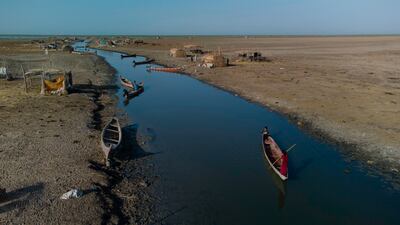
Further south, the port city of Basra faces equally severe pressure. In 2018, amid a severe drought, a combination of rising seawater encroaching into the city's dwindling freshwater supply and pollution from several sources sickened more than 100,000 people.

Unlike Samawa, Basra can benefit from large-scale desalination plants, but such projects take years to complete and are often delayed by Iraq's pervasive political corruption.

“Iraq is currently in its summer months, which means the recurrent events in Basra are renewed, namely the extension of the 'salt tongue' from the Arabian Gulf into the Shatt Al Arab, and then to the city of Basra, which causes desalination plants installed on it to stop,” said Zainab Mehdi, a Women and Security Fellow at the Cambridge Middle East and North Africa Forum.

“The future government should find solutions to this, such as the construction of a moveable dam on the Shatt Al Arab, as well as the installation of desalination plants for extremely saline water.”

As with Jordan and Gaza, time is not on Iraq's side: the country's population, now 41 million, is projected to reach 50 million in 2030.

UAE currency: the story behind the money in your pockets
EA Sports FC 26

Publisher: EA Sports

Consoles: PC, PlayStation 4/5, Xbox Series X/S

Rating: 3/5

The alternatives

• Founded in 2014, Telr is a payment aggregator and gateway with an office in Silicon Oasis. It’s e-commerce entry plan costs Dh349 monthly (plus VAT). QR codes direct customers to an online payment page and merchants can generate payments through messaging apps.

• Business Bay’s Pallapay claims 40,000-plus active merchants who can invoice customers and receive payment by card. Fees range from 1.99 per cent plus Dh1 per transaction depending on payment method and location, such as online or via UAE mobile.

• Tap started in May 2013 in Kuwait, allowing Middle East businesses to bill, accept, receive and make payments online “easier, faster and smoother” via goSell and goCollect. It supports more than 10,000 merchants. Monthly fees range from US$65-100, plus card charges of 2.75-3.75 per cent and Dh1.2 per sale.

2checkout’s “all-in-one payment gateway and merchant account” accepts payments in 200-plus markets for 2.4-3.9 per cent, plus a Dh1.2-Dh1.8 currency conversion charge. The US provider processes online shop and mobile transactions and has 17,000-plus active digital commerce users.

• PayPal is probably the best-known online goods payment method - usually used for eBay purchases -  but can be used to receive funds, providing everyone’s signed up. Costs from 2.9 per cent plus Dh1.2 per transaction.

Islamophobia definition

A widely accepted definition was made by the All Party Parliamentary Group on British Muslims in 2019: “Islamophobia is rooted in racism and is a type of racism that targets expressions of Muslimness or perceived Muslimness.” It further defines it as “inciting hatred or violence against Muslims”.

The Birkin bag is made by Hermès. 
It is named after actress and singer Jane Birkin
Noone from Hermès will go on record to say how much a new Birkin costs, how long one would have to wait to get one, and how many bags are actually made each year.

The biog

First Job: Abu Dhabi Department of Petroleum in 1974  
Current role: Chairperson of Al Maskari Holding since 2008
Career high: Regularly cited on Forbes list of 100 most powerful Arab Businesswomen
Achievement: Helped establish Al Maskari Medical Centre in 1969 in Abu Dhabi’s Western Region
Future plan: Will now concentrate on her charitable work

In numbers: PKK’s money network in Europe

Germany: PKK collectors typically bring in $18 million in cash a year – amount has trebled since 2010

Revolutionary tax: Investigators say about $2 million a year raised from ‘tax collection’ around Marseille

Extortion: Gunman convicted in 2023 of demanding $10,000 from Kurdish businessman in Stockholm

Drug trade: PKK income claimed by Turkish anti-drugs force in 2024 to be as high as $500 million a year

Denmark: PKK one of two terrorist groups along with Iranian separatists ASMLA to raise “two-digit million amounts”

Contributions: Hundreds of euros expected from typical Kurdish families and thousands from business owners

TV channel: Kurdish Roj TV accounts frozen and went bankrupt after Denmark fined it more than $1 million over PKK links in 2013 

Brief scoreline:

Wolves 3

Neves 28', Doherty 37', Jota 45' 2

Arsenal 1

Papastathopoulos 80'

How Sputnik V works
UAE currency: the story behind the money in your pockets
It Was Just an Accident

Director: Jafar Panahi

Stars: Vahid Mobasseri, Mariam Afshari, Ebrahim Azizi, Hadis Pakbaten, Majid Panahi, Mohamad Ali Elyasmehr

Rating: 4/5

TALE OF THE TAPE

Floyd Mayweather

  • Height 
  • Weight
  • Reach
  • Record

Conor McGregor

  • Height 
  • Weight
  • Reach
  • Record
The specs: Lamborghini Aventador SVJ

Price, base: Dh1,731,672

Engine: 6.5-litre V12

Gearbox: Seven-speed automatic

Power: 770hp @ 8,500rpm

Torque: 720Nm @ 6,750rpm

Fuel economy: 19.6L / 100km

Kandahar%20
%3Cp%3E%3Cstrong%3EDirector%3A%3C%2Fstrong%3E%20Ric%20Roman%20Waugh%3C%2Fp%3E%0A%3Cp%3E%3Cstrong%3EStars%3A%C2%A0%3C%2Fstrong%3EGerard%20Butler%2C%20Navid%20Negahban%2C%20Ali%20Fazal%3C%2Fp%3E%0A%3Cp%3E%3Cstrong%3ERating%3A%3C%2Fstrong%3E%202.5%2F5%3C%2Fp%3E%0A
'Moonshot'

Director: Chris Winterbauer

Stars: Lana Condor and Cole Sprouse 

Rating: 3/5

APPLE IPAD MINI (A17 PRO)

Display: 21cm Liquid Retina Display, 2266 x 1488, 326ppi, 500 nits

Chip: Apple A17 Pro, 6-core CPU, 5-core GPU, 16-core Neural Engine

Storage: 128/256/512GB

Main camera: 12MP wide, f/1.8, digital zoom up to 5x, Smart HDR 4

Front camera: 12MP ultra-wide, f/2.4, Smart HDR 4, full-HD @ 25/30/60fps

Biometrics: Touch ID, Face ID

Colours: Blue, purple, space grey, starlight

In the box: iPad mini, USB-C cable, 20W USB-C power adapter

Price: From Dh2,099

Greatest of All Time
Starring: Vijay, Sneha, Prashanth, Prabhu Deva, Mohan
Director: Venkat Prabhu
Rating: 2/5
Visit Abu Dhabi culinary team's top Emirati restaurants in Abu Dhabi

Yadoo’s House Restaurant & Cafe

For the karak and Yoodo's house platter with includes eggs, balaleet, khamir and chebab bread.

Golden Dallah

For the cappuccino, luqaimat and aseeda.

Al Mrzab Restaurant

For the shrimp murabian and Kuwaiti options including Kuwaiti machboos with kebab and spicy sauce.

Al Derwaza

For the fish hubul, regag bread, biryani and special seafood soup. 

Squid Game season two

Director: Hwang Dong-hyuk 

Stars:  Lee Jung-jae, Wi Ha-joon and Lee Byung-hun

Rating: 4.5/5

Real estate tokenisation project

Dubai launched the pilot phase of its real estate tokenisation project last month.

The initiative focuses on converting real estate assets into digital tokens recorded on blockchain technology and helps in streamlining the process of buying, selling and investing, the Dubai Land Department said.

Dubai’s real estate tokenisation market is projected to reach Dh60 billion ($16.33 billion) by 2033, representing 7 per cent of the emirate’s total property transactions, according to the DLD.

Mercer, the investment consulting arm of US services company Marsh & McLennan, expects its wealth division to at least double its assets under management (AUM) in the Middle East as wealth in the region continues to grow despite economic headwinds, a company official said.

Mercer Wealth, which globally has $160 billion in AUM, plans to boost its AUM in the region to $2-$3bn in the next 2-3 years from the present $1bn, said Yasir AbuShaban, a Dubai-based principal with Mercer Wealth.

Within the next two to three years, we are looking at reaching $2 to $3 billion as a conservative estimate and we do see an opportunity to do so,” said Mr AbuShaban.

Mercer does not directly make investments, but allocates clients’ money they have discretion to, to professional asset managers. They also provide advice to clients.

“We have buying power. We can negotiate on their (client’s) behalf with asset managers to provide them lower fees than they otherwise would have to get on their own,” he added.

Mercer Wealth’s clients include sovereign wealth funds, family offices, and insurance companies among others.

From its office in Dubai, Mercer also looks after Africa, India and Turkey, where they also see opportunity for growth.

Wealth creation in Middle East and Africa (MEA) grew 8.5 per cent to $8.1 trillion last year from $7.5tn in 2015, higher than last year’s global average of 6 per cent and the second-highest growth in a region after Asia-Pacific which grew 9.9 per cent, according to consultancy Boston Consulting Group (BCG). In the region, where wealth grew just 1.9 per cent in 2015 compared with 2014, a pickup in oil prices has helped in wealth generation.

BCG is forecasting MEA wealth will rise to $12tn by 2021, growing at an annual average of 8 per cent.

Drivers of wealth generation in the region will be split evenly between new wealth creation and growth of performance of existing assets, according to BCG.

Another general trend in the region is clients’ looking for a comprehensive approach to investing, according to Mr AbuShaban.

“Institutional investors or some of the families are seeing a slowdown in the available capital they have to invest and in that sense they are looking at optimizing the way they manage their portfolios and making sure they are not investing haphazardly and different parts of their investment are working together,” said Mr AbuShaban.

Some clients also have a higher appetite for risk, given the low interest-rate environment that does not provide enough yield for some institutional investors. These clients are keen to invest in illiquid assets, such as private equity and infrastructure.

“What we have seen is a desire for higher returns in what has been a low-return environment specifically in various fixed income or bonds,” he said.

“In this environment, we have seen a de facto increase in the risk that clients are taking in things like illiquid investments, private equity investments, infrastructure and private debt, those kind of investments were higher illiquidity results in incrementally higher returns.”

The Abu Dhabi Investment Authority, one of the largest sovereign wealth funds, said in its 2016 report that has gradually increased its exposure in direct private equity and private credit transactions, mainly in Asian markets and especially in China and India. The authority’s private equity department focused on structured equities owing to “their defensive characteristics.”

Timeline

2012-2015

The company offers payments/bribes to win key contracts in the Middle East

May 2017

The UK SFO officially opens investigation into Petrofac’s use of agents, corruption, and potential bribery to secure contracts

September 2021

Petrofac pleads guilty to seven counts of failing to prevent bribery under the UK Bribery Act

October 2021

Court fines Petrofac £77 million for bribery. Former executive receives a two-year suspended sentence 

December 2024

Petrofac enters into comprehensive restructuring to strengthen the financial position of the group

May 2025

The High Court of England and Wales approves the company’s restructuring plan

July 2025

The Court of Appeal issues a judgment challenging parts of the restructuring plan

August 2025

Petrofac issues a business update to execute the restructuring and confirms it will appeal the Court of Appeal decision

October 2025

Petrofac loses a major TenneT offshore wind contract worth €13 billion. Holding company files for administration in the UK. Petrofac delisted from the London Stock Exchange

November 2025

180 Petrofac employees laid off in the UAE

Who's who in Yemen conflict

Houthis: Iran-backed rebels who occupy Sanaa and run unrecognised government

Yemeni government: Exiled government in Aden led by eight-member Presidential Leadership Council

Southern Transitional Council: Faction in Yemeni government that seeks autonomy for the south

Habrish 'rebels': Tribal-backed forces feuding with STC over control of oil in government territory

Updated: June 17, 2022, 10:28 PM