
The bodies of two men have been found in the hold of an Air Algerie plane at Algiers International Airport.
Algerian police said in a statement that the two bodies were discovered over the weekend.
"Two lifeless male bodies aged between 20 and 23 years were discovered on Saturday at 5am (0400 GMT) in the hold of an Air Algerie plane which was parked at Algiers airport," the police said.
The statement did not specify where the plane came from or where it was going, but said an investigation had been opened.
According to Algerian media, the two men were Algerians seeking to reach Europe illegally.
In March, a 16-year-old managed to get into the baggage hold of an Air Algerie plane at Constantine airport and safely reached France, Algerian media reported.
Crossing the Mediterranean on rickety boats is still the method of choice for the overwhelming majority of illegal immigrants.
-

Migrants aboard a rubber boat end up in the water before being rescued by 'Sea Watch-3' crew members, approximately 35 miles from Libya. All photos: AP -
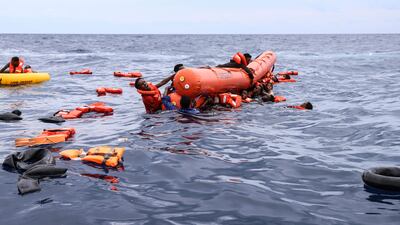
Migrants hold on to the rubber vessel and wait to be rescued. -
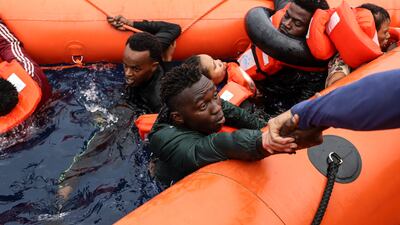
'Sea-Watch 3' is used for rescue operations in the Mediterranean. -
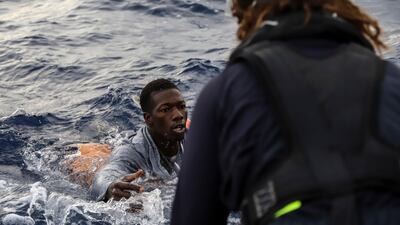
A migrant is rescued from the water. -
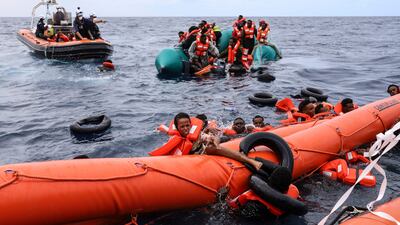
Migrants hold onto a centifloat. -

Migrants wait to board the rescue boat. -

Help is on the way: the migrants spot the 'Sea Watch-3' rescue boat. -

Migrants scramble to get to safety. -
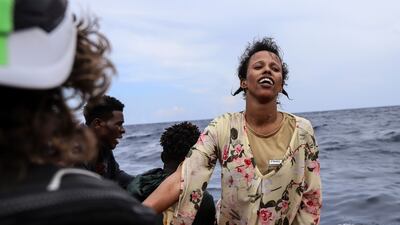
A woman smiles with relief as she sees the rescue team approaching. -
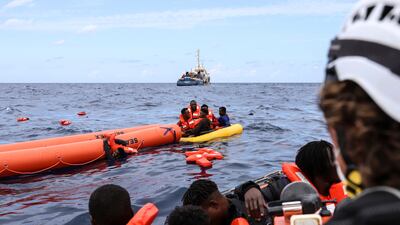
The 'Sea Watch-3' approaches the migrants. -
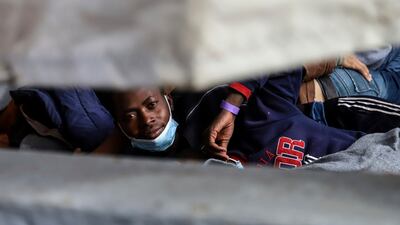
A migrant rests with others on the deck of the 'Sea Watch-3'. -
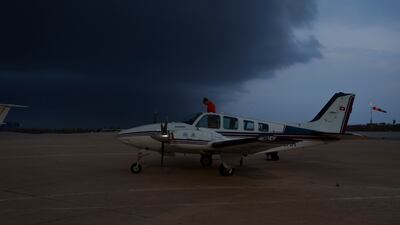
Eike Bretschneider disembarks the 'Seabird' after flying over the Mediterranean Sea, north of Libya. The aircraft documents any breach of human rights against migrants at sea and relays distress cases to nearby ships and authorities. -
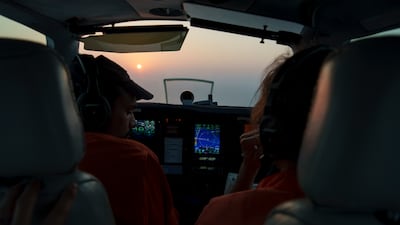
French volunteer pilot Augustin Clot, left, and tactical co-ordinator Jakob Fruehmann of Austria sit in the cockpit of 'Seabird', owned and operated by the German NGO Sea-Watch. -

Migrants who were intercepted crossing the Mediterranean by boat line up behind a fence in Lampedusa, Italy, as they wait to board a ferry to Sicily. -
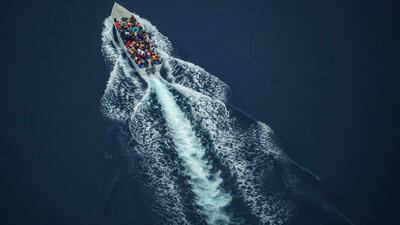
Migrants are crammed in an overcrowded wooden boat, as seen from ‘Seabird’. Despite the risks, many migrants say they would rather die trying to reach Europe than return to Libya. -
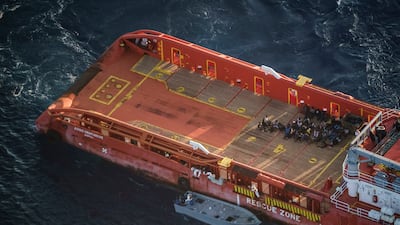
Migrants sit on the deck of the Italian supply vessel ‘Asso Ventinove’ after they were rescued from an unseaworthy boat drifting in the Mediterranean near the Bouri oilfields, north of Libya. -

German volunteers Leona Blankenstein, left, and David Lohmueller aboard 'Seabird', looking for migrant boats in distress. -
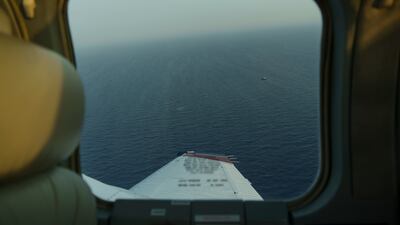
A small migrant boat and a Libyan merchant vessel are visible through the window of the humanitarian aircraft, above the Mediterranean Sea between Libya and Italy.


About 200,000 people were stopped in 2021 by coastal and border guards in European waters, according to the latest statistics of the European Border and Guard Agency.
Libya was the most popular departure point for illegal crossings into southern Europe through the Central Mediterranean route.
People migrating illegally or seeking refuge have seized on the relaxing of Covid-19 restrictions in many countries.
Syrians remained the most frequently reported nationality of the people detected when crossing European borders without permission, followed by Tunisians, Moroccans, Algerians and Afghans.

