


The United States must end its policy of "maximum pressure" on Iran and effectively lift the resulting economic sanctions if it wants to revive the nuclear deal signed in 2015, says Iran’s Foreign Minister Hossein Amirabdollahian.
Speaking at the World Economic Forum in Davos, the Iranian politician said the Biden administration’s approach to Iran was "no different" from the one pursued by former US president Donald Trump. His government left the Joint Comprehensive Plan of Action pact in 2018 and imposed sanctions on Iran's oil, metals and textile industries, as well as on senior officials and military commanders.
“The Trump maximum pressure policy must be removed,” Mr Amirabdollahian said. "We can’t return to the deal if the elements of the Trump maximum pressure policy are still there.
“We are for a strong, lasting and good deal and we are committed to it. But there must be a realistic approach to finalise it.
"The US side has to make the decision and the ball is in their court," he said.
"We are committed to a peaceful nuclear programme.”
Economic sanctions are the main tool used by the United States to pressure Iran into curbing its nuclear programme.
The US suspects Tehran is secretly developing a military nuclear programme, but Iranian officials, including the incumbent foreign minister, deny this.
The 2015 deal lifted most of the US and international sanctions on Iran in exchange for limits on its nuclear activities. But Mr Trump withdrew the US from the deal in 2018 and imposed more sanctions.
“We had this big achievement in 2015. What did the Americans do? They imposed sanctions and froze our assets. They aren’t paying us anything if they lift sanctions. This’s not from their own pockets,” Mr Amirabdollahian said, speaking in Farsi with simultaneous English interpretation, at one of the live sessions on the final day of the forum.
In response to the US withdrawal from the deal, Iran has since then breached the deal's major restriction, which is enriching uranium closer to a higher purity needed to make nuclear weapons, according to the International Atomic Energy Agency (IAEA).
Last week, UN special rapporteur on unilateral coercive measures Alena Douhan said sweeping US sanctions imposed on Tehran have badly affected Iran’s economy and worsened the humanitarian situation in the country.
But Iranian opposition and human rights activists also blame poor governance and the use of the country's limited resources to support proxies in the region for deteriorating living conditions.
In the absence of official accounting, it is not clear exactly how much financial support Iran has given to the Syrian regime, the Houthis in Yemen, Hezbollah in Lebanon and militias in Iraq.
In recent weeks, public anger over worsening economic conditions has mounted in Iran following price hikes of food staples under a new policy to amend the food subsidy system. Scattered protests have erupted in several provinces, with Iranian state media reporting nearly two dozen arrests.
-
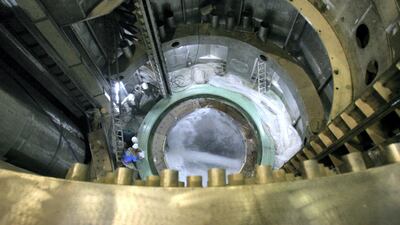
Russian contractors work at the Bushehr nuclear reactor site in 2007. The plant opened four years later. Bloomberg -
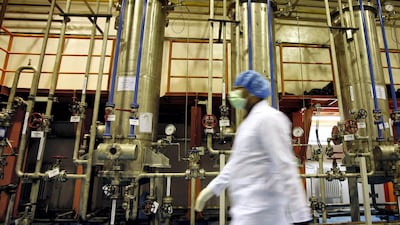
An Iranian technician at the International Atomic Energy Agency inspects the country's Isfahan plant in 2007. Tehran is no longer co-operating with the agency at nuclear sites across the country. EPA -

Workers wait to begin constructing a second reactor at the Bushehr nuclear power plant in 2019. AFP -
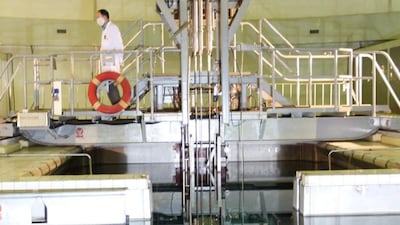
A metal-encased rod with 20 per cent enriched nuclear fuel is inserted into a reactor in Tehran in 2012. AFP -
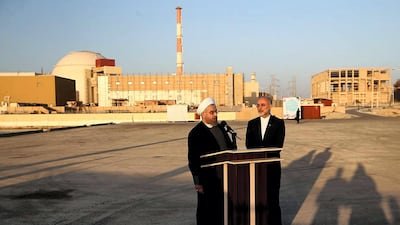
Fomer Iranian President Hassan Rouhani and the country's Atomic Energy Organisation chief Ali Akbar Salehi speak at the Bushehr nuclear site in 2015. AFP -
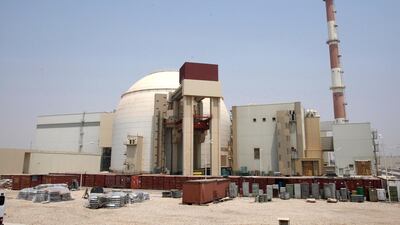
Iran's Bushehr nuclear plant has been restarted. EPA -
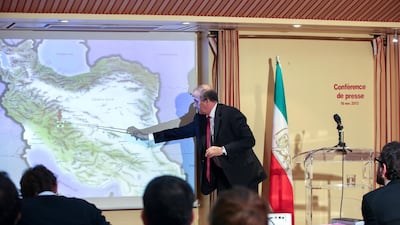
Mehdi Abrichamtchi, chairman of the Peace and Security Committee at the National Council of Resistance of Iran, shows journalists the location of a secret nuclear site in Iran in 2013. AFP -
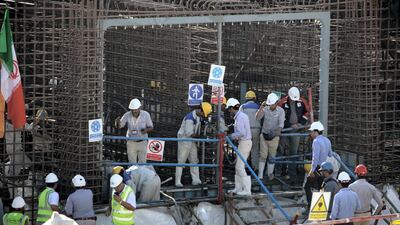
Workers prepare to begin the construction of a second reactor at the Bushehr site. AFP


Revolutionary Guard not the main sticking point
Talks between the Americans, Europeans and Iran to revive the nuclear deal began in Vienna last year but have stalled in recent weeks.
Mr Amirabdollahian said the US is “wrong” if it viewed the controversial issue of removing Iran's Revolutionary Guard from its terrorist list as the main obstacle to reviving the nuclear deal.
“The Americans know very well and Mr Biden knows very well that the economic sanctions are the most important thing. The Israelis have amplified the issue of the Revolutionary Guards and portrayed falsely to the media that it’s the main obstacle to reaching a deal,” he said.
American officials said previously that Iran demanded the designation be removed as a condition for restoring the deal, but the United States refused.
On Sunday, a senior Revolutionary Guards officer, Colonel Sayad Khodaei, was assassinated outside his home in Tehran when two gunmen on motorcycles shot him in his car.
Iran accused Israel for the assassination as it did before in a series of targeted killings of Iranian scientists. Israel has not acknowledged any of the attacks.
Mr Amirabdollahian also dismissed as a “fabricated Israeli story” American press reports that Iran obtained secret records at the IAEA -- which is the United Nations nuclear watchdog -- and used them to prepare cover stories to conceal suspected work on nuclear weapons.
The reports claimed that the Israeli intelligence service Mossad managed to get the alleged records from an official archive in Tehran in recent years.
A spokesperson for the Israeli government was not immediately available to comment on the Iranian foreign minister’s accusations or the American reports about the alleged secret IAEA records.

