


Spain will re-open land borders between the northern enclaves of Ceuta and Melilla and Morocco next week after more than two years of closure.
The borders were closed due to Covid-19 restrictions and tensions between Spain and Morocco.
The reopening will start gradually from May 17, Spanish Interior Minister Fernando Grande-Marlaska told reporters on Thursday.
Crossings will be initially limited to residents of Europe's passport-free Schengen area and their family members. They will be expanded to cross-border workers by the end of the month.
The Spanish enclaves of Ceuta and Melilla sit on the northern shores of Morocco's Mediterranean coast. Together they form the EU's only land borders with Africa.
Thursday's announcement came as Madrid and Rabat are working to mend relations after a months-long spat, mainly over migrants coming from Morocco.
The two cities have long been a flashpoint in the diplomatic relations between both countries.
Madrid asserts that both territories are integral parts of Spain. The two cities were granted self-government and regarded autonomous in 1995.
Tensions soared in the summer of last year after thousands of migrants crossed into Ceuta from Morocco through land borders and the city’s main maritime entry point in the south. Spain then deployed troops to restore order and sent back a large number of migrants to Morocco.
The European country says it will deal firmly with illegal crossings and crack down on people smuggling gangs.
-
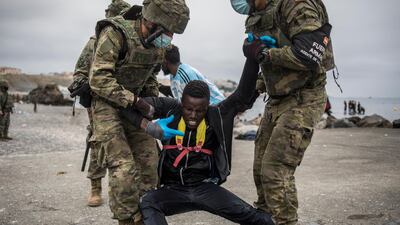
A man is held by soldiers of the Spanish Army at the border of Morocco and Spain at the Spanish enclave of Ceuta. A record 6,000 migrants entered Ceuta illegally on Monday, 1,500 of whom were minors. AP Photo -
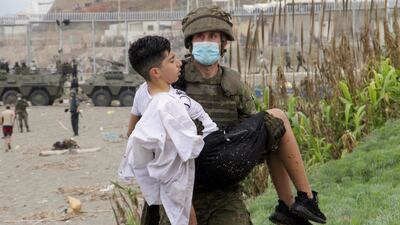
A Spanish soldier helps a migrant as troops are deployed along the coast in Ceuta. EPA -
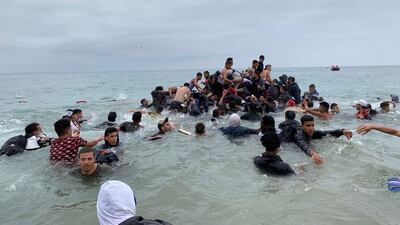
Migrants manage to grab onto a boat of the Moroccan authorities near the coast of Fnideq in an attempt to cross over to Ceuta. EPA -
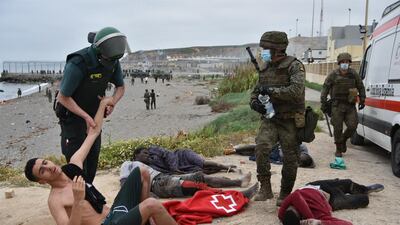
A Spanish Civil Guard holds onto a migrant who swam onto the Spanish enclave of Ceuta. AFP -
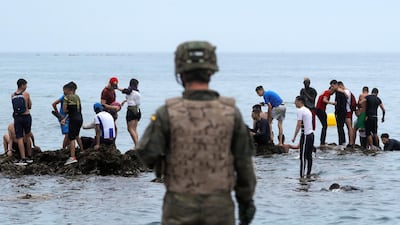
A Spanish soldier stands in front of Moroccan migrants. Reuters -

Red Cross members and Spanish soldiers carry a migrant into an ambulance. AFP -
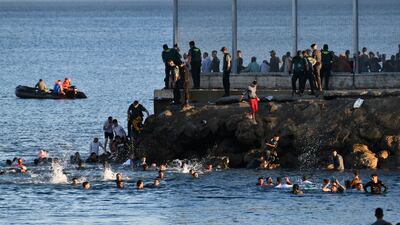
Spanish officers try to stop people swimming into Spanish territory at Ceuta. AP Photo -
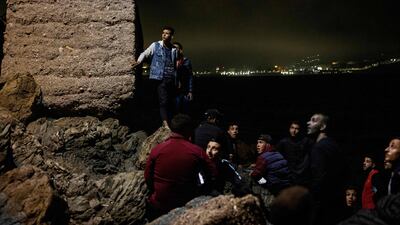
Moroccan migrants climb up a rocky cliffside in the northern town of Fnideq as they attempt to cross the border from Morocco to Ceuta. AFP -
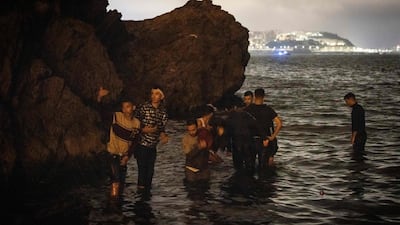
Moroccan migrants walk into shallow waters in the northern town of Fnideq. AFP -
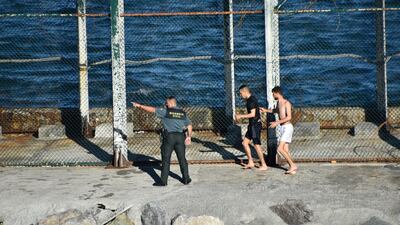
Two migrants are met by a Spanish civil guard in Ceuta. Reuters -
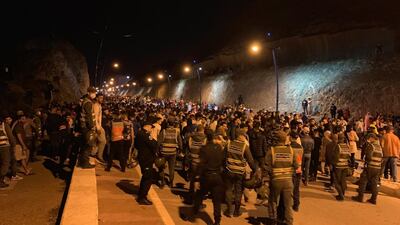
Hundreds of young Moroccans wait to cross the border with Spain. EPA -

About 3,000 Moroccan citizens illegally entered Spain's north African enclave of Ceuta. AFP -
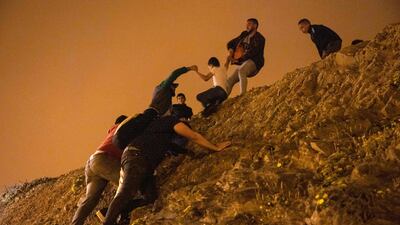
Spain says it will return anyone from the country who illegally enters its north African enclave by water. AFP


Before the pandemic, Ceuta and Melilla used to attract traders and workers as local economics depend on the cross-border movement of goods. Most of the migrants are said to be from Morocco.
In 2021, nearly 20,000 people illegally crossed into Europe on small boats, an increase by 60 per cent compared to 2020, according to the latest statistics from the European Commission.
Spain’s decision to open the borders of Ceuta and Melilla with Morocco also comes after signs of a thaw in relations over Western Sarah, a former Spanish colony claimed by Morocco in 1976.
On March 18, the Spanish government announced publicly and for the first time its support to a 2007 initiative taken by Morocco to grant the disputed Western Sarah autonomy.
It described the Moroccan plan as the “serious and credible” effort taken so far to resolve the dispute.
That decision was a reversal of Spain’s longstanding position of neutrality on the region, a sparsely populated desert area situated on the northwest coast of Africa.

Morocco’s King Mohammed VI decided then to send back the Moroccan ambassador to Spain 10 months after she was recalled and hosting Spanish Prime Minister Pedro Sanchez in an April visit to Rabat.
Morocco administers around 80 per cent of the 266,000 square kilometres of the sparsely populated desert region with the remainder held by the Algerian supported the self-declared Sahrawi Arab Republic founded by the Polisario Front.
The Polisario waged a guerrilla war against Moroccan troops until a UN-brokered ceasefire in 1991.
Rabat is offering to grant Western Sahara autonomy, while Polisario is demanding a referendum on full independence.
The breakaway state is not recognised by the UN and Morocco’s claim to the region is supported by a number of Arab and African states.

