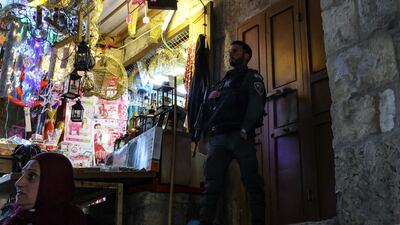
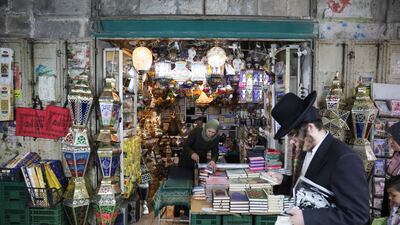
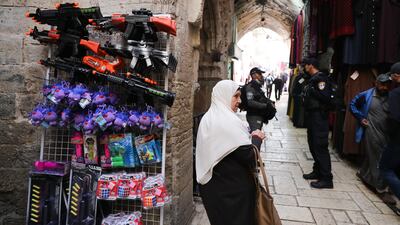
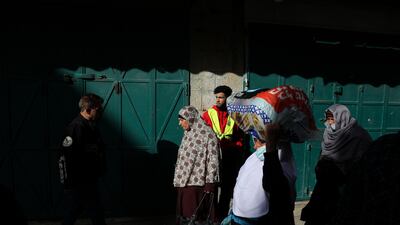
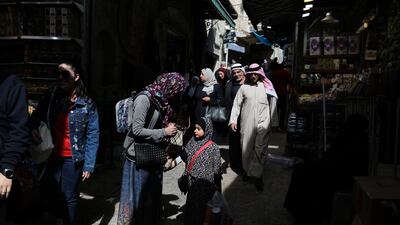
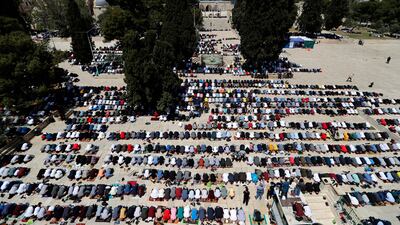
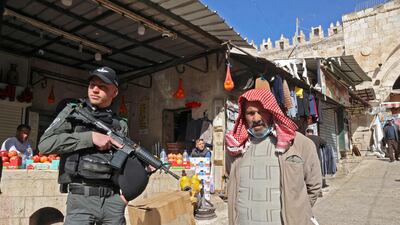
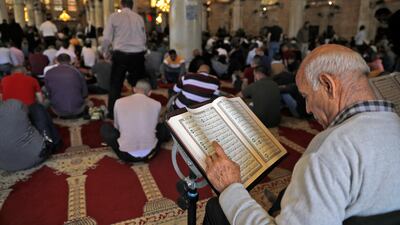
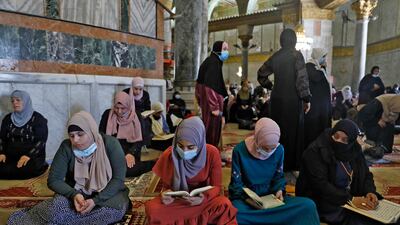
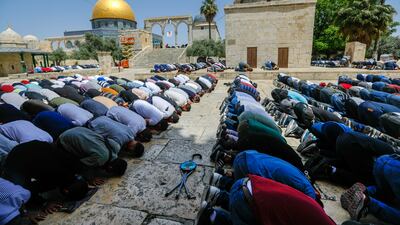
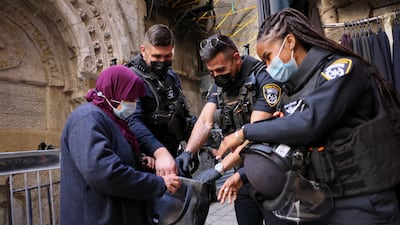
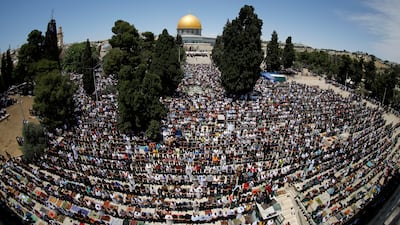
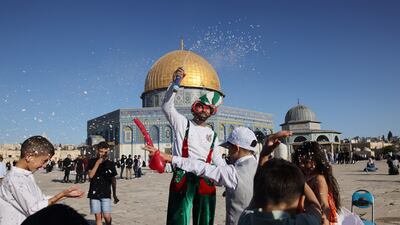
Israel will allow women, children and men aged over 50 from the West Bank to pray at the Al Aqsa Mosque on Friday, in an apparent bid to help calm tension during Ramadan.
The government said that it could further relax restrictions if things remained calm.
The use of incentives around the flashpoint mosque, which is in a hilltop compound, comes about a year after flare-ups led to the 11-day Israel-Gaza war in May.
This year, the government has been on high alert after three attacks by Palestinians in Israel in recent weeks, some claimed by ISIS, killed 11 Israelis.
The attacks raised questions about whether the new rules would be cancelled, but Israel’s coalition government has sought to avoid a repeat of last year’s violence with incentives.
“Along with the civilian steps we are taking starting this week toward Ramadan, which we will expand if there is security stability,” Israeli Defence Minister Benny Gantz said.
"We will continue to do whatever it takes to give people a normal life and to protect Israeli citizens from terrorism."
Under the new rules, Palestinian women from the occupied West Bank will be allowed to enter Israel without a permit for Friday prayers at Al Aqsa Mosque.
Palestinian men and boys older than 50 and younger than 12 will be allowed to enter for prayers without a permit. And men between the ages of 40 and 49 with a permit will also be allowed in.
Thousands of Palestinians with close relatives in Israel will also be given permits to visit them between Sunday and Thursday, the government's Palestinian liaison office said.
The rules will apply for the next week and security officials will meet again to consider expanding them further.
Israel announced the rules a few hours after police arrested eight Palestinians accused of throwing rocks and other objects at officers outside the Damascus Gate to Jerusalem’s Old City.
There have been other scuffles near by.
Last year, clashes between police and protesters in and around the Old City helped to spark the Gaza war.
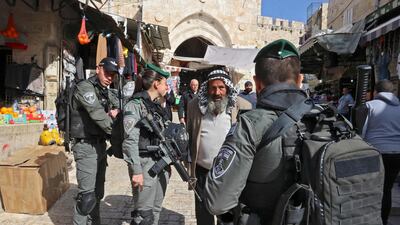
Israeli police are on high alert after the three deadly attacks by Palestinians in Israel in recent weeks.
An Israeli raid on a refugee camp in the occupied West Bank last week in search of a gunman’s suspected accomplices set off a gun battle in which two Palestinians were killed and 15 were wounded.
On Saturday, Israeli police said its officers killed three Palestinian militants who were involved in recent attacks on Israeli forces and were planning another.
Also last week, the government announced $56 million in emergency funding for more police officers and equipment.
Israel captured East Jerusalem, along with its holy sites to the three Abrahamic faiths, in the 1967 Arab-Israeli war and later annexed it in a move unrecognised by most of the international community.
The Palestinians seek East Jerusalem as the capital of a future state that would include the West Bank and Gaza Strip.
Israel considers the entire city its united capital.

Mercer, the investment consulting arm of US services company Marsh & McLennan, expects its wealth division to at least double its assets under management (AUM) in the Middle East as wealth in the region continues to grow despite economic headwinds, a company official said.
Mercer Wealth, which globally has $160 billion in AUM, plans to boost its AUM in the region to $2-$3bn in the next 2-3 years from the present $1bn, said Yasir AbuShaban, a Dubai-based principal with Mercer Wealth.
“Within the next two to three years, we are looking at reaching $2 to $3 billion as a conservative estimate and we do see an opportunity to do so,” said Mr AbuShaban.
Mercer does not directly make investments, but allocates clients’ money they have discretion to, to professional asset managers. They also provide advice to clients.
“We have buying power. We can negotiate on their (client’s) behalf with asset managers to provide them lower fees than they otherwise would have to get on their own,” he added.
Mercer Wealth’s clients include sovereign wealth funds, family offices, and insurance companies among others.
From its office in Dubai, Mercer also looks after Africa, India and Turkey, where they also see opportunity for growth.
Wealth creation in Middle East and Africa (MEA) grew 8.5 per cent to $8.1 trillion last year from $7.5tn in 2015, higher than last year’s global average of 6 per cent and the second-highest growth in a region after Asia-Pacific which grew 9.9 per cent, according to consultancy Boston Consulting Group (BCG). In the region, where wealth grew just 1.9 per cent in 2015 compared with 2014, a pickup in oil prices has helped in wealth generation.
BCG is forecasting MEA wealth will rise to $12tn by 2021, growing at an annual average of 8 per cent.
Drivers of wealth generation in the region will be split evenly between new wealth creation and growth of performance of existing assets, according to BCG.
Another general trend in the region is clients’ looking for a comprehensive approach to investing, according to Mr AbuShaban.
“Institutional investors or some of the families are seeing a slowdown in the available capital they have to invest and in that sense they are looking at optimizing the way they manage their portfolios and making sure they are not investing haphazardly and different parts of their investment are working together,” said Mr AbuShaban.
Some clients also have a higher appetite for risk, given the low interest-rate environment that does not provide enough yield for some institutional investors. These clients are keen to invest in illiquid assets, such as private equity and infrastructure.
“What we have seen is a desire for higher returns in what has been a low-return environment specifically in various fixed income or bonds,” he said.
“In this environment, we have seen a de facto increase in the risk that clients are taking in things like illiquid investments, private equity investments, infrastructure and private debt, those kind of investments were higher illiquidity results in incrementally higher returns.”
The Abu Dhabi Investment Authority, one of the largest sovereign wealth funds, said in its 2016 report that has gradually increased its exposure in direct private equity and private credit transactions, mainly in Asian markets and especially in China and India. The authority’s private equity department focused on structured equities owing to “their defensive characteristics.”
MOUNTAINHEAD REVIEW
Starring: Ramy Youssef, Steve Carell, Jason Schwartzman
Director: Jesse Armstrong
Rating: 3.5/5
Stamp duty timeline
December 2014: Former UK finance minister George Osbourne reforms stamp duty, replacing the slab system with a blended rate scheme, with the top rate increasing to 12 per cent from 10 per cent:
Up to £125,000 - 0%; £125,000 to £250,000 – 2%; £250,000 to £925,000 – 5%; £925,000 to £1.5m: 10%; Over £1.5m – 12%
April 2016: New 3% surcharge applied to any buy-to-let properties or additional homes purchased.
July 2020: Rishi Sunak unveils SDLT holiday, with no tax to pay on the first £500,000, with buyers saving up to £15,000.
March 2021: Mr Sunak decides the fate of SDLT holiday at his March 3 budget, with expectations he will extend the perk unti June.
April 2021: 2% SDLT surcharge added to property transactions made by overseas buyers.
Polarised public
31% in UK say BBC is biased to left-wing views
19% in UK say BBC is biased to right-wing views
19% in UK say BBC is not biased at all
Source: YouGov
Western Region Asia Cup T20 Qualifier
Sun Feb 23 – Thu Feb 27, Al Amerat, Oman
The two finalists advance to the Asia qualifier in Malaysia in August
Group A
Bahrain, Maldives, Oman, Qatar
Group B
UAE, Iran, Kuwait, Saudi Arabia
Iftar programme at the Sheikh Mohammed Centre for Cultural Understanding
Established in 1998, the Sheikh Mohammed Centre for Cultural Understanding was created with a vision to teach residents about the traditions and customs of the UAE. Its motto is ‘open doors, open minds’. All year-round, visitors can sign up for a traditional Emirati breakfast, lunch or dinner meal, as well as a range of walking tours, including ones to sites such as the Jumeirah Mosque or Al Fahidi Historical Neighbourhood.
Every year during Ramadan, an iftar programme is rolled out. This allows guests to break their fast with the centre’s presenters, visit a nearby mosque and observe their guides while they pray. These events last for about two hours and are open to the public, or can be booked for a private event.
Until the end of Ramadan, the iftar events take place from 7pm until 9pm, from Saturday to Thursday. Advanced booking is required.
For more details, email openminds@cultures.ae or visit www.cultures.ae
THE%20SPECS
%3Cp%3EBattery%3A%2060kW%20lithium-ion%20phosphate%3Cbr%3EPower%3A%20Up%20to%20201bhp%3Cbr%3E0%20to%20100kph%3A%207.3%20seconds%3Cbr%3ERange%3A%20418km%3Cbr%3EPrice%3A%20From%20Dh149%2C900%3Cbr%3EAvailable%3A%20Now%3C%2Fp%3E%0A
Retail gloom
Online grocer Ocado revealed retail sales fell 5.7 per cen in its first quarter as customers switched back to pre-pandemic shopping patterns.
It was a tough comparison from a year earlier, when the UK was in lockdown, but on a two-year basis its retail division, a joint venture with Marks&Spencer, rose 31.7 per cent over the quarter.
The group added that a 15 per cent drop in customer basket size offset an 11.6. per cent rise in the number of customer transactions.
Company Profile
Name: Thndr
Started: 2019
Co-founders: Ahmad Hammouda and Seif Amr
Sector: FinTech
Headquarters: Egypt
UAE base: Hub71, Abu Dhabi
Current number of staff: More than 150
Funds raised: $22 million