

The war in Ukraine, one of the world's major wheat producing regions, has led to a massive rise in wheat prices, leaving Iraq facing a multibillion-dollar food import bill.
At a time when the Iraqi government is beset by political deadlock, the additional cost underlines the country's fragile food system, with millions of its poorest people depending on government food handouts, including wheat for flour.
Experts warn the whole system could soon collapse given uncertain oil markets and Iraq's rising population.
-
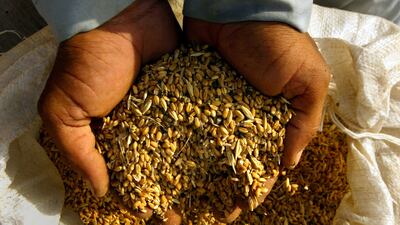
A farmer examines wheat in a sack. Getty Images -
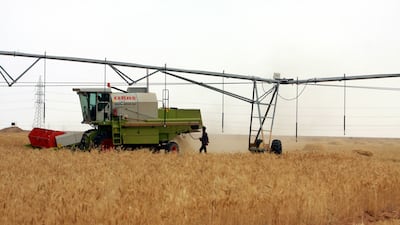
Farmers harvest wheat in a field at Karbala city, southern Iraq. EPA -

Villagers scatter wheat seeds on a field during planting season in Fallujah, west of Baghdad. Reuters -

An Iraqi Kurdish harvests wheat in the Qandil Mountains, in the northern part of the country. AFP -

Villagers harvest wheat in a field in Albu Efan, south-west of Fallujah. Reuters -
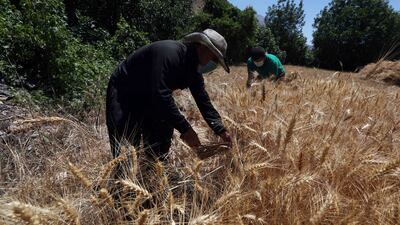
Working on a field in the Qandil Mountains. AFP -

Wheat grain is collected at a silo in Mosul, Iraq. Reuters


Ukraine and Russia make up about 20 per cent of global wheat production and the current situation has created fierce international competition to secure supply from the Black Sea region.
For some countries, particularly in the Middle East, it could drive millions of people into food poverty. In Iraq, which has one of the largest government-run food programmes in the world, it could add up to $3bn to its bill this year, highlighting the dangerous vulnerability of the country's food supply.
"Food prices have started rising again since May/June 2020. Part of it was spurred by drought or issues in China," said Ahmed Tabaqchali, an Iraqi economist and non-resident senior fellow at the Atlantic Council.
In January, Iraq bought 150,000 tonnes of Australian wheat for around $450 a tonne, a fraction of the 2 million tonnes it will likely purchase in 2022.
Australian wheat is in high demand. The country is a major exporter and its wheat prices have risen as importers anxiously keep an eye on Russia's invasion of Ukraine.
Iraq often increases imports when harvests are bad – the Norwegian Refugee Council said 37 per cent of Iraqi wheat farmers experienced crop failure through 2021 as drought returned to the country after a bumper harvest in 2019-20.
This is a problem for Iraq, where the government buys wheat locally and on international markets to distribute to private flour millers, an almost entirely government-led system.
The price Iraq paid for the Australian wheat is about $70 more per tonne than the government pays local producers.
The cost will soon mount for a government many say needs to spend more on schools, water, electricity and infrastructure.
“While in 2020-21, Iraq’s cereal imports, including flour, was around $0.9bn, the imports for 2021-22 are projected to almost triple to reach $3bn given the failed barley harvest, reduced wheat harvest and the increase of global cereal prices by almost double,” said Hadi Fathallah, director with the NAMEA Group, a public advisory company in Dubai, who has advised multilateral financial institutions on agriculture and food policy in Iraq.
To understand the trade-off Iraq is making between its social safety net and other sectors, $3bn is more than 22 times the 2021 draft budget allocation the country will spend on schools and teaching materials, says Utica Risk, a consultancy that specialises in Iraq’s political economy.
Corruption in the food market
The flour the Iraqi government buys from private millers is redistributed to the people as part of one of the world's largest government food programmes, the Public Distribution System, which dishes out cooking oil, sugar, lentils and flour.
The PDS follows a decades-old model where Iraq’s agriculture system is dominated by state-owned enterprises that buy agricultural produce from Iraqi farmers, often at inflated cost, and also purchase imports. They even provide cheap, or free, items such as fertiliser.
The system is riddled with corruption. A report by the UN Food and Agriculture Organisation says that when wheat prices are lower in neighbouring countries than the government-set price, traders smuggle wheat into Iraq to sell at the official higher price.
Corruption allegations came to a head in 2009 when PDS imports were found to have been rigged with fake prices, allowing for government kickbacks and leading to the arrest of former trade minister Abdul Falah Al Sudani.
More allegations afflicted the PDS system in 2020, with owners of government-run silos accused of accepting bribes from farmers for favourable wheat-purchasing terms.
Oil for food
The system is prone to global market shocks. If oil revenue crashes, as it did in 2014, from $100 (the equivalent price today) to $23, the state cannot buy the produce, often leaving farmers to take to the streets in protest, while poor Iraqis are exposed to food poverty.
During the last oil price crash, Iraq was spending billions fighting ISIS and, the World Food Programme says, had to cut back PDS to vulnerable families as the government “focused all available resources on paying the public sector wage bill".
It is a scenario that could be repeated as Iraq’s population is expected to surge from today's 41 million to about 50 million in 2030, gradually eating into the government budget for salaries and services.
Reforming Iraq’s food system
The PDS was established by the UN to stave off mass hunger during a period of harsh international sanctions against the Saddam Hussein regime in the 1990s.
Critics say that because Iraq is radically different today, the system is no longer fit for purpose.
Crucially, they say it discourages free market-led production, which could be more efficient and pose fewer risks of corruption and waste, which is often a feature of large Iraqi government programmes.
“There are no incentives for farmers to begin to produce commercially, as they don’t respond to fixed price markets, and if you don't respond commercially then your operation is not sustainable without government subsidies,” Mr Tabaqchali said, highlighting fears that the entire system could fail.
The UN has noted that, despite being aimed at the most vulnerable, a lot of PDS goods goes to families who can easily afford food, while its clumsy and inefficient management opens the door for corruption.
Climate change risk
Iraq’s growing dilemma is that if imports become prohibitively expensive, as the population grows and oil prices fall, government-run wheat distribution is also at risk from climate change and water use by neighbouring countries where dam construction is under way, including in Turkey and Iran.
In 2018, levels in the River Tigris dropped precipitously after Turkish dam construction and Iraq sharply cut wheat production, albeit temporarily.
“Given the failed wheat and barley crops in northern Iraq in the marketing year of 2020-21 and lower rice productivity, and given the decreased water available for irrigation in the south in 2021, Iraq will have to import higher amounts of grain in 2022 to cover its needs, at a time when grain prices are at a record high,” said Mr Fathallah.
Critics of Iraq's state-run food distribution system have repeatedly call for a complete overhaul of the PDS, even replacing it with a cash transfer system for poor families, something that has been trialled in Sadr City, Baghdad.
“PDS is dysfunctional, mainly because of corruption. Not much from PDS itself goes back to farmers. There is a separate programme, the Wheat and Barley Purchase programme, which actually subsidises the two value chains through higher-than-market government procurement price. This is also stalling,” said Mr Fathallah, underlining Iraq’s complex web of state involvement in food.
Nonetheless, Mr Fathallah said one positive – at least in the short term – is that high oil prices can prop up Iraq’s inefficient food system.
“The surplus government revenue from oil in 2021 has boosted foreign currency reserves to $55bn, up from $48bn in 2020, which helped Iraq cover six months worth of agrifood imports based on 2019 imports," he said.
But Mr Fathallah said this situation cannot be sustained without major reform, a concept with which the Iraqi government struggles, especially when it is mired in months of political deadlock after October’s elections.
“Given the increase in global food prices in 2021, Iraq’s agrifood import costs are projected to have increased by at least 28 per cent in 2021, to reach around $12bn, close to its peak in 2014,” he said.
“We need a policy where we address the government subsidy programme and remove the government’s hand because it has been a failure,” said Mr Tabaqchali, who insisted Iraqi politicians had counted on high rainfall rather than pushing reforms.
“We can protect farmers through charges and tariffs on imports, but our country has to be competitive for its own sake and it can never be competitive if the government controls input and output prices."

