


As countries made ambitious pledges to decarbonise their economies at November’s Cop26 climate summit in Glasgow, Iraq stayed silent.
The country faces a major problem. Oil is the lifeblood of its economy, not only for revenue but also as fuel for power stations to address a chronic shortage of electricity.
Oil exports make up the bulk of Iraq’s national budget, more than 90 per cent of annual revenue, most of which is spent on public sector wages. This leaves little to spend on green energy.
Iraq is now vulnerable to being left behind: 35 countries pledged to transition entirely to electric vehicles at Cop26, revisiting the 2015 Paris Agreement that Iraq ratified in January.

Its most recent national environment strategy calls for a reduction of emissions of only 2 per cent by 2030.
Meanwhile, its electricity problems call for urgent solutions. Frequent power cuts have prompted a national protest movement, which was met with force leaving hundreds dead.
Iraq's population is also expected to double to 80 million by 2050, the year set as a target by dozens of countries to drastically cut gas emissions, part of the Paris agreement.
This rapidly growing population depends on oil revenue for everything from food imports to public sector wages.
Time to prioritise
For former energy minister Luay Al Khateeb, Iraq must its priorities right, even if that means setting aside Cop26 targets of cutting emissions to net zero by 2050.
“We shouldn’t neglect current and future challenges, such as the severe shortage of electricity and shrinking water supply, just to achieve a target that doesn’t fit our priorities. So, if we are talking about existential threats facing humanity, we should also talk about the existential threats facing Iraq based on its national security,” Mr Al Khateeb, a distinguished fellow at the Centre on Global Energy Policy at Columbia University in New York, told The National.
Successive governments have struggled to resolve the power crisis, in part because the Iraqi government has failed to set aside enough investment to upgrade the national grid or incentivise private investment in the sector.
Repeated oil price crashes since 2014 have seriously depleted Iraq’s investment capital for renewable projects.
Investing in renewables
Exactly how Iraq can achieve zero emissions remains an open question.
Impressive as they sound on paper, the country’s green projects, including solar energy programmes, planting millions of palm trees and introducing more efficient technology to generate power, are far from enough.
Transitioning to solar energy has been a slow process, in part because foreign companies have been nervous about large energy projects in Iraq.
Many solar projects have not yet left the planning stage. Others are still nascent.
But a project with Masdar – which has headquarters in the UAE – to install about 1 gigawatt of solar power would be an important step forward and could inspire confidence to launch similar schemes.
Currently, about 76 per cent of Iraq’s electricity supply comes from oil burning, while gas provides the bulk of the remainder. Solar and wind account for about one per cent.
Natural gas is also plentiful, a byproduct of oil extraction, but capturing and processing it is expensive, even if it makes sense economically in the long term.
Instead of capturing the gas, many oil companies choose to burn it off, a highly polluting and wasteful practice called flaring.
Mr Al Khateeb says that the continuing waste of a precious resource like natural gas could light up to four million homes.
“I know that the current government is committed to reducing to zero flaring by 2025. But we've seen similar targets being missed. In 2010, the then government pledged to cut down flaring to zero by 2015. We missed that. Today, they have added five more years to hopefully meet the target by 2030,” he said.
A question of economics
Despite Iraq’s attachment to the allure of oil revenue and burning hydrocarbons for electricity, the reasons for supporting the global green transition are becoming more stark.
The UN Environment Programme classifies Iraq as the fifth most vulnerable country in the world to decreased water, food availability and extreme temperatures.
The warmer Iraq gets, the more frequent droughts become, raising soil salinity to levels that render fields useless for farming.

The country is expected to record a 2ºC increase in temperature and a 9 per cent decline in rainfall by 2050, says the Climate Change Knowledge Portal, a centre for climate-related information, data and tools for the World Bank.
Such a rise would smash Baghdad's heat record of 51.8ºC, reached on July 29.
These levels of heat would be unbearable for most people and could prove the final straw for Iraqis already exhausted from poor electricity supplies.
The Paris Agreement’s ultimate goal is to keep increases in global warming to well below 2ºC, aiming for 1.5ºC, and to nudge the nearly 200 signatories, including Iraq, to keep pace with the necessary global transformation to sustainable development.
-
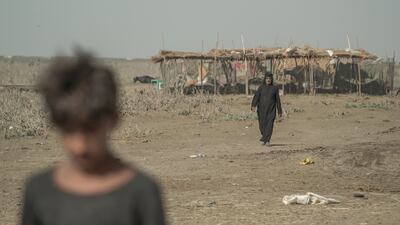
Raheem Noor Dawood and his son at home in the Chabayech Marshes in southern Iraq. Haider Husseini for The National -
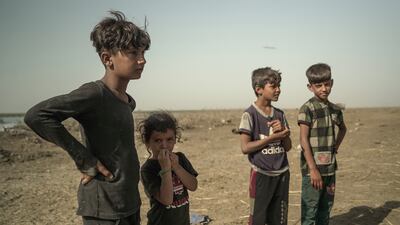
Mr Dawood's children and grandchildren stand in the oasis in the middle of the desert. Haider Husseini for The National -
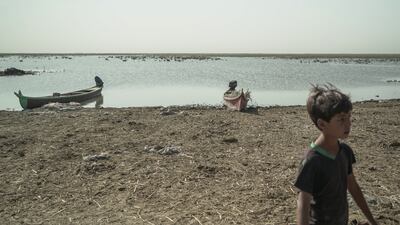
Drinking water is sourced from the centre of the marshes. Haider Husseini for The National -
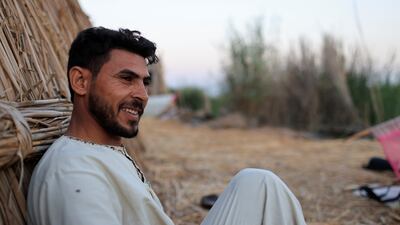
Iraq's 2020-2021 rainfall season was the second driest in 40 years, the UN says. Sabah Thamer Al Baher is struggling to feed his animals as a result. Reuters -
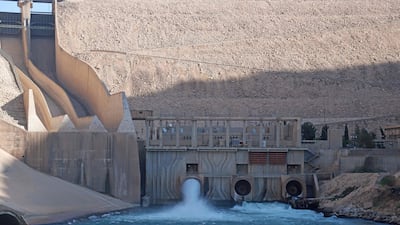
Darbandikhan Dam's water level has fallen by 7. 5 metres in only one year. AFP -
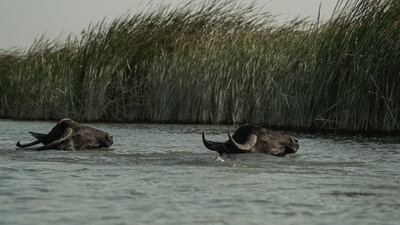
The Chabayech Marshes are a vital water source. Haider Husseini for The National -
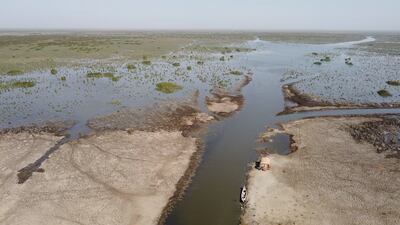
Low water levels are evident. Haider Husseini for The National -
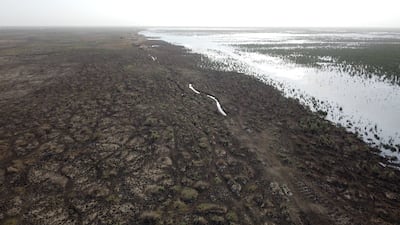
What was once a healthy water supply is shrinking fast. Haider Husseini for The National -
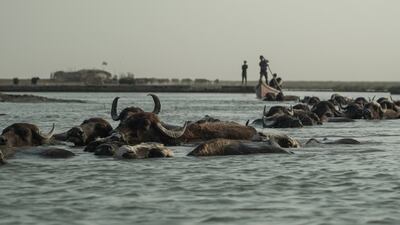
Water buffalo swim in the Chabayech Marshes. Haider Husseini for The National -
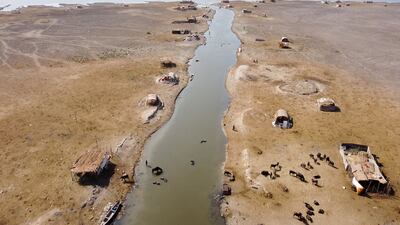
This aerial view shows the dry parts of the marshes. Haider Husseini for The National -
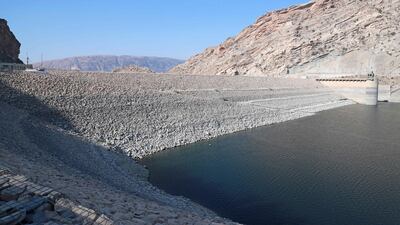
Iraqi officials have said the drastic drop in water levels is due to low rainfall and dam-building in neighbouring Iran. AFP -
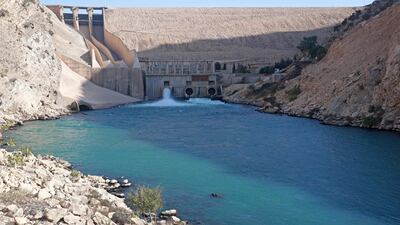
The Sirwan River begins in Iran, flowing to Darbandikhan Dam in north-eastern Iraq before going through the rural province of Diyala and joining the Tigris. AFP


Ali Al Lami has served as an environment and climate change adviser to different Iraqi governments and was among the official Iraqi delegation at Cop26.
He recalls how Iraq used to be named in Arabic Ard Asswad (the land of blackness) due to its fertile farmlands with the annual overflow of the Tigris and the Euphrates depositing thick layers of silt and clay on Iraq's vast floodplains.
“The seasonal rain has failed in recent years compared to the past decades. I’m not exaggerating when I say that we have three seasons of summer today, as winter, spring and autumn have become very short. I would say drought has become the biggest threat to Iraq and its food security today,” Mr Al Lami told The National.
To address the problem, Iraqi economist Mazin Al Eshaiker, who has managed large corporations in Iraq including Motorola and Asia Cell, suggests that the country needs to rein in the overbearing role of the state in the energy sector, with its record of bureaucracy and corruption.
Instead, the government should be more proactive in inviting local and foreign investors to develop the transition to a green economy, he said.
“The concept of having an investor is almost not there, you know, this build, operate and transfer system is hardly being used in Iraq. The government wants to fund everything and this is wrong,” Mr Al Eshaiker told The National.
“I've always advised the governments in Iraq not to invest a single dollar in the power infrastructure and solar stations to dispense with oil. They're still trying to fund these projects and I keep telling them 'no',” he said, insisting that private investors should take the strain.
For Iraq, that transition to private investment in green energy can’t come soon enough.

