



Human rights groups on Thursday said Israel had failed to investigate shootings that killed more than 200 Palestinians and wounded thousands at violent protests along the Gaza frontier in recent years.
The Israeli military rejected the findings, which rights groups said strengthened the case for the International Criminal Court to intervene. The “mass riots” organised by Gaza’s militant Hamas rulers were aimed at providing cover for cross-border attacks, while alleged abuse was investigated thoroughly, with soldiers held accountable, the military said.
Beginning in March 2018, Gaza activists organised weekly protests that were aimed initially at highlighting the plight of Palestinian refugees from what is now Israel, who make up about 75 per cent of Gaza’s population of more than 2 million.
-
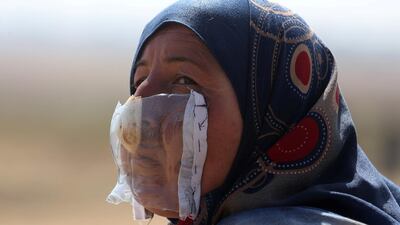
A Palestinian woman wears a mask containing an onion to protect herself from Israeli tear gas during protests on the Israel-Gaza border in 2018. Reuters -
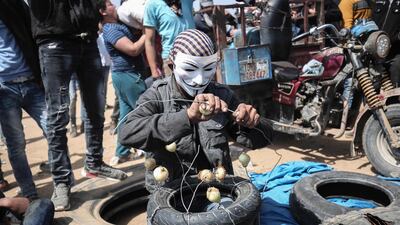
A Palestinian man wearing an Anonymous mask prepares to protest with onions to minimise the effects of tear gas fired by Israeli forces in 2018, a week after similar demonstrations led to violence in which Israeli forces killed 19 Palestinians. AFP -
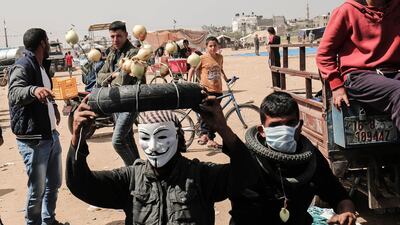
Palestinians prepare for a 2018 protest near Khan Yunis. AFP -
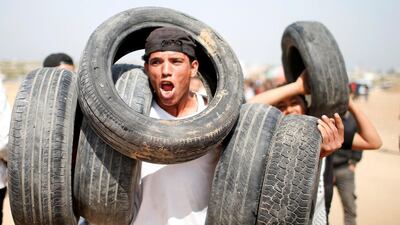
A Palestinian youth carries tyres that protesters were setting on fire on the Israel-Gaza border. Reuters -
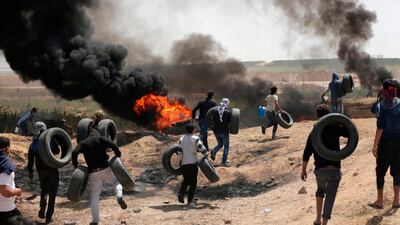
Palestinian men burn tyres on the Israel-Gaza border in 2018 during the second consecutive Friday of mass protests. AFP -
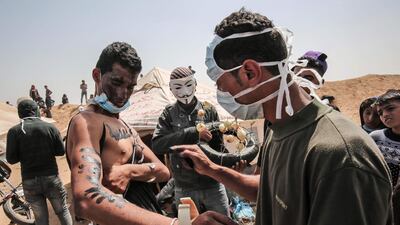
A Palestinian man prepares to join protests on the Israel-Gaza border near Khan Yunis. AFP -
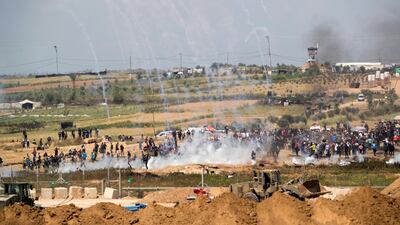
Tear gas canisters fired by Israeli forces fall on a 2018 Palestinian protest march. EPA -
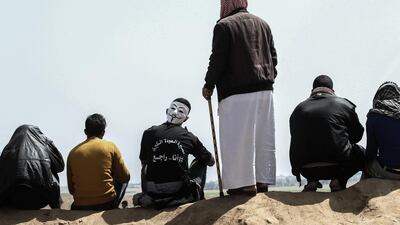
Palestinian men wait for the start of protests near Khan Yunis. AFP -
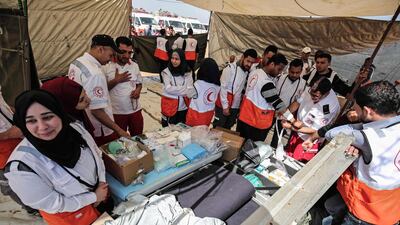
Paramedics set up before Palestinian demonstrations on the Israel-Gaza border in 2018. AFP -
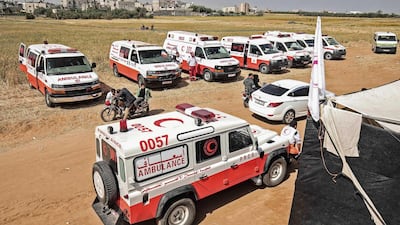
Palestinian emergency vehicles parked near the Israel-Gaza border before the protest. AFP


But Hamas, the militant group that rules Gaza, used the protests to push for the easing of the Israeli-Egyptian blockade imposed on the territory when it seized power from rival Palestinian forces in 2007.
Every week for about 18 months, thousands of Palestinians gathered at different points along the frontier, often after being abused there by Hamas. Groups of protesters burnt tyres, hurled stones and firebombs, and tried to breach the security fence.
Israeli snipers fired live ammunition, rubber-coated bullets and tear gas in what Israel said was self-defence, to prevent thousands of Palestinians — including potentially armed Hamas operatives — from rushing into Israel.
Israeli fire killed at least 215 Palestinians, most of them unarmed, including 47 people under 18 and two women, Gaza’s Al Mezan Centre for Human Rights said.
Hundreds of others were seriously wounded in the demonstrations, which wound down in late 2019. Many were far from the border fence when they were shot.
An Israeli soldier was killed by a Palestinian sniper in 2018 and several others were wounded.
A report released on Thursday by the Israeli rights group B’Tselem and the Gaza-based Palestinian Centre for Human Rights said the military failed to investigate orders issued by senior commanders and took virtually no action against any soldiers.
As of April, out of 143 cases transferred to military prosecutors by an Israeli fact-finding mechanism, 95 were closed with no further action.
Only one — the killing of a 14-year-old Palestinian — led to an indictment, with the remainder still pending, the report said. It cited figures obtained from the Israeli military through a freedom of information request.
The indicted soldier was convicted of “abuse of authority to the point of endangering life or health” in a plea bargain and sentenced to one month of community service, the report said.
More than 13,000 Palestinians were wounded over 18 months of protests, including more than 8,000 hit by live fire. The report said at least 155 people required amputation.
It said the military’s fact-finding mechanism reviewed only 234 cases in which Palestinians were killed, including some deaths unrelated to the demonstrations.
The Israeli military said it had carried out the investigations in a “thorough and in-depth manner” and filed indictments in two incidents in which soldiers were convicted and sentenced to “imprisonment during military service, probation and demotion”.
It said other cases were still pending “due to the complexity of the events and the need for an in-depth examination”.
“Dozens of incidents have been handled”, it said, since B’Tselem obtained its figures, which the military described as “outdated.”
The International Criminal Court this year launched an investigation into potential war crimes committed by Israel and Palestinian militants in Gaza since 2014, when the two sides fought their third of four wars since Hamas seized power.
Israel has rejected the investigation, saying the court was biased and that Israel’s justice system was capable of conducting its own probe in line with international standards. It says its security forces make every effort to avoid civilian casualties and investigate alleged abuses.
Israel is not a party to the ICC but Israeli officials could be subject to arrest in other countries if it hands down warrants. Israel could potentially fend off the probe by proving it has launched credible investigations of its own.
B’Tselem and the PCHR say Israel has failed to meet those requirements.
Its investigations “consist entirely of the military investigating itself and have not examined the unlawful open-fire policy regulations handed down to security forces or the policies implemented during the protests”, they said.
“Instead, they focus exclusively on lower-ranking soldiers and on the question of whether they acted contrary to these illegal orders.”
Yuval Shany, a senior fellow at the Israel Democracy Institute and a member of the Hebrew University of Jerusalem Faculty of Law, said Israel could be vulnerable to ICC action over its response to the protests but that the bar is relatively low for a country to prove it has investigated itself.
“It’s certainly not about actually prosecuting anyone. It’s really about genuinely investigating the incidents,” he said. "That’s for prosecutors to determine and it’s unclear whether Israel will co-operate with the court to try to prove its case.
"There’s also the question of whether the prosecutors view Israel’s response to the protests as a law enforcement action or as an armed conflict with Hamas."
Israel has said Hamas activists were among the protesters, justifying its open-fire regulations in the context of long-running hostilities with the group.
“In the context of an armed conflict, you have greater latitude in applying lethal force toward militants,” Mr Shany said. “If this is a law enforcement operation, then you have to basically use more restraint.”

