

Israel started a campaign on Tuesday to vaccinate children as young as five against coronavirus, part of an effort to stave off an increase in infections reported in some other countries.
Prime Minister Naftali Bennett, while accompanying his son for his first shot, said: “I call on all Israeli parents to come and have their children vaccinated. It is safe and it safeguards our children.”
Israel is one of the first countries to inoculate children between the ages of 5 and 11, after US regulators last month approved the Pfizer vaccine for the age group.
"It is important to get vaccinated so that children don't get sick with corona and so that they won’t infect their parents,” said the premier’s son David, 9, at the clinic in Herzliya on Israel’s coast.
-

Israeli President Isaac Herzog and his wife Michal receive their third coronavirus vaccine injections at Sheba Medical Centre in Ramat Gan, Israel. -
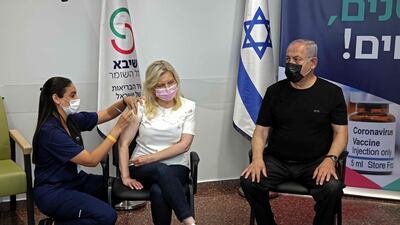
Former Israeli prime minister Benjamin Netanyahu and his wife Sara receive their third doses of the Pfizer-BioNTech Covid-19 vaccine in Tel Aviv. -
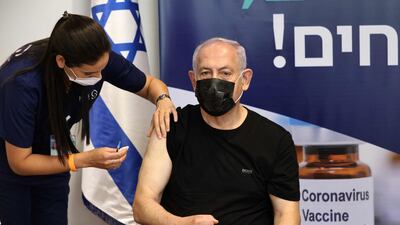
Israel has launched a campaign to give booster shots to people 60 years and over. -

An Israeli health worker prepares to administer a third dose of the Pfizer-BioNtech vaccine at a Maccabi Health Service clinic in Jerusalem. -
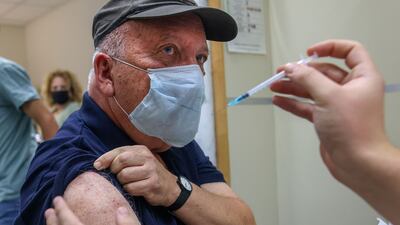
More than 57 per cent of the country’s 9.3 million citizens have received two doses of the Pfizer-BioNTech vaccine. -
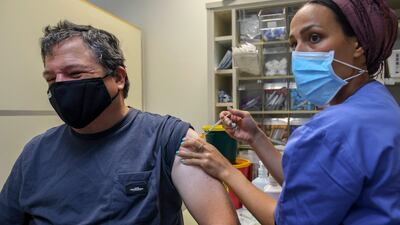
Israel is the first country to offer a third dose of a Western vaccine to its citizens on a wide scale. -
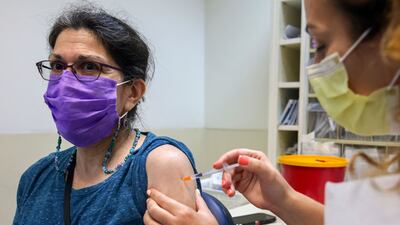
Anyone over 60 who was vaccinated more than five months ago will be eligible for a third vaccine. -
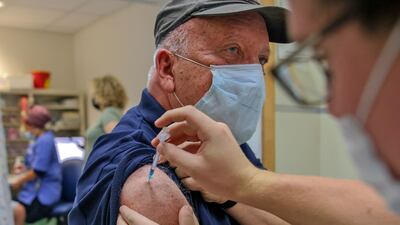
Neither the US nor the EU have approved coronavirus booster shots. -
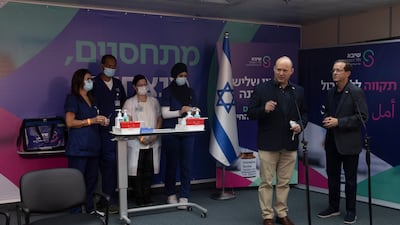
Israeli Prime Minister Naftali Bennett, first right from centre, said a team of expert advisers had agreed it made sense to launch the booster campaign. -
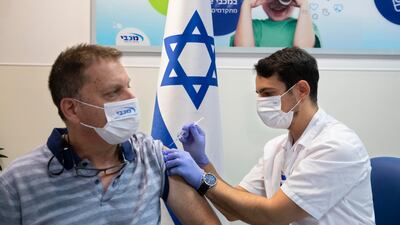
Mr Bennett said the recommendation was made after 'considerable research and analysis'. -

Israel said its research behind the third vaccine would be shared around the world. -
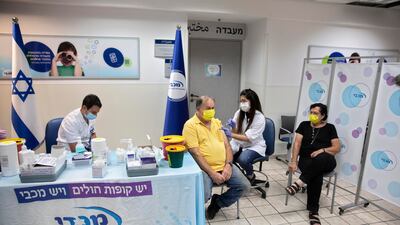
The decision to offer booster shots to older citizens comes at a time of rising infections and signs the vaccine’s efficacy dwindles over time.


The new vaccination drive comes as some European countries reimpose restrictions as case numbers rise. They include Austria, which began a nationwide lockdown this week, and the Netherlands, where evening closures have been met with protests.
In recent months Israel’s government repeatedly warned residents that vaccinations are the only way to avoid a fourth lockdown.
At a vaccination centre in Kfar Saba, a city in central Israel, children coming for their vaccines after school were welcomed by blue balloons.
Dikla Bederman, a nurse managing the centre, said the atmosphere was unique compared with inoculating children against other viruses.
“The actual giving of the vaccine is the same, but there’s more excitement,” she said.
The doses are in separate packaging and are stored separately to adult ones, “so we don’t make mistake”, Ms Bederman said.
Some children looked delighted as they left the clinic clutching a balloon, although one little boy was carried out in tears.
Adam Rena was accompanying his 11-year-old son, Ori, who admitted to feeling a bit nervous about the injection.
“We already had our eldest daughter vaccinated and it looks like everything is OK,” said Mr Rena, a local resident.
“I think when you kind of weigh the pros and the cons, the risks and the benefits, and take into account that we want to keep our parents safe, we think that this course of action [is right],” he said.
Coronavirus cases spiked in September to around 10,000 a day, among a population of nine million, as health officials urged people to get a third vaccine shot.
The strategy has been praised in Israel for driving the infection rate down, although third vaccines were opposed by the World Health Organisation, which cited shortages elsewhere.
Last month, Israel made vaccination mandatory for entering public spaces, including restaurants. The entry is now limited to those who have received an approved Covid-19 vaccine or recovered from the virus within six months. Children under 12 have been asked to show a negative test on entering various indoor venues, although such checks are not always carried out.
About 44 per cent of the population have received three doses, compared with the 62 per cent who have had two shots, health ministry data show.
The figures are significantly lower in Gaza and the Israeli-occupied West Bank, home to five million Palestinians. Only 31 per cent of the population there have received two doses, while Palestinian records show about 120,000 people have received three doses.
Israelis and Palestinians rely entirely on imported vaccines, although the Israeli government this week moved to set up a production centre in the country.

