


Hopes of a return to a power-sharing government in Sudan were raised on Thursday as life in Khartoum began slowly returning to normal, 10 days after a military coup triggered street protests and a wave of strikes.
The UN special envoy for Sudan told Reuters late on Thursday that talks involving military head Gen Abdel Fattah Al Burhan, ousted prime minister Abdalla Hamdok and others had produced the "contours" of a potential deal for a return to power-sharing.
Volker Perthes said the areas covered in the talks included the return of Mr Hamdok to office, the release of detainees and the lifting of the state of emergency as well as adjustments to some transitional institutions and a new technocratic Cabinet.
In the first sign a deal may be drawing closer, Gen Al Burhan on Thursday ordered the release of four detained civilian ministers as international pressure mounted to restore the democratic transition.
"We are considering all internal and external initiatives to serve the national interest," Gen Al Burhan's media adviser, Taher Abouhaga, said. "The government formation is imminent."
Hours later, Sudan TV said Gen Al Burhan ordered the release of Hashem Hassabalrasoul, Ali Geddo, Hamza Baloul and Youssef Adam.
Mr Hassabalrasoul is telecomms minister, Mr Geddo heads the trade ministry, Mr Baloul is information minister and Mr Adam holds the youth and sports portfolio.
The ministers' release came shortly after a phone call between Gen Al Burhan and UN Secretary General Antonio Guterres, who personally appealed to the leader to restore the democratic transition.
He also called for “efforts towards resolving the political crisis in Sudan and urgently restoring the constitutional order in Sudan’s transitional process”, UN spokeswoman Eri Kaneko said.
Tut Gatluak, South Sudanese presidential adviser and head of a mediation delegation, said the order to free the ministers came after separate meetings with both Gen Al Burhan and Mr Hamdok.
"The releases were a result of mediation efforts, where we agreed that detainees would be released in batches," Mr Gatluak told AFP in Khartoum. "We called for all detainees to be released."
Mr Gatluak said negotiations to form a government were ongoing.
"Burhan has no problem with Mr Hamdok returning to his position of prime minister, but he doesn't want the situation to go back as before October 25", the day of the coup, Mr Gatluak said.
"Hamdok remains the first nominee for the head of Cabinet, but that's in case he agrees," he added.
But Mr Hamdok, he said, "wants the situation to go back as it was before October 25".
There have been daily demonstrations calling for the military to step down and allow the transition process to resume.
At least 12 people were killed and some 300 injured in the protests, mostly by gunshot wounds. The largest protest on October 30 attracted hundreds of thousands in Khartoum and across Sudan.
A campaign of civil disobedience paralysed the capital and dramatically curtailed public services, creating additional hardships for ordinary Sudanese, many of whom survive on daily wages.
-
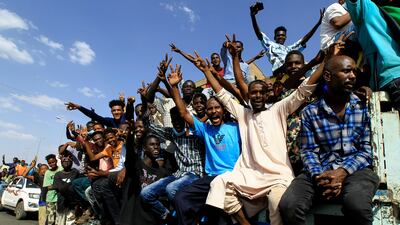
Protesters demonstrate against the Sudanese military's seizure of power and removal of the civilian government, in the capital Khartoum. Reuters -
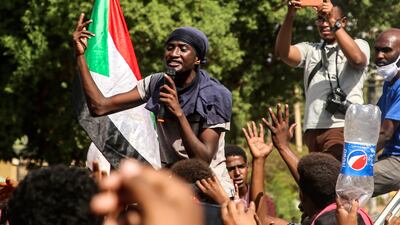
Thousands of Sudanese people took to the streets in the capital of Khartoum, above, and other major cities across the country to demand the country's transition to democratic rule be put back on track. EPA -
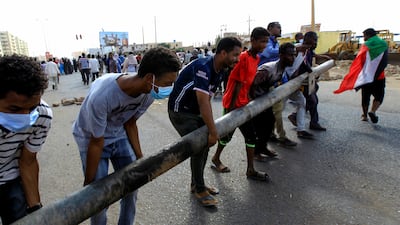
Protesters carry a barricade as they demonstrate against the Sudanese military, in the capital Khartoum. Reuters -

A Sudanese protester flashes a victory sign near a burning tyre as thousands of people joined anti-coup protests in Khartoum. EPA -
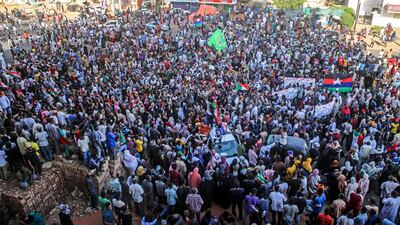
Thousands of Sudanese people participated in anti-military protests in the capital Khartoum. EPA -

A Sudanese protester dressed up as Spider-Man, stands on car during an anti-coup protest in the capital Khartoum. EPA -
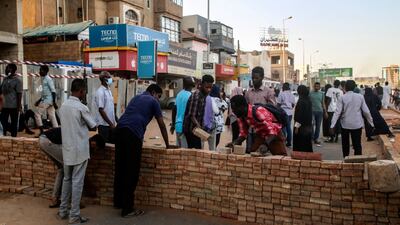
Demonstrators build a barricade on a street in the capital Khartoum during an anti-coup protest. EPA -
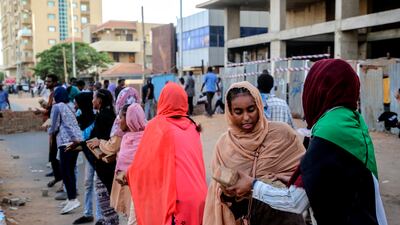
Sudanese women during anti-coup protests as a part of nationwide demonstrations against the military takeover of the government on October 25, in the capital Khartoum. EPA -

Protesters raised slogans demanding the exit of Gen Abdel Fattah Al Burhan, in the capital Khartoum. AP Photo -

Protesters declared 'the revolution will continue' during a demonstration in Khartoum. AP -

'Going back is impossible' was among slogans raised by Sudanese protesters in the capital Khartoum. AP


But on Thursday, banks, petrol stations and some government offices reopened across the capital. There was more traffic on the streets in central Khartoum, although it remains a fraction of its normal level. Schools are scheduled to reopen on Sunday.
State hospitals and pharmacies are only available for emergencies, but private clinics have reopened. Air traffic also resumed at Khartoum International Airport, but internet access has remained cut since the day of the coup.
Resistance committees in residential neighbourhoods have been reinforcing barricades and digging large holes to block the entry of army or police vehicles.
In a significant move, the military on Thursday removed the concrete barriers placed around its Khartoum headquarters on October 16, a sign that was interpreted by many at the time as indicative of an imminent coup.
“Civil obedience is, in theory, an effective tool against coups, but it cannot continue in Sudan for more than four or five days because most of us survive on a daily wage,” said Nasraldeen Mohammed, a 40-year-old businessman.
“Sudan’s situation can easily foil any attempt at civil disobedience. People suffered so much the past week because their money had run out.”
51
Another Khartoum resident, 51-year-old government employee Ammar Mohammed, said he was against the use of civil disobedience given Sudan’s poor economic conditions.
“Sudan can only be built through work, not strikes.
“People must be fed and clothed. Politicians should not interfere with that.”
Gen Al Burhan has, since the coup, dismissed Mr Hamdok’s government, placed him under house arrest and detained members of his Cabinet. Pro-democracy activists, politicians, state media chiefs and the head of civil aviation have been rounded up in recent arrests.
Mr Hamdok, a senior adviser said, has agreed to a conditional return as the head of a new government.
His return is dependent on terms set by him, including the release of all political detainees and the reinstatement of the constitutional declaration, the adviser said.
The US envoy to the Horn of Africa, Jeffrey Feltman, said Washington would support a Sudanese-brokered solution to the country's crisis.
For any resolution to work, Mr Feltman said, “releasing all the detainees, allowing Prime Minister [Abdalla Hamdok] to do his job, [and] not be under house arrest are a priority”.
A statement from Mr Hamdok’s office on Wednesday said the ousted prime minister was unwilling to engage in dialogue with the military before his conditions are met.
James Reinl in New York contributed to this report.

