


Washington would support a Sudanese-brokered solution to the country's crisis following the October 25 coup, a senior US official said on Tuesday, while also applauding the military for what he saw as restraint during a recent demonstration.
Jeffrey Feltman, the special envoy to the Horn of Africa, said the US “would be supportive of a Sudanese solution” that would include the restoration of the civilian government and the reversal of measures taken during the coup.
For any resolution to work, the US has told the Sudanese that “releasing all the detainees, allowing Prime Minister [Abdalla Hamdok] to do his job, [and] not be under house arrest, are a priority,” Mr Feltman said.
He also applauded what he saw as restraint during Saturday's demonstrations against the military coup.
The US envoy said the death toll of three was “far too many” but added, “we also commend those members of the security forces who exercised restraint and upheld their obligations to respect human rights".
Still, Mr Feltman said the military takeover represented a “grave setback” to Sudan.
“Gen Abdel Fattah Al Burhan and his military supporters have hijacked and betrayed the aspirations of the Sudanese people for a peaceful, democratic country,” the US envoy said.
-
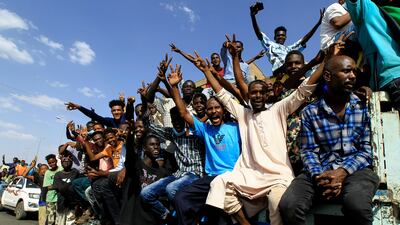
Protesters demonstrate against the Sudanese military's seizure of power and removal of the civilian government, in the capital Khartoum. Reuters -
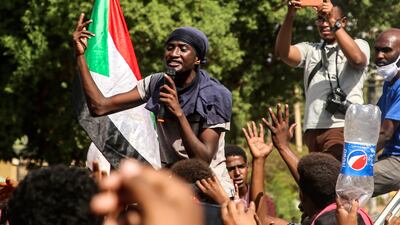
Thousands of Sudanese people took to the streets in the capital of Khartoum, above, and other major cities across the country to demand the country's transition to democratic rule be put back on track. EPA -
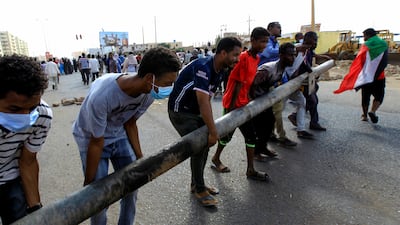
Protesters carry a barricade as they demonstrate against the Sudanese military, in the capital Khartoum. Reuters -

A Sudanese protester flashes a victory sign near a burning tyre as thousands of people joined anti-coup protests in Khartoum. EPA -
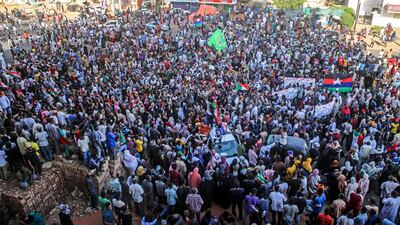
Thousands of Sudanese people participated in anti-military protests in the capital Khartoum. EPA -

A Sudanese protester dressed up as Spider-Man, stands on car during an anti-coup protest in the capital Khartoum. EPA -
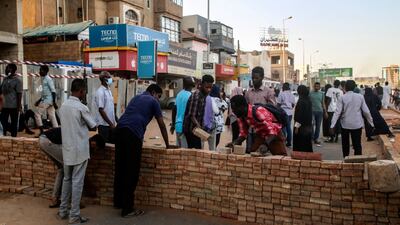
Demonstrators build a barricade on a street in the capital Khartoum during an anti-coup protest. EPA -
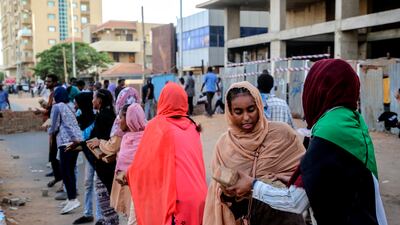
Sudanese women during anti-coup protests as a part of nationwide demonstrations against the military takeover of the government on October 25, in the capital Khartoum. EPA -

Protesters raised slogans demanding the exit of Gen Abdel Fattah Al Burhan, in the capital Khartoum. AP Photo -

Protesters declared 'the revolution will continue' during a demonstration in Khartoum. AP -

'Going back is impossible' was among slogans raised by Sudanese protesters in the capital Khartoum. AP


Sudan's top general and takeover leader Gen Al Burhan dissolved the Cabinet and the ruling military-civilian Sovereign Council, which had been charged with directing Sudan's transition to full civilian rule after the April 2019 overthrow of dictator Omar Al Bashir.
He also declared a state of emergency, detained Sudan's civilian leadership and suspended the work of a commission appointed by the civilian-led government in charge of dismantling the legacy of Al Bashir's 29-year rule.
Gen Al Burhan “needs to allow the civilian government to resume its work and to look for mechanisms to address what he says are concerns,” Mr Feltman said.
Mr Hamdok on Monday said the reinstatement of his government, rather than a Cabinet of technocrats as suggested by the military, could pave the way for an end to the military takeover.
He made the remarks during a meeting with the ambassadors of the US, Britain and Norway at his home — where he remains under house arrest — the Information Ministry, which remains loyal to him, said.
The ousted prime minister “insisted on the legitimacy of his government and transitional institutions,” the Information Ministry said on its Facebook page.
It quoted Mr Hamdok as saying “the release of Cabinet ministers and the full reinstatement of the government could pave the way to a solution”.
Mr Hamdok demanded that the situation in Sudan be returned to what it was before the takeover and refused to negotiate with the country's military rulers, the ministry said.
In addition to calling for the release of civilians detained in the coup, Mr Feltman said those injured in protests after the takeover should receive medical care.
Mr Feltman said the US is co-ordinating with French, Arab and African countries to find a solution.
“Our impression is that whether we're talking about the Emirates or the Egyptians or [Sudan’s] African neighbours or others is that there's a real interest in stability in Sudan,” he said.
He said failure to reach a solution restoring Sudan's civilian leadership could bring further aid cuts.
The US already suspended $700 million of assistance to Sudan following the coup.
On Monday, the UN envoy to Sudan described intensive efforts to mediate between the military and civilian leaders, saying a new power-sharing plan could be revealed within days.
The takeover has been met by daily street protests in which 12 people have been killed and more than 200 injured.
It has also been internationally condemned, with major donors, including the World Bank, suspending aid and the UN repeatedly calling on the military to reverse its course.
AFP contributed to this report


