

Three protesters were killed by soldiers as Sudan’s military and pro-democracy demonstrators faced off on Saturday in what could be a day of reckoning for army chief Gen Abdel Fattah Al Burhan, who seized power on Monday.
Hundreds of thousands took to the streets in the capital of Khartoum and other major cities in the north, west and east of Sudan to demand the country's transition to democratic rule be put back on track.
They shouted for Gen Al Burhan to “leave!” and also chanted “The people are stronger, the revolution will continue!” and “Going back is impossible!”
They carried pictures of Abdalla Hamdok, the civilian prime minister ousted by the military, and waved Sudan's red, green, white black flags.
Saturday's deaths occurred in Khartoum's twin city of Omdurman, according to the Central Committee of Sudan's Doctors, a body linked to the pro-democracy movement whose information has been accurate in the past. It said at least 38 people were also wounded.
The violence took place despite warnings by the US and the UN that the military should not use force against the protesters.
The latest casualties took the number of dead to 13 since the protests began and the injured to at least 210.
The actual number could be higher and is difficult to determine because the internet outage is preventing activists from tallying and verifying casualties.
For Sudan’s pro-democracy forces, Saturday’s huge turnout provided evidence of the extent of popular support for civilian rule in the country — despite the economic hardship many of the country’s 40 million people have endured.
These challenges are largely the result of reforms introduced by Mr Hamdok's overthrown civilian government.
-
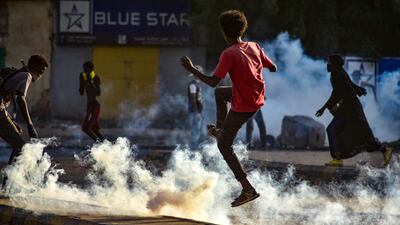
Sudanese youths take to the streets as security forces use tear gas to disperse protesters in the capital Khartoum. AFP -
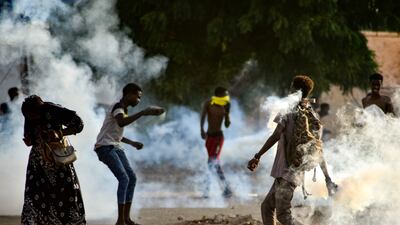
Sudanese youths confront security forces amid the tear gas. AFP -
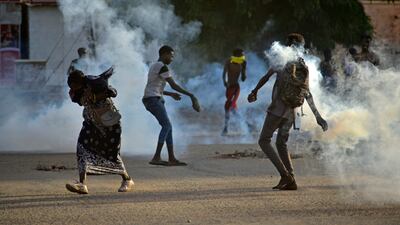
Demonstrations are continuing against a military takeover that has sparked widespread international condemnation. AFP -
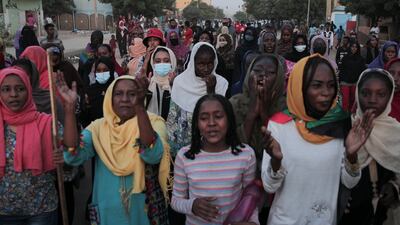
The coup threatens to halt Sudan's fitful transition to democracy, which began after the 2019 removal of long-time ruler Omar Al Bashir and his Islamist government in a popular uprising. AP -

Sudanese anti-coup protesters use bricks to barricade a street in the capital Khartoum. The military takeover came after weeks of mounting tensions between military and civilian leaders over the course and the pace of Sudan's transition to democracy. AFP -
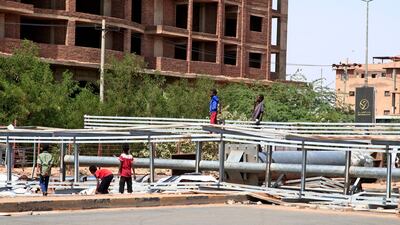
Protesters barricade a street. AFP -
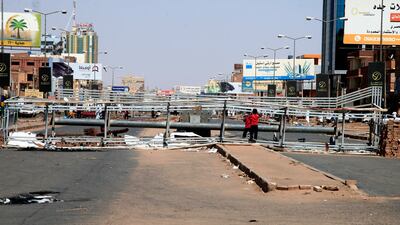
A civil disobedience campaign protesting against the military takeover has taken root in the vast Afro-Arab nation. AFP -
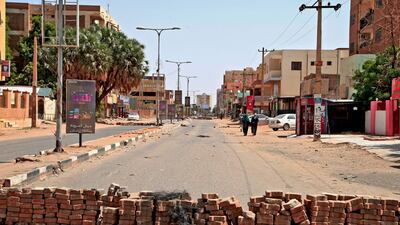
A doctors’ union said the death toll in clashes between protesters and security forces since the coup has risen to eight and the number of injured to 157. AFP -

A Sudanese protester holds the national flag next to burning tyres during a demonstration in Khartoum. EPA -
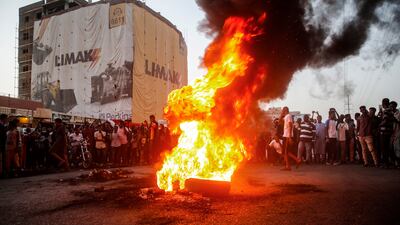
Sudanese protesters chant slogans next to burning tyres. EPA -

Protests continued after Sudan's military launched a takeover and arrested Prime Minister Abdalla Hamdok and other senior ministers and civilian members of the Transitional Sovereignty Council. EPA -
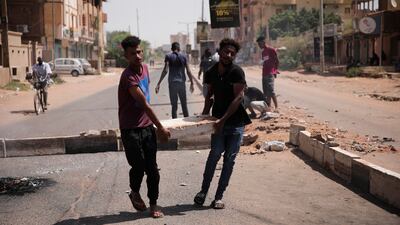
Demonstrators set up a barricade during a protest. AP -
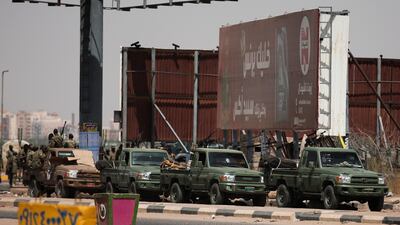
Sudanese security forces are deployed during a protest. AP


Braving temperatures of 38°C, the protesters marched through the capital and other cities. They also demanded the release of scores of Cabinet ministers, other politicians and activists detained since the takeover.
Earlier on Saturday, soldiers sealed off all Nile bridges connecting the capital's three boroughs — Khartoum, Omdurman and Bahari — to prevent a large gathering near army headquarters at the heart of the capital.
Pedestrians attempting to cross the bridges were turned back by the soldiers.
Authorities have also greatly limited the use of mobile phones, with residents complaining they cannot receive or make local calls.
Some, however, say they are receiving overseas calls.
No internet
The internet has been cut off since Monday, forcing activists in neighbourhood resistance committees to use flyers, word of mouth, graffiti and SMS messages to mobilise for Saturday's demonstrations.
In the eastern Khartoum district of Sharq Al Neel, east of the Nile, protesters tried unsuccessfully to cross the Manshiyah bridge on the Blue Nile to reach fellow demonstrators. The army had blocked the bridge with barbed wire and concrete barriers overnight.
When the protesters tried to storm the barriers, soliders fired tear gas to push them back.
"This is exactly what the ousted (Al Bashir) used to do to us," said Salma Ali, a 33-year-old telecom company employee, watching the soldiers manning the barriers on the Manshiyah bridge. "The internet outage is to cover up the criminal and inhuman treatment of the revolutionaries."
A short distance away stood Fouad Abdul Azeem, struggling with the effects of tear gas.
"We are against the absurdity committed by Al Burhan to steal our December revolution," he said, in a reference to the start of the 2018-19 uprising against dictator Omar Al Bashir.
"They are delaying the building of our nation," he said, as heavy gunfire rang out from the direction of Street 60th, less than two kilometres away and one of the designated assembly points for Saturday's demonstrations.
"Thousands of troops backed by armoured cars began to deploy across the capital on Friday in anticipation of Saturday’s mass protests.
Columns of up to 10 army vehicles were seen racing across the city and positioning themselves at key intersections and near assembly points designated by the organisers of Saturday’s marches.
Soldiers have used live ammunition, tear gas, rubber bullets, sticks and whips to disperse street protesters since the takeover.
Additionally, the soldiers — aided by plainclothes security men and members of a notorious paramilitary force — have been conducting checks on cars and mobile phones and making arbitrary arrests in Khartoum.
In anticipation of renewed violence, the US on Friday urged Sudan's military leaders not to use force against peaceful protesters during Saturday’s demonstrations.
How the army reacts, it said, will be a litmus test.
“Tomorrow is going to be a real indication of what the military intentions are,” said a senior US State Department official.
“We call on the security forces to refrain from any and all violence against protesters and to fully respect the citizens' right to demonstrate peacefully,” the official said.
US Secretary of State Antony Blinken sent out a similar message in a Twitter post: “Sudan’s security forces must respect human rights; any violence against peaceful demonstrators is unacceptable.”
UN Secretary General Antonio Guterres called on the military to show restraint and emphasising his “strong condemnation” of the takeover. “People must be allowed to demonstrate peacefully,” Mr Guterres said.
Saturday’s demonstrations were called by the Association of Sudanese Professionals, a loose alliance that was at the forefront of the street protests in 2018 and 2019 that forced the military to oust longtime dictator Omar Al Bashir in April 2019.
They follow similar action by pro-democracy supporters on October 21, the anniversary of an uprising in 1964 that toppled the six-year regime of military strongman Ibrahim Abboud.
The previous demonstrations attracted hundreds of thousands in Khartoum and across much of Sudan.

Gen Al Burhan announced the military takeover on Monday, saying the army had no choice but to act to prevent a civil war.
He dismissed the civilian-led government, declared a nationwide state of emergency and vowed that elections would be held in July 2023 after which the military would hand the reins of power to an elected government.
A government of independent technocrats would run the country until the elections, he said.
He also fired provincial governors and suspended a committee mandated to dismantle the legacy of Al Bashir’s 29-year rule. He said the committee’s work methods needed to be revised.
Gen Al Burhan, viewed as being among Al Bashir’s most trusted generals, also arrested Prime Minister Abdalla Hamdok and members of his government.
Mr Hamdok was placed under house arrest a day later, but the others remain held at unknown locations.
The general said on Thursday night the military was trying to persuade Mr Hamdok, a career UN economist, to head the next government, but to no avail.

Monday’s takeover was swiftly met by strong condemnation and punitive action from the international community.
The African Union suspended Sudan’s membership, while the US called for the transitional process to be put back on track and paused $700 million in aid.
The World Bank also condemned the takeover and halted hundreds of millions of dollars in aid. The EU was expected to follow the World Bank's example.

