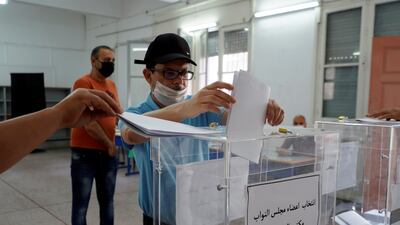
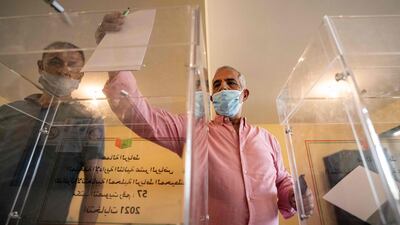
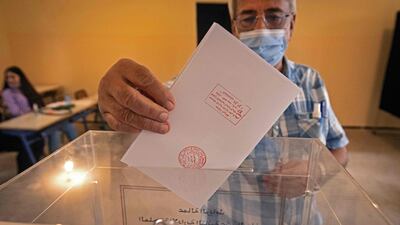
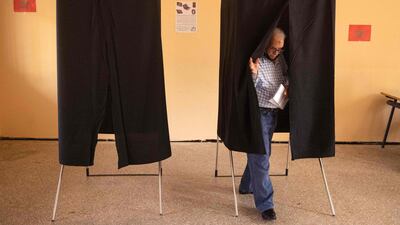
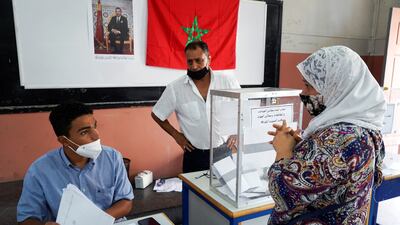
• Saad-Eddine El Othmani, Morocco's Prime Minister and president of the Islamist Justice and Development Party (PJD) casts his ballot on September 8. AFP
    Saad-Eddine El Othmani, Morocco's Prime Minister and president of the Islamist Justice and Development Party (PJD) casts his ballot on September 8. AFP
  • A man casts his vote at a polling station in Casablanca, Morocco. Reuters
    A man casts his vote at a polling station in Casablanca, Morocco. Reuters
  • The PJD has dominated Morocco's politics for a decade. Reuters
    The PJD has dominated Morocco's politics for a decade. Reuters
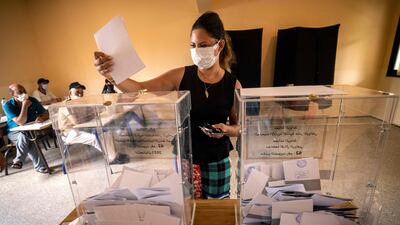
  • A voter casts a ballot in the capital Rabat. AFP
    A voter casts a ballot in the capital Rabat. AFP
  • Polls are banned in Morocco. AFP
    Polls are banned in Morocco. AFP
  • Wednesday's elections came as the country grapples with the economic impact of Covid-19 . AFP
    Wednesday's elections came as the country grapples with the economic impact of Covid-19 . AFP
  • Voter turnout in Moroccan elections is usually below 50 per cent. AFP
    Voter turnout in Moroccan elections is usually below 50 per cent. AFP
  • Official figures show that about three million young people between 18 and 22 registered to vote for the first time this year. Reuters
    Official figures show that about three million young people between 18 and 22 registered to vote for the first time this year. Reuters
  • Morocco adopted a new constitution in 2011 in response to the February 20 Movement, the local version of the Arab uprisings. Reuters
    Morocco adopted a new constitution in 2011 in response to the February 20 Movement, the local version of the Arab uprisings. Reuters
  • The step brought the country closer to a system of constitutional monarchy. EPA
    The step brought the country closer to a system of constitutional monarchy. EPA
  • A woman prepares to cast her ballot during Morocco's parliamentary and local elections in the capital Rabat. AFP
    A woman prepares to cast her ballot during Morocco's parliamentary and local elections in the capital Rabat. AFP

Morocco elections: The billionaire tycoon who unseated Islamist incumbents


Ahmed Maher
  • English
  • Arabic

There’s widespread jubilation among the supporters of Morocco’s liberal party National Rally of Independents (RNI) that the future is with them as long-ruling Islamists have suffered a crushing defeat in the parliamentary elections on Wednesday, according to provisional results.

After 10 years of successive governments dominated by the Islamist Justice and Development Party (PJD), the RNI's popularity was already riding high in the months leading up to the vote, analysts told The National, offering the best insight into the race because election polls are banned in the kingdom.

RNI's head Aziz Akhannouch led the party to take 97 seats out of 395, after 96 per cent of the votes were counted. As for the PJD, which has headed governments for a decade since 2011, it suffered a complete rout as its share nosedived from 125 seats in the outgoing parliament to just 12.

The RNI leaders said during campaigning that it is high time they led the next government to make much-needed changes and improve education, health care, employment and welfare in the country.

The PJD doesn't have a big economic or social achievement it can count on as a rallying point in this election
Mohamed Bouden

The PJD has been singled out for sharp criticism by economists and political scientists for failing to galvanise the economy, which shrank by 6 per cent last year, as well as for being unable to tackle corruption and improve living conditions for the majority of the country’s 37 million people.

“The general mood, especially among the swing and angry voters, was 'let’s end the reign of the PJD and try our economic chances with other well-established and pro-king parties like the RNI,' which is led by business tycoon Aziz Akhannouch,” said Mohamed Bouden, head of the Rabat-based Atlas Centre for the Analysis of Political and Institutional Indicators.

“The PJD didn't have a big economic or social achievement it can count on as a rallying point in this election,” he told The National.

Morocco is a constitutional monarchy. The king picks the prime minister from the party that wins most seats in parliament.

King Mohammed VI has unveiled a 15-year development plan to help bridge economic inequality and boost job creation.

“That also endeared voters to the leaders of the pro-palace parties,” Mr Bouden said.

Electoral paintings in Casablanca of political party logos. The lamp represents the Justice and Development Party and the sun the Renaissance and Virtue Party. AP

'You deserve better'

The RNI has used the slogan “you deserve better” during its campaigns.

Founded in 1978 by Ahmed Osman – prime minister at the time and the son-in-law of King Hassan II who ruled the country between 1961 and 1999 – the party has participated in several Moroccan governments since the 1970s.

After unrest broke out across the Arab world in 2011 the RNI re-emerged as a political force in Morocco, with Mr Akhannouch becoming its president in 2016.

Mr Akhannouch, who has been the Minister of Agriculture since 2007, believes that his party has developed a clear and feasible programme based on travelling widely in the country to speak to voters from different walks of life.

Earlier this year the tycoon launched the 100 Days 100 Cities programme, which he considered to be the best-funded and most ambitious public consultation in Morocco's history.

Mr Akhannouch has promised to increase the monthly salary of teachers, create one million jobs and allocate a monthly salary for those of 65 years and above without an income.

“The citizens' demands revolve around social welfare, the doubling of the health sector's budget as well as the achievement of quality education,” he said in a recent interview with Moroccan media.

Aziz Akhannouch runs a business empire involving about 50 companies, mainly in the fields of oil and communications. He is one of the richest people in the Arab world, according to Forbes. AP

In the October 2016 legislative elections, his party won just 37 seats.

“The RNI has deep pockets and no party can match the wealth of its leader and his well-funded publicity drive in TV, street billboards or social media. It’s widely known here in Morocco as the party of businessmen. It’s like a money machine and the growing public frustration at the Islamists plays well into their hands,” Saida El Kamel, a political science researcher at the Mohammed V University, told The National.

Mr Akhannouch is one of the richest people in the Arab world, with a net wealth of nearly $1.8 billion, according to Forbes. He runs a business empire that includes about 50 companies, mainly in the fields of energy and communications.

The father of three was born in Tafraout, southern Morocco, in 1961 and studied administrative management at the prestigious Canadian Universite de Sherbrooke in 1986.

  • Saad-Eddine El Othmani, Morocco's Prime Minister and president of the Islamist Justice and Development Party (PJD) casts his ballot on September 8. AFP
    Saad-Eddine El Othmani, Morocco's Prime Minister and president of the Islamist Justice and Development Party (PJD) casts his ballot on September 8. AFP
  • A man casts his vote at a polling station in Casablanca, Morocco. Reuters
    A man casts his vote at a polling station in Casablanca, Morocco. Reuters
  • The PJD has dominated Morocco's politics for a decade. Reuters
    The PJD has dominated Morocco's politics for a decade. Reuters
  • A voter casts a ballot in the capital Rabat. AFP
    A voter casts a ballot in the capital Rabat. AFP
  • Polls are banned in Morocco. AFP
    Polls are banned in Morocco. AFP
  • Wednesday's elections came as the country grapples with the economic impact of Covid-19 . AFP
    Wednesday's elections came as the country grapples with the economic impact of Covid-19 . AFP
  • Voter turnout in Moroccan elections is usually below 50 per cent. AFP
    Voter turnout in Moroccan elections is usually below 50 per cent. AFP
  • Official figures show that about three million young people between 18 and 22 registered to vote for the first time this year. Reuters
    Official figures show that about three million young people between 18 and 22 registered to vote for the first time this year. Reuters
  • Morocco adopted a new constitution in 2011 in response to the February 20 Movement, the local version of the Arab uprisings. Reuters
    Morocco adopted a new constitution in 2011 in response to the February 20 Movement, the local version of the Arab uprisings. Reuters
  • The step brought the country closer to a system of constitutional monarchy. EPA
    The step brought the country closer to a system of constitutional monarchy. EPA
  • A woman prepares to cast her ballot during Morocco's parliamentary and local elections in the capital Rabat. AFP
    A woman prepares to cast her ballot during Morocco's parliamentary and local elections in the capital Rabat. AFP

But experts say his party’s big gains in the elections are also linked to the failure of Islamists in other Arab countries to consolidate their power base, such as Ennhada in neighbouring Tunisia and the Muslim Brotherhood in Egypt.

They have proved out of touch, says Mustafa Menshawy, a post-doctoral fellow at Lancaster University’s sectarianism, proxies and de-sectarianisation project.

He explained: “I believe that the main problem with Islamists in power revolves around a struggle to juggle religion and politics. With the first mostly fixed and immobile and textually sacred, and the second dynamic, shifting, malleable and profane, the Islamists’ rise to power thus exemplifies a moment of tension, incongruity and contradiction between the two paths,” he told The National.

“Members of the parties and many people felt disillusioned as Islamists always propagated their preparedness for a radical full 'overturn' or transformation of power by replacing an old regime with a puritan one, bringing the dream of 'Islamic state and society' closer," he said. "It was more a baptism by fire under which they enter this upper level of politics through immersion and without full preparation.”


The%20specs
%3Cp%3E%3Cstrong%3EEngine%3A%3C%2Fstrong%3E%20Dual%20synchronous%20electric%20motors%0D%3Cbr%3E%3Cstrong%3EPower%3A%20%3C%2Fstrong%3E660hp%0D%3Cbr%3E%3Cstrong%3ETorque%3A%20%3C%2Fstrong%3E1%2C100Nm%0D%3Cbr%3E%3Cstrong%3ETransmission%3A%20%3C%2Fstrong%3ESingle-speed%20automatic%0D%3Cbr%3E%3Cstrong%3ETouring%20range%3A%20%3C%2Fstrong%3E488km-560km%0D%3Cbr%3E%3Cstrong%3EPrice%3A%20%3C%2Fstrong%3EFrom%20Dh850%2C000%20(estimate)%0D%3Cbr%3E%3Cstrong%3EOn%20sale%3A%20%3C%2Fstrong%3EOctober%3C%2Fp%3E%0A
Trump v Khan

2016: Feud begins after Khan criticised Trump’s proposed Muslim travel ban to US

2017: Trump criticises Khan’s ‘no reason to be alarmed’ response to London Bridge terror attacks

2019: Trump calls Khan a “stone cold loser” before first state visit

2019: Trump tweets about “Khan’s Londonistan”, calling him “a national disgrace”

2022:  Khan’s office attributes rise in Islamophobic abuse against the major to hostility stoked during Trump’s presidency

July 2025 During a golfing trip to Scotland, Trump calls Khan “a nasty person”

Sept 2025 Trump blames Khan for London’s “stabbings and the dirt and the filth”.

Dec 2025 Trump suggests migrants got Khan elected, calls him a “horrible, vicious, disgusting mayor”

Generation Start-up: Awok company profile

Started: 2013

Founder: Ulugbek Yuldashev

Sector: e-commerce

Size: 600 plus

Stage: still in talks with VCs

Principal Investors: self-financed by founder

England's lowest Test innings

- 45 v Australia in Sydney, January 28, 1887

- 46 v West Indies in Port of Spain, March 25, 1994

- 51 v West Indies in Kingston, February 4, 2009

- 52 v Australia at The Oval, August 14, 1948

- 53 v Australia at Lord's, July 16, 1888

- 58 v New Zealand in Auckland, March 22, 2018

What can victims do?

Always use only regulated platforms

Stop all transactions and communication on suspicion

Save all evidence (screenshots, chat logs, transaction IDs)

Report to local authorities

Warn others to prevent further harm

Courtesy: Crystal Intelligence

Pharaoh's curse

British aristocrat Lord Carnarvon, who funded the expedition to find the Tutankhamun tomb, died in a Cairo hotel four months after the crypt was opened.
He had been in poor health for many years after a car crash, and a mosquito bite made worse by a shaving cut led to blood poisoning and pneumonia.
Reports at the time said Lord Carnarvon suffered from “pain as the inflammation affected the nasal passages and eyes”.
Decades later, scientists contended he had died of aspergillosis after inhaling spores of the fungus aspergillus in the tomb, which can lie dormant for months. The fact several others who entered were also found dead withiin a short time led to the myth of the curse.

How much do leading UAE’s UK curriculum schools charge for Year 6?
  1. Nord Anglia International School (Dubai) – Dh85,032
  2. Kings School Al Barsha (Dubai) – Dh71,905
  3. Brighton College Abu Dhabi - Dh68,560
  4. Jumeirah English Speaking School (Dubai) – Dh59,728
  5. Gems Wellington International School – Dubai Branch – Dh58,488
  6. The British School Al Khubairat (Abu Dhabi) - Dh54,170
  7. Dubai English Speaking School – Dh51,269

*Annual tuition fees covering the 2024/2025 academic year

Biography

Favourite Meal: Chicken Caesar salad

Hobbies: Travelling, going to the gym

Inspiration: Father, who was a captain in the UAE army

Favourite read: Rich Dad Poor Dad by Robert Kiyosaki and Sharon Lechter

Favourite film: The Founder, about the establishment of McDonald's

The burning issue

The internal combustion engine is facing a watershed moment – major manufacturer Volvo is to stop producing petroleum-powered vehicles by 2021 and countries in Europe, including the UK, have vowed to ban their sale before 2040. The National takes a look at the story of one of the most successful technologies of the last 100 years and how it has impacted life in the UAE. 

Read part four: an affection for classic cars lives on

Read part three: the age of the electric vehicle begins

Read part two: how climate change drove the race for an alternative 

Updated: September 09, 2021, 7:30 AM