



Listen to the latest podcast on the Beirut blast here
When a fire started in Hangar 12 at Beirut port a little before 6pm on August 4 last year, the 15 workers on shift at the port’s giant grain silos were not worried. They heard firefighters arrive and thought it would be over quickly.
Fires at the port happened from time to time, and the silos had never stopped operating day and night since they were built in 1968, not even during heavy Syrian bombardment during Lebanon's 1975-1990 civil war.
But the workers became concerned when they heard the loud bangs of fireworks shooting out the window of the hangar, leaving a trail of red and white smoke behind them.
What they didn’t know was that, alongside fireworks and other flammable materials, Hangar 12 contained hundreds of tonnes of highly explosive ammonium nitrate that had been stored unsafely at the port for the past seven years.
At 6.07pm, the ammonium nitrate exploded, tearing through the port and surrounding areas of the Lebanese capital, killing at least 214 people. Only six of the silo workers survived.
Ramez Mansour, who rushed out of the silo offices moments before the blast, said the hangar looked “like a pressure cooker”.
Mr Mansour, 42, still finds it hard to believe that he survived one of the biggest non-nuclear explosions in recent history. The feeling is widely shared among his surviving colleagues, who were all working less than 100 metres away from Hangar 12.
An estimated 30,000 tonnes of grain stored in the silos collapsed on top of eight people, killing all of them. Six of them were employed by the company that operates the silos: Ghassan Hasrouty, Khalil Issa, Joe Akiki, Joe Andoun, Shawki Alloushe and Hussein Boucher. The other two, Ali Fneiche and Ibrahim Amine, worked for a subcontractor as cleaners.
A seventh silo employee, Hassan Haydar, died in his car as he was preparing to leave after his shift.
Elias Nohra, one of the survivors, helped the army for weeks afterwards to clear the rubble and find the bodies of his colleagues.
“We found pieces of them,” said Mr Nohra, 64. “They were almost unrecognisable.”
Of the six survivors, Mr Mansour, Mr Nohra, Walid Sebaali, 46, and Badda Al Hage, 24, sustained minor injuries. Michel Abdo, 58, lost an eye in the explosion, while Hassan Mortada, 34, suffered six broken vertebrae and two broken pelvic bones. He was unable to walk for a month, and he still cannot remain on his feet for longer than 30 minutes at a time. He will never be able to carry a load heavier than five kilograms.
Mr Al Hage alone did not respond to a request for an interview.
A local investigation has yet to discover the reasons behind the explosion, but officials and victims’ families blame the negligence of various government bodies operating at the port.
On the afternoon of the blast, Mr Abdo and Mr Sebaali were unloading a ship, the Raouf H, which had arrived with a shipment of wheat from Ukraine.
They said an initial, smaller explosion from the warehouse caused the boat to sway slightly but it was mostly drowned out by the din of the machines around them,
“I heard something that went ‘boom’,” Mr Sebaali said. “I looked at Michel and asked him what it was. I thought that a door had fallen. He gestured, telling me I should look behind me.”
Mr Sebaali did not like what he saw. The colour of the fire at Hangar 12 was white and red, unlike usual fires.
“I saw it getting higher, sucking in oxygen from below. I knew there was going to be an explosion,” he recalled. “There was a detonation. The hangar disappeared, and I saw a wall of pressure coming towards me.”
Mr Sebaali ran under some stairs, put his hands over his eyes and screamed. “I didn’t want all this pressure to come inside me and explode,” he said.
Onshore, 20 metres closer to Hangar 12, Mr Nohra had thrown himself by a pillar in the silo office, holding on to Mr Al Hage. Mr Mortada remained seated in his chair on the other side of the room.
The pillar stood firm; the ceiling collapsed on to Mr Mortada’s back.
“Everything just fell on top of us for three or four seconds,” said Mr Nohra. “When it stopped, I opened my eyes but could not see anything. Around me, there were just rocks and blood. Everything was dark. It was like night.”
A warehouse adjacent to the office, filled with 800 tonnes of crushed soya for animal feed, acted as a buffer between them and Hangar 12. “Without that soya, they wouldn’t be here today,” Mr Sebaali said of his colleagues. Today, what is left of their office lies under a pile of mangled steel.
Seconds before the explosion, Mr Mansour ran out of the office to shelter behind a warehouse full of cars on the other side of the silos. He flung himself to the ground as he felt the earth tremble beneath him. The blast flattened the warehouse.
“I thought I was dead. It was a miracle that we survived,” he said. “I was surprised. Everything was destroyed around me. How could I still be alive?”
On the Raouf H, Mr Sebaali saw Mr Abdo lying unconscious and bleeding from the right side of his face, which had been smashed by debris from the boat. Two metres from him, a sailor lay dying with a piece of iron through his jaw. The captain of the ship was dead.
Mr Abdo detected a faint pulse in the sailor.
“I thought maybe if I get him directly to the ambulance, they’ll save him. But he was dead by the time he touched the shore,” he said.
Mr Nohra, who had run to the ship after removing Mr Mortada from the rubble of their office, helped Mr Sebaali moor it to the quay.
Mr Nohra and Mr Sebaali carried Mr Abdo, who was unconscious for about half an hour, to land.
By then, dozens of people had arrived to help the survivors, along with journalists.
A widely published Associated Press photo shows Mr Abdo staring into the distance as a cloud of black smoke rises behind him near the damaged silos. Blood seeps through the bandage around his face, and his T-shirt is spattered with blood.
-
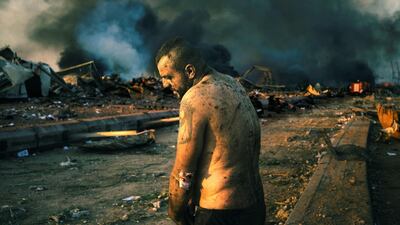
The winner of the World Press Photo contest 'Spot News - Stories' category is 'Port Explosion in Beirut' by Lorenzo Tugnoli. An injured man stands inside the wrecked site of the port of Beirut while firefighters work to put out the fires that engulfed the warehouses after the explosion. Lorenzo Tugnoli/Contrasto for The Washington Post -
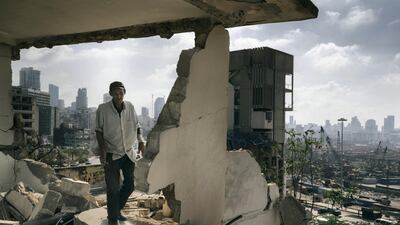
Abdullah walks in the ruins of his former house. Since the day of the explosion he is squatting in the damaged building were he once lived with his family, with no water or electricity. An estimated 300,000 people lost their homes in after the blast. Lorenzo Tugnoli/Contrasto for The Washington Post -

Firefighters work to put out the fires that engulfed the warehouses in the port of Beirut after the explosion. Lorenzo Tugnoli/Contrasto for The Washington Post -
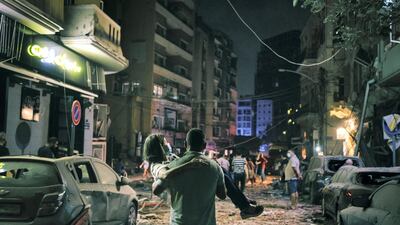
An old woman is carried to safety in the destroyed neighbourhood of Jemmayzeh. The blast wrecked several densely populated neighbourhoods. Lorenzo Tugnoli/Contrasto for The Washington Post


Pictures of Mr Mortada bleeding from the head started circulating on social media. “Thank God my parents didn’t see it. It looks like I’m dead,” he said.
The soldiers took Mr Mortada away for treatment by boat, along with the body of the Syrian sailor. “They put me in the boat with a dead man,” he recalled.
“Look, maybe we look tough. But a doctor would probably find that we’re full of psychological problems.”
employee at Beirut port silos
In the confusion, Mr Sebaali decided he would try to find his colleagues buried under the collapsed silos. “I stopped when I saw the destruction. They were under 15 metres of wheat and cement,” he said.
He then tried to climb what was left of the mountain of soya but he sank into the burning grain and turned back.
He spotted Hassan Haydar’s rubble-covered car. “I learnt later that Hassan had just turned his car on to leave work,” he said. “He loved to sit in the car listening to music and he played the oud.”
Bleeding from his back and arms, Mr Sebaali decided to take a taxi to a hospital from outside the port, but he had not realised that the damage from the blast had halted all traffic. He ended up walking for two hours until he reached an area called Dawra, where his brother picked him up.
Mr Sebaali struggles to describe the carnage he witnessed on the way, including a woman in a car whom he tried to help before realising that she was dead, her stomach ripped open. “There’s a lot of things I saw that I try to forget,” he said.
One year later, the survivors say they feel largely forgotten by Lebanese institutions and have little faith in the judiciary to find who was responsible for the death of their colleagues. They said the first judge appointed to investigate the tragedy never sought their testimony, and the judge who replaced him in February spoke to them only last month.
Mr Abdo is still waiting for the funding for a prosthetic eye. Mr Mortada, a civil engineer, wants to emigrate because he fears his injuries have put an end to his employment prospects in Lebanon.
“If the silos are handed over to the private sector, maybe they’ll tell me and Michel that we are useless because we have life disabilities. What is my future? I don’t know,” Mr Mortada said.
The semi-private company that operated the silos still pays its employees monthly, minus perks for difficult on-site work conditions, but the value of the salary has plummeted to less than a tenth of what it was before the country’s financial crisis began in 2019.
Some of the survivors still meet every week at the company's new offices in an Economy Ministry building, although Mr Mansour has been moved to the ministry’s intellectual property rights department. Mr Abdo rarely goes and prefers to stay in his brother’s house in southern Lebanon. Mr Mortada and Mr Sebaali, who go to the office a few times a week, said their work consists mostly of meetings about the future of the silos.
But the sense of camaraderie born out of hundreds of mornings of brewing coffee together at dawn, or sleeping on site for days as they unloaded ships, is gone.
“They would wait for me to make the coffee because my coffee is good,” Mr Sebaali recalled. “Michel and Elias were the oldest among us. They were like fathers to us. I would spend my whole life with them and see my wife and family maybe twice a week.”
For them, the work was more than a job. The wheat unloaded from ships was essential to feed the Lebanese population.
“We participated in Lebanon’s food security by protecting our wheat,” said Mr Mortada. “We used to think that we were doing something great for our country.”
Beirut port blast survivor
The silos themselves have been slowly tilting over the past year and the Economy Ministry is now preparing a tender for their demolition, said Assaad Haddad, the managing director of the silo operator.
“May God bless their souls,” said Mr Abdo.
He hopes to take part in protests in Beirut on Wednesday to mark the anniversary of the explosion, but expects them to achieve little.
“Our officials want the country to stay like this so that they can keep stealing. They stole everything. The people’s money, their dreams, everything. The country is burning and they don’t care,” he said.
“This is the first time I have spoken like this. I never used to talk about people in power, but I saw what happened with my own eyes. The explosion convinced me that the whole country is corrupt.”

