One of my clearest memories from my time working as a journalist in Beirut was covering the aftermath of a twin suicide bombing in early 2014. A string of terrorist bombings had taken place in the city, particularly in Shia-majority areas, by extremist groups who targeted civilians in retaliation for Hezbollah's involvement in the war in Syria.
This particular bombing had taken place in a heavily populated area, and one of the cars exploded in front of an orphanage. (Mercifully, all the children there survived.) After covering the attack, I went back the next day to see how residents were coping with the aftermath. I climbed the stairs to an apartment that was directly across from one of the car bombs, and found a home that was completely destroyed, debris and wood and concrete everywhere - a lifetime of memories shattered in an instant.
An elderly man who lived in the apartment was there. His wife was being treated in the hospital. His daughter was there to help them pack and drive them to their hometown. On the balcony outside, the railing had been blown off. But they had set up two chairs and a rakwah or pot of Turkish coffee. I snapped a picture of the scene. In the rubble of their apartment, they were determined to hold on to something – perhaps it was beauty, perhaps a measure of comfort and solace in familiar rituals, perhaps joy. It was an image that epitomised a strength I had never seen in humans.
The balcony railing of an apartment I visited In 2014 had been partially destroyed by bomb blast the previous day. That the family living in this apartment was determined to get on with their lives epitomised a strength I had never seen in humans. Courtesy of Kareem Shaheen
Lebanon itself was like that to me. Surrounded by an unstable region, with a war in Syria, the refugee crisis, sectarianism, the rivalry between regional powers that played out every day – it wasn’t an oasis of calm by any means, the currents driving the country here and there, its people suffering under the corruption and ineptitude of its ruling class. But it nevertheless found ways to be alive, to be a refuge.
Come to think of it, it felt like being on the Titanic and listening to the orchestra play as the ship sank beneath the waves.
But now, the Titanic is underwater. Beirut was brought down by 2,700 tonnes of ammonium nitrate that were left in the city's port, so close to so many homes. Calling it criminal negligence is too kind.
I still can't quite comprehend the level of devastation, the cataclysm brought on by an explosion that large. I keep looking at videos of the shockwave, and my jaw keeps dropping. The wave of white oblivion that crashes over the buildings. Looking at the images of Mar Mikhail and Gemmayze, neighbourhoods I had lived in that used to be vibrant with night life, landmarks I recognised, streets I had walked, now covered in broken glass and debris, shingles torn off the roofs of houses, or homes collapsed all together.
Every friend I had there posted images of their broken homes. Another told us about watching the wave come in from the port and panicking as she searched for her son who was playing downstairs. The pictures of broken children’s rooms got to me the most now that I have a son of my own. I keep imagining what it would have been like had we stayed.
'Aftermath' by Tom Young, an artist who lives between London and Beirut. A number of Young's paintings were damaged following the blast on August 4. Tom Young
I didn’t need to imagine it for very long, because the friend who rented our old apartment near the port posted photos of the broken everything.
I left Beirut at the end of 2016 to take up another post, before moving halfway across the world to Canada. I thought doing so would inure me against the heartbreak that I navigated every day working as a journalist in the Middle East. But it turns out I never really left. Because the grief was all-encompassing and debilitating, and my heart still shattered into a thousand pieces.
I owe everything to the city. I met the love of my life there, at a little cafe in Mar Mikhail called Bar Tartine, along a stretch of road devastated by its proximity to the blast. I proposed to her at a spot overlooking Beirut’s marina. I made friendships in this city that will last a lifetime, and which made me who I am today. I owe to it my career in journalism.
But more importantly, I owe to it everything I learned about love, courage, hope, sacrifice, grief, hatred, dance, music, suffering and violence. Everything about life and meaning. The kind of yearning for life that finds the lone grass shoot in the desert, the diamond in the rough, the steaming pot of coffee on the balcony after the suicide bombing.
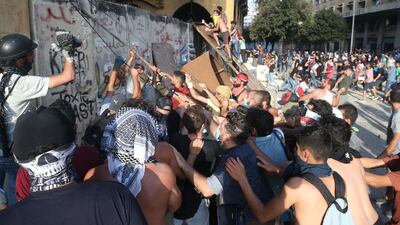
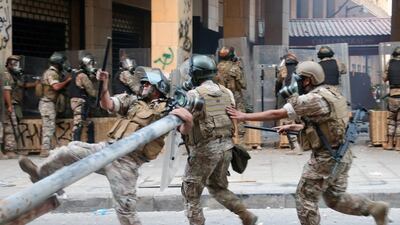
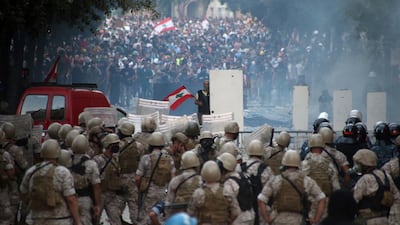
Lebanese anti-government protesters pull a protection wall leading to the Parliament square during a protest in Beirut. EPA
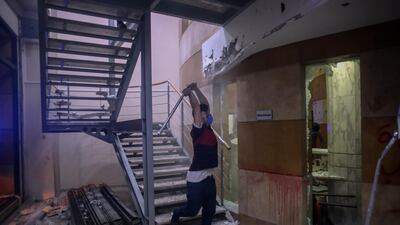
A protester strikes a wall with a metal bar inside the Lebanese Banks Association (ABL) headquarters. Bloomberg
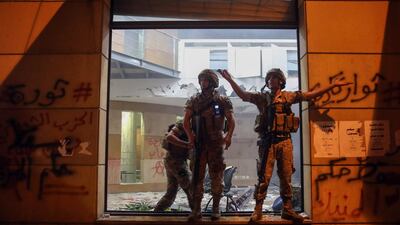
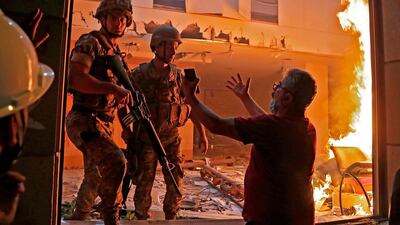
Lebanese army soldiers stand guard by a shattered window inside the Lebanese Banks Association (ABL) headquarters during a demonstration. Bloomberg
Protesters break into the Lebanese Banks Association (ABL) headquarters during a demonstration. Bloomberg
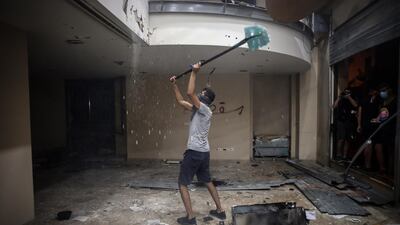
A protester strikes the ceiling inside the Lebanese Banks Association (ABL) headquarters during a demonstration. Bloomberg
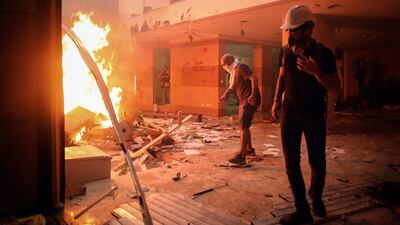
Protesters light fires inside the Lebanese Banks Association (ABL) headquarters during a demonstration. Bloomberg
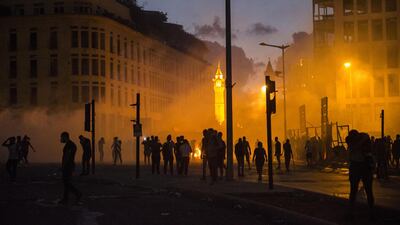
A cloud of tear gas drifts through a crowd of protesters during a protest at Martyrs Square. Getty Images
Lebanese security forces run during clashes with anti-government protesters. EPA
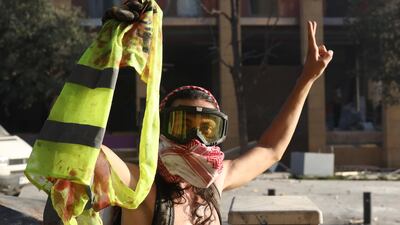
A Lebanese anti-government protester flashes a victory sign and holds a blood-stained yellow jacket of a fellow protester during clashes with riot police. EPA
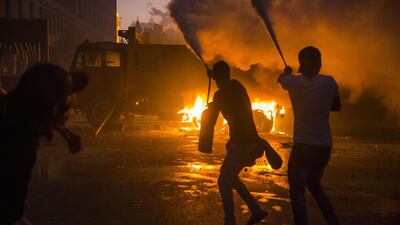
Protesters use fire extinguishers to block protesters' movements from the Internal Security Forces, not pictured, during a protest at Martyrs Square. Getty Images
Protesters move through a cloud of tear gas during a protest at Martyrs Square. Getty Images
Lebanese anti-government protesters face off with riot police. EPA
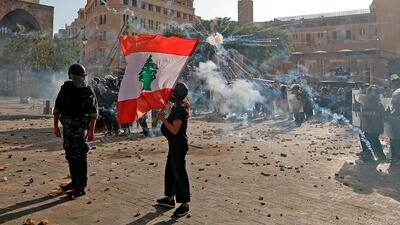
A Lebanese protester waves the national flag during clashes with security forces in downtown Beirut. AFP
A Lebanese protester speaks to soldiers at the headquarters of the Lebanese association of banks in downtown Beirut. AFP
An injured demonstrator is evacuated during a protest. Reuters
I don't know what comes next. This is only the latest in a battery of crises for the Lebanese people, though it is more monumental. It follows a currency crash, hyperinflation, collapsing economy, coronavirus resurgence, poverty, and hunger. You only rise again after so many beatings. Lebanon's ruling elite deserve the harshest of punishment, but I don't know if they'll get away with it again. I don't know if things can change, or if people will reach the conclusion I reached, that they should just leave everything behind.
I don’t know any of that. I’m not there, though I find myself wishing I could be there. All I have are memories of Beirut that aren’t scarred by the shattered glass, and the tears that well up unprompted. And a dark sadness that has made it impossible to smile.
Kareem Shaheen is a former Middle East correspondent based in Canada

SQUADS
UAE
Mohammed Naveed (captain), Mohamed Usman (vice-captain), Ashfaq Ahmed, Chirag Suri, Shaiman Anwar, Mohammed Boota, Ghulam Shabber, Imran Haider, Tahir Mughal, Amir Hayat, Zahoor Khan, Qadeer Ahmed, Fahad Nawaz, Abdul Shakoor, Sultan Ahmed, CP Rizwan
Non-fungible tokens (NFTs) are tokens that represent ownership of unique items. They allow the tokenisation of things such as art, collectibles and even real estate.
An NFT can have only one official owner at one time. And since they're minted and secured on the Ethereum blockchain, no one can modify the record of ownership, not even copy-paste it into a new one.
This means NFTs are not interchangeable and cannot be exchanged with other items. In contrast, fungible items, such as fiat currencies, can be exchanged because their value defines them rather than their unique properties.
1. Domestic VAT refund amendments: request your refund within five years
If a business does not apply for the refund on time, they lose their credit.
2. E-invoicing in the UAE
Businesses should continue preparing for the implementation of e-invoicing in the UAE, with 2026 a preparation and transition period ahead of phased mandatory adoption.
3. More tax audits
Tax authorities are increasingly using data already available across multiple filings to identify audit risks.
4. More beneficial VAT and excise tax penalty regime
Tax disputes are expected to become more frequent and more structured, with clearer administrative objection and appeal processes. The UAE has adopted a new penalty regime for VAT and excise disputes, which now mirrors the penalty regime for corporate tax.
5. Greater emphasis on statutory audit
There is a greater need for the accuracy of financial statements. The International Financial Reporting Standards standards need to be strictly adhered to and, as a result, the quality of the audits will need to increase.
6. Further transfer pricing enforcement
Transfer pricing enforcement, which refers to the practice of establishing prices for internal transactions between related entities, is expected to broaden in scope. The UAE will shortly open the possibility to negotiate advance pricing agreements, or essentially rulings for transfer pricing purposes.
7. Limited time periods for audits
Recent amendments also introduce a default five-year limitation period for tax audits and assessments, subject to specific statutory exceptions. While the standard audit and assessment period is five years, this may be extended to up to 15 years in cases involving fraud or tax evasion.
8. Pillar 2 implementation
Many multinational groups will begin to feel the practical effect of the Domestic Minimum Top-Up Tax (DMTT), the UAE's implementation of the OECD’s global minimum tax under Pillar 2. While the rules apply for financial years starting on or after January 1, 2025, it is 2026 that marks the transition to an operational phase.
9. Reduced compliance obligations for imported goods and services
Businesses that apply the reverse-charge mechanism for VAT purposes in the UAE may benefit from reduced compliance obligations.
10. Substance and CbC reporting focus
Tax authorities are expected to continue strengthening the enforcement of economic substance and Country-by-Country (CbC) reporting frameworks. In the UAE, these regimes are increasingly being used as risk-assessment tools, providing tax authorities with a comprehensive view of multinational groups’ global footprints and enabling them to assess whether profits are aligned with real economic activity.
Contributed by Thomas Vanhee and Hend Rashwan, Aurifer
My Sister, the Serial Killer by Oyinkan Braithwaite
Milkman by Anna Burns
Ordinary People by Diana Evans
An American Marriage by Tayari Jones
Circe by Madeline Miller
Tamkeen's offering
Option 1: 70% in year 1, 50% in year 2, 30% in year 3
Option 2: 50% across three years
Option 3: 30% across five years
Chef Nobu's advice for eating sushi
“One mistake people always make is adding extra wasabi. There is no need for this, because it should already be there between the rice and the fish.
“When eating nigiri, you must dip the fish – not the rice – in soy sauce, otherwise the rice will collapse. Also, don’t use too much soy sauce or it will make you thirsty. For sushi rolls, dip a little of the rice-covered roll lightly in soy sauce and eat in one bite.
“Chopsticks are acceptable, but really, I recommend using your fingers for sushi. Do use chopsticks for sashimi, though.
“The ginger should be eaten separately as a palette cleanser and used to clear the mouth when switching between different pieces of fish.”
2002: "Hezbollah supporters feared becoming a target of security services because of the effects of [9/11] ... discussions on Hezbollah policy moved from mosques into smaller circles in private homes." Supporters in Germany: 800
2013: "Financial and logistical support from Germany for Hezbollah in Lebanon supports the armed struggle against Israel ... Hezbollah supporters in Germany hold back from actions that would gain publicity." Supporters in Germany: 950
2023: "It must be reckoned with that Hezbollah will continue to plan terrorist actions outside the Middle East against Israel or Israeli interests." Supporters in Germany: 1,250
Source: Federal Office for the Protection of the Constitution
How to watch Ireland v Pakistan in UAE
When: The one-off Test starts on Friday, May 11 What time: Each day’s play is scheduled to start at 2pm UAE time. TV: The match will be broadcast on OSN Sports Cricket HD. Subscribers to the channel can also stream the action live on OSN Play.
Olympic-size swimming pool with a split bulkhead for multi-use configurations, including water polo and 50m/25m training lanes
Premier League-standard football pitch
400m Olympic running track
NBA-spec basketball court with auditorium
600-seat auditorium
Spaces for historical and cultural exploration
An elevated football field that doubles as a helipad
Specialist robotics and science laboratories
AR and VR-enabled learning centres
Disruption Lab and Research Centre for developing entrepreneurial skills
World record transfers
1. Kylian Mbappe - to Real Madrid in 2017/18 - €180 million (Dh770.4m - if a deal goes through)
2. Paul Pogba - to Manchester United in 2016/17 - €105m
3. Gareth Bale - to Real Madrid in 2013/14 - €101m
4. Cristiano Ronaldo - to Real Madrid in 2009/10 - €94m
5. Gonzalo Higuain - to Juventus in 2016/17 - €90m
6. Neymar - to Barcelona in 2013/14 - €88.2m
7. Romelu Lukaku - to Manchester United in 2017/18 - €84.7m
8. Luis Suarez - to Barcelona in 2014/15 - €81.72m
9. Angel di Maria - to Manchester United in 2014/15 - €75m
10. James Rodriguez - to Real Madrid in 2014/15 - €75m
UAE currency: the story behind the money in your pockets
David Einhorn closed out 2018 with his biggest annual loss ever for the 22-year-old Greenlight Capital.
The firm’s main hedge fund fell 9 per cent in December, extending this year’s decline to 34 percent, according to an investor update viewed by Bloomberg.
Greenlight posted some of the industry’s best returns in its early years, but has stumbled since losing more than 20 per cent in 2015.
Other value-investing managers have also struggled, as a decade of historically low interest rates and the rise of passive investing and quant trading pushed growth stocks past their inexpensive brethren. Three Bays Capital and SPO Partners & Co., which sought to make wagers on undervalued stocks, closed in 2018. Mr Einhorn has repeatedly expressed his frustration with the poor performance this year, while remaining steadfast in his commitment to value investing.
Greenlight, which posted gains only in May and October, underperformed both the broader market and its peers in 2018. The S&P 500 Index dropped 4.4 per cent, including dividends, while the HFRX Global Hedge Fund Index, an early indicator of industry performance, fell 7 per cent through December. 28.
At the start of the year, Greenlight managed $6.3 billion in assets, according to a regulatory filing. By May, the firm was down to $5.5bn.
Specs
Engine: 3.0L twin-turbo V6 Gearbox: 10-speed automatic Power: 405hp at 5,500rpm Torque: 562Nm at 3,000rpm Fuel economy, combined: 11.2L/100km Price: From Dh292,845 (Reserve); from Dh320,145 (Presidential) On sale: Now
Stop all transactions and communication on suspicion
Save all evidence (screenshots, chat logs, transaction IDs)
Report to local authorities
Warn others to prevent further harm
Courtesy: Crystal Intelligence
What vitamins do we know are beneficial for living in the UAE
Vitamin D: Highly relevant in the UAE due to limited sun exposure; supports bone health, immunity and mood. Vitamin B12: Important for nerve health and energy production, especially for vegetarians, vegans and individuals with absorption issues. Iron: Useful only when deficiency or anaemia is confirmed; helps reduce fatigue and support immunity. Omega-3 (EPA/DHA): Supports heart health and reduces inflammation, especially for those who consume little fish.
The burning issue
The internal combustion engine is facing a watershed moment – major manufacturer Volvo is to stop producing petroleum-powered vehicles by 2021 and countries in Europe, including the UK, have vowed to ban their sale before 2040. The National takes a look at the story of one of the most successful technologies of the last 100 years and how it has impacted life in the UAE.