Destruction of West Bank home sparks debate on Israeli policy after Palestinian attacks


Rosie Scammell
  • English
  • Arabic

The demolition of a family house in the occupied West Bank this month has blown open the debate on Israel’s policy of destroying the homes of Palestinians linked to attacks.

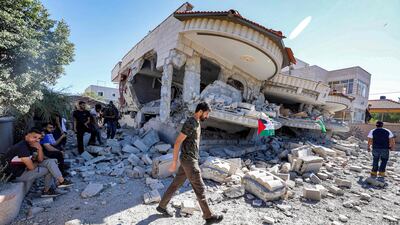
Fiery explosions ripped through the two-storey house in Turmus Ayya, a village north of Ramallah, before the red-roofed turrets of the house came crashing down on July 8.

On a quiet street opposite a school, the house had been home to Sanaa Shalabi and her three children who are all American citizens.

It was also where the children’s father, Muntasser Shalabi, stayed the night before reportedly carrying out a drive-by shooting in the West Bank that killed Israeli Yehuda Guetta and wounded two others.

  • Palestinians gather by the rubble of a building that belonged to Montasser Shalabi, who was arrested in May on suspicion of carrying out a drive-by shooting that killed an Israeli student.
    Palestinians gather by the rubble of a building that belonged to Montasser Shalabi, who was arrested in May on suspicion of carrying out a drive-by shooting that killed an Israeli student.
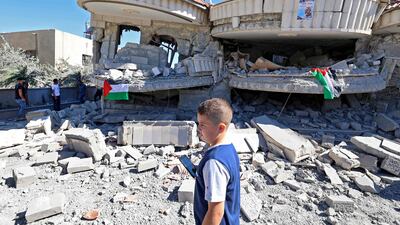
  • The building, in the village of Turmus Aya in the occupied West Bank, was destroyed by Israeli forces on July 8.
    The building, in the village of Turmus Aya in the occupied West Bank, was destroyed by Israeli forces on July 8.
  • Mr Shalabi is suspected of firing at people at a bus stop at Tapuah junction south of Nablus, in the northern West Bank, and killing 19-year-old student Yehuda Guetta.
    Mr Shalabi is suspected of firing at people at a bus stop at Tapuah junction south of Nablus, in the northern West Bank, and killing 19-year-old student Yehuda Guetta.
  • The US has criticised Israel for demolishing the family home.
    The US has criticised Israel for demolishing the family home.
  • While Mr Shalabi did not live in the house, according to Israeli human rights organisation Hamoked, it was home to his estranged wife Sanaa Shalabi and three of their seven children.
    While Mr Shalabi did not live in the house, according to Israeli human rights organisation Hamoked, it was home to his estranged wife Sanaa Shalabi and three of their seven children.
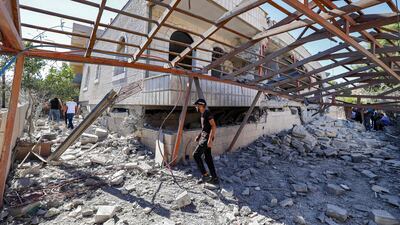
  • Troops levelled the two-storey home with controlled explosions.
    Troops levelled the two-storey home with controlled explosions.
  • The Israeli army said that during the demolition 'approximately 200 rioters hurled rocks and launched fireworks' at troops.
    The Israeli army said that during the demolition 'approximately 200 rioters hurled rocks and launched fireworks' at troops.
  • West Bank villages often hold Friday demonstrations against land confiscation, house demolitions and Israeli settlements, which are deemed illegal under international law.
    West Bank villages often hold Friday demonstrations against land confiscation, house demolitions and Israeli settlements, which are deemed illegal under international law.

Mr Shalabi has been charged over the shooting and is set to face an Israeli military court. Meanwhile, the family home was demolished as part of a policy the army says is necessary “to deter potential terrorists from carrying out attacks” against Israelis.

“The demolition of the house was approved in a detailed judgment of the Supreme Court, which ruled that the demolition of the house is legal, proportionate and achieves the purpose of deterrence,” the military said.

The military did not provide evidence to show that the policy serves as a deterrent when asked by The National.

Around 2,000 Palestinian homes have been punitively demolished or sealed up by Israeli forces since the country’s military took control of the West Bank in 1967, a UN report shows.

The policy has been repeatedly challenged by Israeli rights groups including HaMoked, whose executive director Jessica Montell described it as “morally bankrupt”.

“It’s a blatant collective punishment. You’re intentionally targeting innocent people because you think it’s going to deter future terrorists,” said Ms Montell.

Israeli courts have upheld the law itself numerous times and so HaMoked presents objections specific to each demolition order, such as the unique circumstances of the Shalabi case.

Sanaa Shalabi, who did not respond to an interview request, has been estranged from her husband for years. He had been living in the US and spent a few weeks each year visiting his children.

The rights group also argued that he had been suffering from mental illness and was on antipsychotic drugs at the time of the May 2 attack.

These arguments were rejected by the court. Of around 80 legal challenges filed since 2014, only 10 have been successful in preventing a home demolition according to HaMoked.

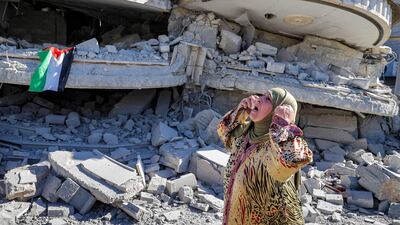
A Palestinian woman stands outside the demolished Shalabi family home.

The Shalabi family’s American citizenship drew the attention of the US embassy in Jerusalem, which called for “all parties to refrain from unilateral steps that exacerbate tensions”.

“As we stated numerous times, the home of an entire family should not be demolished for the actions of one individual,” an embassy spokesman said.

US envoy Hady Amr travelled to Israel and the Palestinian territories last week, but the issue was not mentioned in a summary of his visit published by the embassy.

Michael Lynk, UN special rapporteur for human rights in the Palestinian territories, described punitive demolitions as collective punishment which is “absolutely prohibited” under international law.

Without broader global criticism, which would in turn pressure Washington, he saw no end to the policy.

“Virtually the only government that Israel listens to internationally would be the American government,” Mr Lynk told The National.

“[If] America doesn’t decide to pose any costs on the occupation regarding Israel’s practices, then I don’t think we’re going to see any substantive changes.”

Although the current government is a broad coalition that includes Arab and left-wing parties, the alliance led by nationalist Prime Minister Naftali Bennett is unlikely to table policy changes in the West Bank.

“Certainly with respect to the Palestinians, I suspect what we have now is a government that’s going to be Netanyahu with more manners,” said Mr Lynk, referring to the former right-wing leader.


Unresolved crisis

Russia and Ukraine have been locked in a bitter conflict since 2014, when Ukraine’s Kremlin-friendly president was ousted, Moscow annexed Crimea and then backed a separatist insurgency in the east.

Fighting between the Russia-backed rebels and Ukrainian forces has killed more than 14,000 people. In 2015, France and Germany helped broker a peace deal, known as the Minsk agreements, that ended large-scale hostilities but failed to bring a political settlement of the conflict.

The Kremlin has repeatedly accused Kiev of sabotaging the deal, and Ukrainian officials in recent weeks said that implementing it in full would hurt Ukraine.

'Lost in Space'

Creators: Matt Sazama, Burk Sharpless, Irwin Allen

Stars: Molly Parker, Toby Stephens, Maxwell Jenkins

Rating: 4/5

Know your Camel lingo

The bairaq is a competition for the best herd of 50 camels, named for the banner its winner takes home

Namoos - a word of congratulations reserved for falconry competitions, camel races and camel pageants. It best translates as 'the pride of victory' - and for competitors, it is priceless

Asayel camels - sleek, short-haired hound-like racers

Majahim - chocolate-brown camels that can grow to weigh two tonnes. They were only valued for milk until camel pageantry took off in the 1990s

Millions Street - the thoroughfare where camels are led and where white 4x4s throng throughout the festival

Squad for first two ODIs

Kohli (c), Rohit, Dhawan, Rayudu, Pandey, Dhoni (wk), Pant, Jadeja, Chahal, Kuldeep, Khaleel, Shami, Thakur, Rahul.

Where to donate in the UAE

The Emirates Charity Portal

You can donate to several registered charities through a “donation catalogue”. The use of the donation is quite specific, such as buying a fan for a poor family in Niger for Dh130.

The General Authority of Islamic Affairs & Endowments

The site has an e-donation service accepting debit card, credit card or e-Dirham, an electronic payment tool developed by the Ministry of Finance and First Abu Dhabi Bank.

Al Noor Special Needs Centre

You can donate online or order Smiles n’ Stuff products handcrafted by Al Noor students. The centre publishes a wish list of extras needed, starting at Dh500.

Beit Al Khair Society

Beit Al Khair Society has the motto “From – and to – the UAE,” with donations going towards the neediest in the country. Its website has a list of physical donation sites, but people can also contribute money by SMS, bank transfer and through the hotline 800-22554.

Dar Al Ber Society

Dar Al Ber Society, which has charity projects in 39 countries, accept cash payments, money transfers or SMS donations. Its donation hotline is 800-79.

Dubai Cares

Dubai Cares provides several options for individuals and companies to donate, including online, through banks, at retail outlets, via phone and by purchasing Dubai Cares branded merchandise. It is currently running a campaign called Bookings 2030, which allows people to help change the future of six underprivileged children and young people.

Emirates Airline Foundation

Those who travel on Emirates have undoubtedly seen the little donation envelopes in the seat pockets. But the foundation also accepts donations online and in the form of Skywards Miles. Donated miles are used to sponsor travel for doctors, surgeons, engineers and other professionals volunteering on humanitarian missions around the world.

Emirates Red Crescent

On the Emirates Red Crescent website you can choose between 35 different purposes for your donation, such as providing food for fasters, supporting debtors and contributing to a refugee women fund. It also has a list of bank accounts for each donation type.

Gulf for Good

Gulf for Good raises funds for partner charity projects through challenges, like climbing Kilimanjaro and cycling through Thailand. This year’s projects are in partnership with Street Child Nepal, Larchfield Kids, the Foundation for African Empowerment and SOS Children's Villages. Since 2001, the organisation has raised more than $3.5 million (Dh12.8m) in support of over 50 children’s charities.

Noor Dubai Foundation

Sheikh Mohammed bin Rashid Al Maktoum launched the Noor Dubai Foundation a decade ago with the aim of eliminating all forms of preventable blindness globally. You can donate Dh50 to support mobile eye camps by texting the word “Noor” to 4565 (Etisalat) or 4849 (du).

Liverpool’s fixtures until end of 2019

Saturday, November 30, Brighton (h)

Wednesday, December 4, Everton (h)

Saturday, December 7, Bournemouth (a)

Tuesday, December 10, Salzburg (a) CL

Saturday, December 14, Watford (h)

Tuesday, December 17, Aston Villa (a) League Cup

Wednesday, December 18, Club World Cup in Qatar

Saturday, December 21, Club World Cup in Qatar

Thursday, December 26, Leicester (a)

Sunday, December 29, Wolves (h)

Dates for the diary

To mark Bodytree’s 10th anniversary, the coming season will be filled with celebratory activities:

  • September 21 Anyone interested in becoming a certified yoga instructor can sign up for a 250-hour course in Yoga Teacher Training with Jacquelene Sadek. It begins on September 21 and will take place over the course of six weekends.
  • October 18 to 21 International yoga instructor, Yogi Nora, will be visiting Bodytree and offering classes.
  • October 26 to November 4 International pilates instructor Courtney Miller will be on hand at the studio, offering classes.
  • November 9 Bodytree is hosting a party to celebrate turning 10, and everyone is invited. Expect a day full of free classes on the grounds of the studio.
  • December 11 Yogeswari, an advanced certified Jivamukti teacher, will be visiting the studio.
  • February 2, 2018 Bodytree will host its 4th annual yoga market.
Updated: August 01, 2021, 3:52 PM