Remember when Elon Musk said during an earnings call in October 2019 that Tesla only continued to build the Model S and X for sentimental reasons?
Now we have refreshed, updated ‘Plaid’ versions of each.
Tesla has given the cars all-new interiors, with updated screens and climate controls. It’s also redesigned the battery pack and modules in the new cars and has been making upgrades to the plant in Fremont ahead of their launch later this quarter.
The Model S Plaid is quite something. Tesla says it’s capable of 0-60 in less than two seconds, claiming in the earnings presentation that it’s the fastest-accelerating production car in the world.
It will cost $112,990, including potential incentives. That will get you 627 kilometres of range and a top speed of 322kph. Deliveries will start around March, according to the company’s website.
There’s a higher-spec $132,990 Plaid+ model, which has a greater 837km range on a single charge. The company estimates it will be set for delivery in late 2021.
-
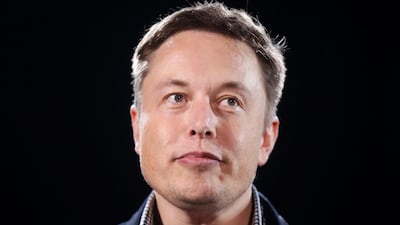
Mr Musk unveils a new all-wheel-drive version of the Model S car in Hawthorne, California, in 2014. Reuters -
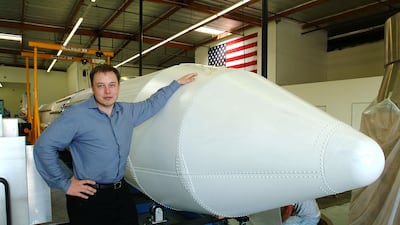
Tesla and SpaceX founder Elon Musk. Getty Images -
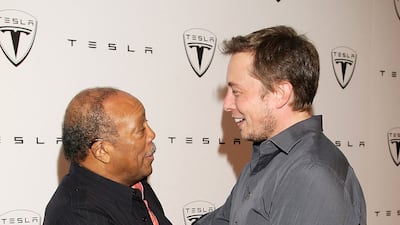
Mr Musk with music producer Quincy Jones. AFP -
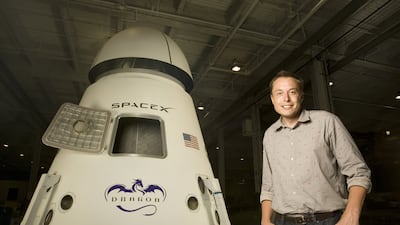
The wealthiest person in the world with a worth of $274.3 billion, Mr Musk was named 'Person of the Year' by 'Time' magazine in 2021. Getty Images -
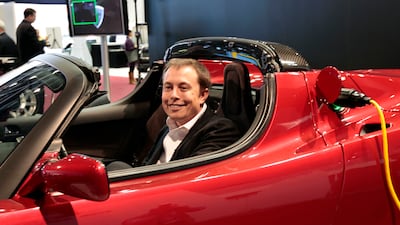
Focus on Mr Musk's taxes grew last year as Tesla achieved a rarefied $1 trillion in market value. Reuters -
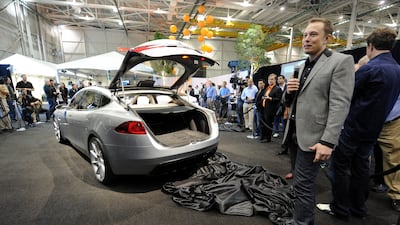
The billionaire has hit back, saying he does not draw a salary from either SpaceX or Tesla, and pays an effective tax rate of 53 per cent on stock options he exercises. AFP -
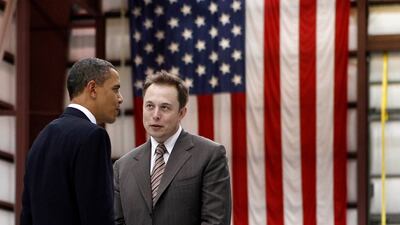
Then US president Barack Obama speaks to Mr Musk on a tour of Cape Canaveral Air Force Station in Cape Canaveral, Florida, in 2010. Reuters -
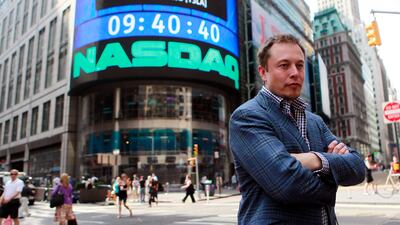
Mr Musk during a television interview after Tesla's initial public offering at the Nasdaq market in New York, in 2010. Reuters -
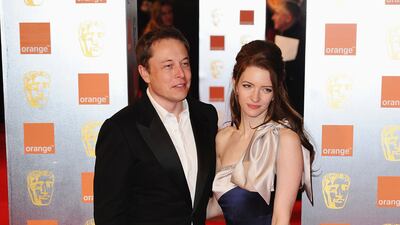
With former wife Talulah Riley at the 2011 Orange British Academy Film Awards in London. Getty Images -
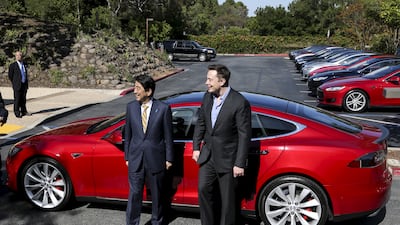
With Japan's former prime minister Shinzo Abe after a test drive of the Tesla Model S P85D in Palo Alto, California, in 2015. Reuters -
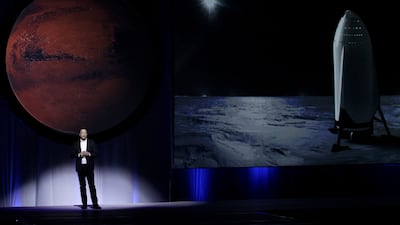
Mr Musk during the 67th International Astronautics Congress in Guadalajara, Mexico, in 2016. EPA -
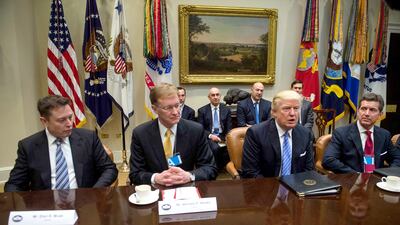
From left: SpaceX chief executive Elon Musk, Corning chief executive Wendell Weeks, then US president Donald Trump and Johnson & Johnson chief executive Alex Gorsky during a meeting at the White House. AFP -
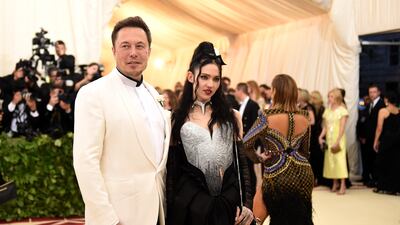
Mr Musk and former wife Grimes at The Metropolitan Museum of Art in New York City, in 2018. AFP -
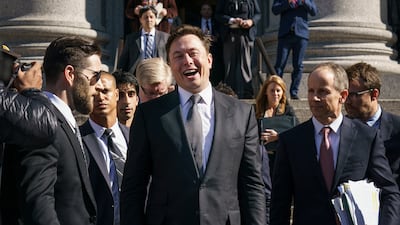
Mr Musk leaves a court in New York City, in 2019, after a hearing in a lawsuit brought against him by the US Securities and Exchange Commission. Getty Images -
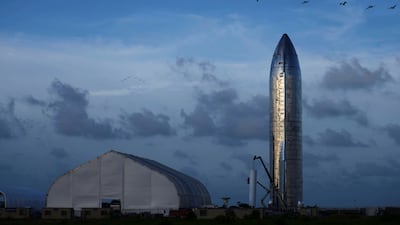
A prototype of SpaceX's Starship spacecraft is seen before Mr Musk gives an update on the company's Mars rocket Starship in Boca Chica, Texas, in 2019. Reuters -
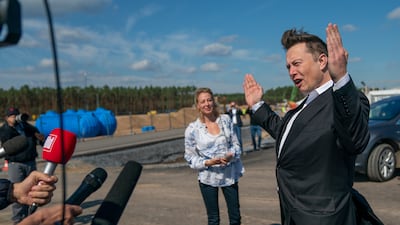
Mr Musk at the construction site of the Tesla Gigafactory in Gruenheide, near Berlin, Germany, last year. EPA -
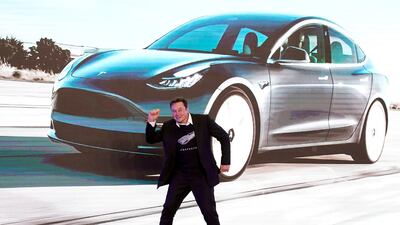
Dancing onstage during a delivery event for Tesla's China-made Model 3 cars in Shanghai. Reuters -

Mikey Day as a lawyer, Cecily Strong as a judge, and host Elon Musk as Wario during the "Wario" sketch on NBC's 'Saturday Night Live', in May. Getty Images -
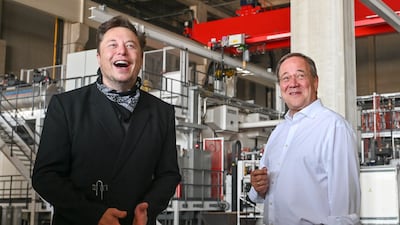
Mr Musk with Armin Laschet, CDU party federal chairman and prime minister of Germany's North Rhine-Westphalia, talk during a tour of the plant of the future foundry of the Tesla Gigafactory in Grünheide, near Berlin, Germany. Getty Images
The Plaid version of the Model X has had a similar makeover and injection of speed and power. In fact, Tesla claim it is the “highest performing SUV ever built” in terms of power and acceleration.
Starting at $113,190, inclusive of incentives, it has a maximum range of 547km (less than the more standard Long Range model) and can do 0-60kph in 2.5 seconds. Three high-performance motors give the X plaid peak power of 1,020 horsepower. Musk said in the earnings call deliveries of the Model S Plaid will be in February.

While you're here
LOVE%20AGAIN
Coffee: black death or elixir of life?
It is among the greatest health debates of our time; splashed across newspapers with contradicting headlines - is coffee good for you or not?
Depending on what you read, it is either a cancer-causing, sleep-depriving, stomach ulcer-inducing black death or the secret to long life, cutting the chance of stroke, diabetes and cancer.
The latest research - a study of 8,412 people across the UK who each underwent an MRI heart scan - is intended to put to bed (caffeine allowing) conflicting reports of the pros and cons of consumption.
The study, funded by the British Heart Foundation, contradicted previous findings that it stiffens arteries, putting pressure on the heart and increasing the likelihood of a heart attack or stroke, leading to warnings to cut down.
Numerous studies have recognised the benefits of coffee in cutting oral and esophageal cancer, the risk of a stroke and cirrhosis of the liver.
The benefits are often linked to biologically active compounds including caffeine, flavonoids, lignans, and other polyphenols, which benefit the body. These and othetr coffee compounds regulate genes involved in DNA repair, have anti-inflammatory properties and are associated with lower risk of insulin resistance, which is linked to type-2 diabetes.
But as doctors warn, too much of anything is inadvisable. The British Heart Foundation found the heaviest coffee drinkers in the study were most likely to be men who smoked and drank alcohol regularly.
Excessive amounts of coffee also unsettle the stomach causing or contributing to stomach ulcers. It also stains the teeth over time, hampers absorption of minerals and vitamins like zinc and iron.
It also raises blood pressure, which is largely problematic for people with existing conditions.
So the heaviest drinkers of the black stuff - some in the study had up to 25 cups per day - may want to rein it in.
Rory Reynolds
ELECTION%20RESULTS
ICC Awards for 2021
MEN
Cricketer of the Year – Shaheen Afridi (Pakistan)
T20 Cricketer of the Year – Mohammad Rizwan (Pakistan)
ODI Cricketer of the Year – Babar Azam (Pakistan)
Test Cricketer of the Year – Joe Root (England)
WOMEN
Cricketer of the Year – Smriti Mandhana (India)
ODI Cricketer of the Year – Lizelle Lee (South Africa)
T20 Cricketer of the Year – Tammy Beaumont (England)
Mercer, the investment consulting arm of US services company Marsh & McLennan, expects its wealth division to at least double its assets under management (AUM) in the Middle East as wealth in the region continues to grow despite economic headwinds, a company official said.
Mercer Wealth, which globally has $160 billion in AUM, plans to boost its AUM in the region to $2-$3bn in the next 2-3 years from the present $1bn, said Yasir AbuShaban, a Dubai-based principal with Mercer Wealth.
“Within the next two to three years, we are looking at reaching $2 to $3 billion as a conservative estimate and we do see an opportunity to do so,” said Mr AbuShaban.
Mercer does not directly make investments, but allocates clients’ money they have discretion to, to professional asset managers. They also provide advice to clients.
“We have buying power. We can negotiate on their (client’s) behalf with asset managers to provide them lower fees than they otherwise would have to get on their own,” he added.
Mercer Wealth’s clients include sovereign wealth funds, family offices, and insurance companies among others.
From its office in Dubai, Mercer also looks after Africa, India and Turkey, where they also see opportunity for growth.
Wealth creation in Middle East and Africa (MEA) grew 8.5 per cent to $8.1 trillion last year from $7.5tn in 2015, higher than last year’s global average of 6 per cent and the second-highest growth in a region after Asia-Pacific which grew 9.9 per cent, according to consultancy Boston Consulting Group (BCG). In the region, where wealth grew just 1.9 per cent in 2015 compared with 2014, a pickup in oil prices has helped in wealth generation.
BCG is forecasting MEA wealth will rise to $12tn by 2021, growing at an annual average of 8 per cent.
Drivers of wealth generation in the region will be split evenly between new wealth creation and growth of performance of existing assets, according to BCG.
Another general trend in the region is clients’ looking for a comprehensive approach to investing, according to Mr AbuShaban.
“Institutional investors or some of the families are seeing a slowdown in the available capital they have to invest and in that sense they are looking at optimizing the way they manage their portfolios and making sure they are not investing haphazardly and different parts of their investment are working together,” said Mr AbuShaban.
Some clients also have a higher appetite for risk, given the low interest-rate environment that does not provide enough yield for some institutional investors. These clients are keen to invest in illiquid assets, such as private equity and infrastructure.
“What we have seen is a desire for higher returns in what has been a low-return environment specifically in various fixed income or bonds,” he said.
“In this environment, we have seen a de facto increase in the risk that clients are taking in things like illiquid investments, private equity investments, infrastructure and private debt, those kind of investments were higher illiquidity results in incrementally higher returns.”
The Abu Dhabi Investment Authority, one of the largest sovereign wealth funds, said in its 2016 report that has gradually increased its exposure in direct private equity and private credit transactions, mainly in Asian markets and especially in China and India. The authority’s private equity department focused on structured equities owing to “their defensive characteristics.”


