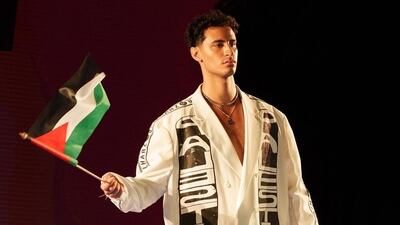
Australian label Beilharz instructed a model to wave the Palestinian flag during its spring-summer 2025 collection. Photo Beilharz/Instagram

As a Palestinian flag is waved at New York Fashion Week, a look back at protest fashion


  • English
  • Arabic

Australian designer Lewis Beilharz hit the headlines recently when a model waved a Palestinian flag during his New York Fashion Week show.

But what got the fashion-focused crowd buzzing was the collection itself, the clothes serving as an ode to Palestine and a comment on the continuing violence in Gaza and the West Bank. While waving the flag, model Abdul Almo was also wearing a jacket with Palestine written across it.

The small brand may have put itself on the map with this viral moment, but with so much of the attention on Almo rather than Beilharz, the designer who has a long history of support for Palestine, the moment arguably backfired. What it did do was start a conversation and shine a light on the issue.

Beilharz is not the first, nor will be the last, person to use fashion to make a noise about a particular event or topic. In 1984, the British designer Katherine Hamnett met the then Prime Minister Margaret Thatcher wearing a T-shirt protesting against nuclear weapons. With a T-shirt down almost to her knees, Hamnett's outfit declared that “58% Don't Want Pershing”, highlighting the number of Britons who opposed the weapons. Eight decades earlier, Suffragettes campaigned for women's right to vote dressed in all-white – because this made them easier to see in crowds.

Model Ayesha Tan-Jones staged a protest on the Gucci spring summer 2020 runway, with hands that read, 'Mental health is not fashion'. Getty Images

In 2019, model Ayesha Tan-Jones walked the runway for Gucci, displaying a collection partly inspired by straitjackets. Tan-Jones showed her displeasure at this by writing “mental health is not fashion” on her palms.

There have been numerous protests against fur, leather and even cashmere on and around the runway, notably by People for the Ethical Treatment of Animals, or Peta. In February, it stormed the Fendi show in Milan, with a sign saying “Animals Are Not Clothing.” Fendi began as a fur and leather company. A couple of weeks earlier, Peta invaded the Coach show during New York Fashion Week, with signs that read “Coach: Let Cows Live.”

In 2021, the climate action group Extinction Rebellion managed to crash numerous shows during Fashion Week, including Louis Vuitton, where protesters unfurled banners with the words “Overconsumption = Extinction.” The same week, it also interrupted the Christian Dior show with a banner reading: “We Are All Fashion Victims.” Interestingly, given designer Maria Grazia Chiuri's fondness for making political and social statements with her collections, many in the audience were left wondering if this, too, was just part of the show.

A Peta protester holds a sign reading 'Coach: Leather Kills' during the Coach Spring 2024 show at New York Fashion Week. AFP

In 2019, French comedian Marie S'Infiltre – real name Marie Benoliel – clambered on to the Chanel runway, dressed in a dog-tooth coat and black hat.

She managed to walk a fair distance before being stopped by the American-Palestinian model Gigi Hadid, who led her away. It was deemed to be a publicity stunt rather than a protest.


UAE currency: the story behind the money in your pockets
If you go

The flights

There are direct flights from Dubai to Sofia with FlyDubai (www.flydubai.com) and Wizz Air (www.wizzair.com), from Dh1,164 and Dh822 return including taxes, respectively.

The trip

Plovdiv is 150km from Sofia, with an hourly bus service taking around 2 hours and costing $16 (Dh58). The Rhodopes can be reached from Sofia in between 2-4hours.

The trip was organised by Bulguides (www.bulguides.com), which organises guided trips throughout Bulgaria. Guiding, accommodation, food and transfers from Plovdiv to the mountains and back costs around 170 USD for a four-day, three-night trip.


57%20Seconds
%3Cp%3E%3Cstrong%3EDirector%3A%3C%2Fstrong%3E%20Rusty%20Cundieff%0D%3Cbr%3E%3Cstrong%3EStars%3A%20%3C%2Fstrong%3EJosh%20Hutcherson%2C%20Morgan%20Freeman%2C%20Greg%20Germann%2C%20Lovie%20Simone%0D%3Cbr%3E%3Cstrong%3ERating%3A%20%3C%2Fstrong%3E2%2F5%0D%3Cbr%3E%0D%3Cbr%3E%3C%2Fp%3E%0A
Pieces of Her

Stars: Toni Collette, Bella Heathcote, David Wenham, Omari Hardwick   

Director: Minkie Spiro

Rating:2/5

Nepotism is the name of the game

Salman Khan’s father, Salim Khan, is one of Bollywood’s most legendary screenwriters. Through his partnership with co-writer Javed Akhtar, Salim is credited with having paved the path for the Indian film industry’s blockbuster format in the 1970s. Something his son now rules the roost of. More importantly, the Salim-Javed duo also created the persona of the “angry young man” for Bollywood megastar Amitabh Bachchan in the 1970s, reflecting the angst of the average Indian. In choosing to be the ordinary man’s “hero” as opposed to a thespian in new Bollywood, Salman Khan remains tightly linked to his father’s oeuvre. Thanks dad. 

Updated: September 15, 2024, 10:21 AM