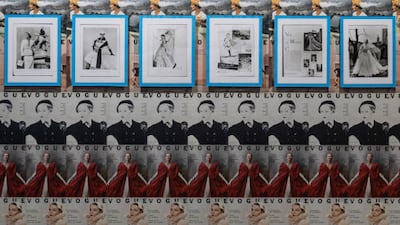
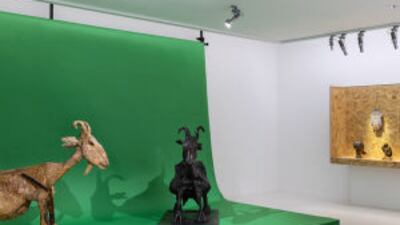
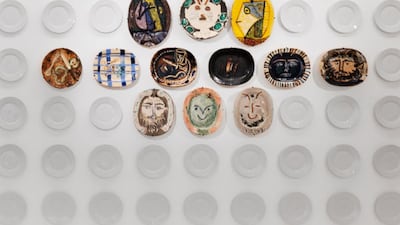
When the Picasso Museum in Paris invited Sir Paul Smith to design the exhibition marking the 50th anniversary of Pablo Picasso's death, it was clearly looking to shake things up.
The museum, shifting away from the expected guest expert, instead hand-picked a fashion designer to curate the show. Smith – best known for his colourful creations and rigorous tailoring – inevitably threw the rule book out of the window.
How fitting, then, that the show itself is called Picasso Celebration: The collection in a new light.
The National chats to Smith about the process behind the exhibition, which is open to visitors until August.
Speaking from his chaotic, treasure-filled office in London, which overflows with art books, paintings and just, well, stuff, Smith recalls how, in 2019, he was contacted by then-Picasso Museum director, Laurent Le Bon, about co-curating the anniversary show.
“I said: ‘I am not an art historian, I am not a curator and I am not an expert on Picasso’, and he said: 'We just like the way you think about things,'” Smith explains. “I think he liked my eccentricity.”
While Smith is no stranger to being in the spotlight, taking on Picasso was a daunting thought. Amid gentle teasing from his wife that Le Bon had “got the wrong Smith”, he accepted. “And then, of course, I was pretty scared,” he says.
When the pandemic shut the world down in March 2020, Smith and the museum team, including co-curators Joanne Snrech and Cecile Debray, had to do much of their work online. This included making selections from the museum's archives, which contain more than 50,000 works. “Looking at artwork on a small screen, it’s very hard to know if the thing is this or that big,” Smith says, tracing outlines of vast canvasses and tiny artworks in the air with his hands.
He also had to rely on video calls to gain an understanding of the layout of the museum housed within the historic Hotel Sale, which would prove integral to his vision for the show.
“You have to imagine doing something different in every room, where some are very tall with big windows, and some are like an attic with beams, so that was tough in itself,” he explains. “And then trying to think about [the art] in situ – what should the exhibition start with, and try to get this strange rhythm going. The first floor is this amazing vista, a beautiful set of rooms, which go on to big windows that overlook the garden.”
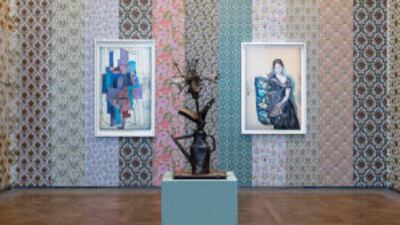
Seizing the chance to do something unexpected, he filled the room at one end of the corridor with studies for Les Demoiselles d’Avignon (1907), on walls now painted a punchy pink, while at the opposite end, Smith hung Paul as Harlequin (1924), on a wall hand-painted to echo the diamond pattern of the child's costume.
“The original was too neat,” he explains of the cross hatched lines covering the wall. “When they first painted it, they did it too perfectly.” Still unable to travel because of the pandemic, Smith had to explain his ideas via the phone. “I wanted it to be done in more a relaxed way, and that was all done by holding up my phone to the camera. It was mad,” he says with a laugh.
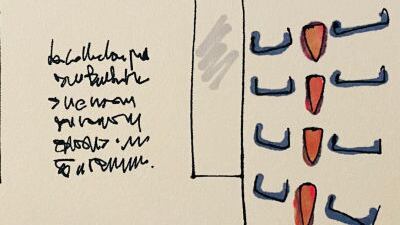
This ad hoc method, Smith explains, was the only option available for communicating many of his ideas. “For two years it was all about online meetings. For a lot of the decisions, I would get a piece of paper, draw something and hold it up to the camera saying: “Like this, can you see it?” A lot of this was done with Post-it notes and on the back of envelopes.”
Despite the difficulties, Smith was given space to work intuitively. “Looking through hundreds of paintings, there was one period where Picasso put quite a lot of stripes into the artwork, and I thought: ‘Oh, that is very Paul Smith.’”
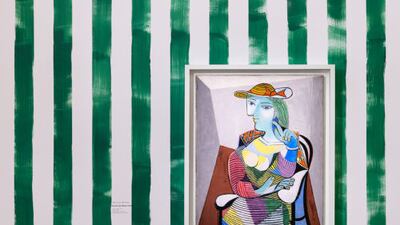
Using stripes as an inspiration, he coated the walls of one of the museum's rooms in white and green, on to which he hung the famous Portrait de Marie-Therese Walter (1937).
“People were blown away, saying: ‘I can’t imagine you would put a £100 million painting on to a striped wall.’ But somehow it works,’’ he says.
The enormous value of the artworks was an issue in itself, Smith explains. Not only were many of the pieces he wanted in different European institutions, but each piece also had to be stored and transported in its own custom-made crate. “I remember seeing three big boxes [at the museum] one day, and saying: ‘Oh, what’s in there?’ And the lady said: ‘£300 million pounds.’ Mad stuff.”
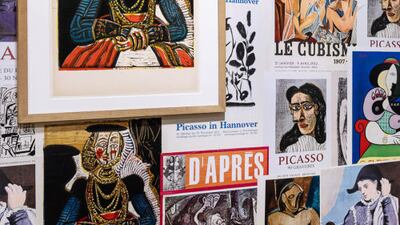
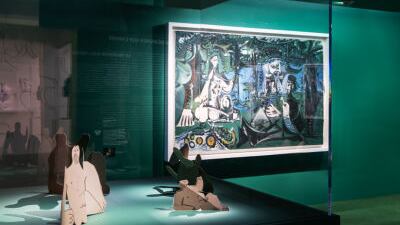
Leaning into his eclectic taste, Smith painted one room a deep, melancholy blue with a matching carpet, while another is lined with vintage Victorian wallpapers. Elsewhere, walls are plastered with fly posters of long-expired Picasso exhibitions.
Smith's radical take on a traditional exhibition has not only helped to draw record crowds, but also sparked a wider conversation about how art is shown.
“I am someone who is not afraid of colour,” he says. “They could easily have chosen someone who is more minimal, but I don’t think that is what they wanted. I think they wanted something that really surprised people.
“The most difficult thing – apart from being petrified – was being aware that people might not like it. When you are given carte blanche, it’s very much a personal point of view, you know?”
Describing the experience as “humbling”, he explains that even half a century after his death, Picasso has much to teach us. “As a designer I have to be very aware of change and always moving on, the volume of a jacket, the colour, the texture,” Smith says. “Picasso was always interested in new ideas and doing things differently, whereas I have to do it commercially, but I learnt that in the creative business you just have to keep moving.”

if you go
The flights
Emirates flies to Delhi with fares starting from around Dh760 return, while Etihad fares cost about Dh783 return. From Delhi, there are connecting flights to Lucknow.
Where to stay
It is advisable to stay in Lucknow and make a day trip to Kannauj. A stay at the Lebua Lucknow hotel, a traditional Lucknowi mansion, is recommended. Prices start from Dh300 per night (excluding taxes).
House-hunting
Top 10 locations for inquiries from US house hunters, according to Rightmove
- Edinburgh, Scotland
- Westminster, London
- Camden, London
- Glasgow, Scotland
- Islington, London
- Kensington and Chelsea, London
- Highlands, Scotland
- Argyll and Bute, Scotland
- Fife, Scotland
- Tower Hamlets, London
Why your domicile status is important
Your UK residence status is assessed using the statutory residence test. While your residence status – ie where you live - is assessed every year, your domicile status is assessed over your lifetime.
Your domicile of origin generally comes from your parents and if your parents were not married, then it is decided by your father. Your domicile is generally the country your father considered his permanent home when you were born.
UK residents who have their permanent home ("domicile") outside the UK may not have to pay UK tax on foreign income. For example, they do not pay tax on foreign income or gains if they are less than £2,000 in the tax year and do not transfer that gain to a UK bank account.
A UK-domiciled person, however, is liable for UK tax on their worldwide income and gains when they are resident in the UK.
Tributes from the UAE's personal finance community
• Sebastien Aguilar, who heads SimplyFI.org, a non-profit community where people learn to invest Bogleheads’ style
“It is thanks to Jack Bogle’s work that this community exists and thanks to his work that many investors now get the full benefits of long term, buy and hold stock market investing.
Compared to the industry, investing using the common sense approach of a Boglehead saves a lot in costs and guarantees higher returns than the average actively managed fund over the long term.
From a personal perspective, learning how to invest using Bogle’s approach was a turning point in my life. I quickly realised there was no point chasing returns and paying expensive advisers or platforms. Once money is taken care off, you can work on what truly matters, such as family, relationships or other projects. I owe Jack Bogle for that.”
• Sam Instone, director of financial advisory firm AES International
"Thought to have saved investors over a trillion dollars, Jack Bogle’s ideas truly changed the way the world invests. Shaped by his own personal experiences, his philosophy and basic rules for investors challenged the status quo of a self-interested global industry and eventually prevailed. Loathed by many big companies and commission-driven salespeople, he has transformed the way well-informed investors and professional advisers make decisions."
• Demos Kyprianou, a board member of SimplyFI.org
"Jack Bogle for me was a rebel, a revolutionary who changed the industry and gave the little guy like me, a chance. He was also a mentor who inspired me to take the leap and take control of my own finances."
• Steve Cronin, founder of DeadSimpleSaving.com
"Obsessed with reducing fees, Jack Bogle structured Vanguard to be owned by its clients – that way the priority would be fee minimisation for clients rather than profit maximisation for the company.
His real gift to us has been the ability to invest in the stock market (buy and hold for the long term) rather than be forced to speculate (try to make profits in the shorter term) or even worse have others speculate on our behalf.
Bogle has given countless investors the ability to get on with their life while growing their wealth in the background as fast as possible. The Financial Independence movement would barely exist without this."
• Zach Holz, who blogs about financial independence at The Happiest Teacher
"Jack Bogle was one of the greatest forces for wealth democratisation the world has ever seen. He allowed people a way to be free from the parasitical "financial advisers" whose only real concern are the fat fees they get from selling you over-complicated "products" that have caused millions of people all around the world real harm.”
• Tuan Phan, a board member of SimplyFI.org
"In an industry that’s synonymous with greed, Jack Bogle was a lone wolf, swimming against the tide. When others were incentivised to enrich themselves, he stood by the ‘fiduciary’ standard – something that is badly needed in the financial industry of the UAE."
Ziina users can donate to relief efforts in Beirut
Ziina users will be able to use the app to help relief efforts in Beirut, which has been left reeling after an August blast caused an estimated $15 billion in damage and left thousands homeless. Ziina has partnered with the United Nations High Commissioner for Refugees to raise money for the Lebanese capital, co-founder Faisal Toukan says. “As of October 1, the UNHCR has the first certified badge on Ziina and is automatically part of user's top friends' list during this campaign. Users can now donate any amount to the Beirut relief with two clicks. The money raised will go towards rebuilding houses for the families that were impacted by the explosion.”
How to help
Send “thenational” to the following numbers or call the hotline on: 0502955999
2289 – Dh10
2252 – Dh 50
6025 – Dh20
6027 – Dh 100
6026 – Dh 200
Mercer, the investment consulting arm of US services company Marsh & McLennan, expects its wealth division to at least double its assets under management (AUM) in the Middle East as wealth in the region continues to grow despite economic headwinds, a company official said.
Mercer Wealth, which globally has $160 billion in AUM, plans to boost its AUM in the region to $2-$3bn in the next 2-3 years from the present $1bn, said Yasir AbuShaban, a Dubai-based principal with Mercer Wealth.
“Within the next two to three years, we are looking at reaching $2 to $3 billion as a conservative estimate and we do see an opportunity to do so,” said Mr AbuShaban.
Mercer does not directly make investments, but allocates clients’ money they have discretion to, to professional asset managers. They also provide advice to clients.
“We have buying power. We can negotiate on their (client’s) behalf with asset managers to provide them lower fees than they otherwise would have to get on their own,” he added.
Mercer Wealth’s clients include sovereign wealth funds, family offices, and insurance companies among others.
From its office in Dubai, Mercer also looks after Africa, India and Turkey, where they also see opportunity for growth.
Wealth creation in Middle East and Africa (MEA) grew 8.5 per cent to $8.1 trillion last year from $7.5tn in 2015, higher than last year’s global average of 6 per cent and the second-highest growth in a region after Asia-Pacific which grew 9.9 per cent, according to consultancy Boston Consulting Group (BCG). In the region, where wealth grew just 1.9 per cent in 2015 compared with 2014, a pickup in oil prices has helped in wealth generation.
BCG is forecasting MEA wealth will rise to $12tn by 2021, growing at an annual average of 8 per cent.
Drivers of wealth generation in the region will be split evenly between new wealth creation and growth of performance of existing assets, according to BCG.
Another general trend in the region is clients’ looking for a comprehensive approach to investing, according to Mr AbuShaban.
“Institutional investors or some of the families are seeing a slowdown in the available capital they have to invest and in that sense they are looking at optimizing the way they manage their portfolios and making sure they are not investing haphazardly and different parts of their investment are working together,” said Mr AbuShaban.
Some clients also have a higher appetite for risk, given the low interest-rate environment that does not provide enough yield for some institutional investors. These clients are keen to invest in illiquid assets, such as private equity and infrastructure.
“What we have seen is a desire for higher returns in what has been a low-return environment specifically in various fixed income or bonds,” he said.
“In this environment, we have seen a de facto increase in the risk that clients are taking in things like illiquid investments, private equity investments, infrastructure and private debt, those kind of investments were higher illiquidity results in incrementally higher returns.”
The Abu Dhabi Investment Authority, one of the largest sovereign wealth funds, said in its 2016 report that has gradually increased its exposure in direct private equity and private credit transactions, mainly in Asian markets and especially in China and India. The authority’s private equity department focused on structured equities owing to “their defensive characteristics.”
BIO
Favourite holiday destination: Turkey - because the government look after animals so well there.
Favourite film: I love scary movies. I have so many favourites but The Ring stands out.
Favourite book: The Lord of the Rings. I didn’t like the movies but I loved the books.
Favourite colour: Black.
Favourite music: Hard rock. I actually also perform as a rock DJ in Dubai.
Five personal finance podcasts from The National
To help you get started, tune into these Pocketful of Dirham episodes
·
Balance is essential to happiness, health and wealth
·
What is a portfolio stress test?
·
What are NFTs and why are auction houses interested?
·
How gamers are getting rich by earning cryptocurrencies
·
Should you buy or rent a home in the UAE?
KILLING OF QASSEM SULEIMANI
Off-roading in the UAE: How to checklist
What is a Ponzi scheme?
A fraudulent investment operation where the scammer provides fake reports and generates returns for old investors through money paid by new investors, rather than through ligitimate business activities.
UAE currency: the story behind the money in your pockets