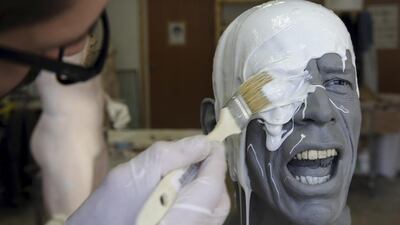
• The figure is prepared ahead of the opening of the new Grevin Wax Museum in Prague on May 1st. Philippe Wojazer / Reuters
    The figure is prepared ahead of the opening of the new Grevin Wax Museum in Prague on May 1st. Philippe Wojazer / Reuters
  • Helene Jonca, one of the painters at the Paris Grevin Wax Museum checks the wax statue of Rolling Stones lead singer Mick Jagger in their workshop in Paris on April 4, 2014. Philippe Wojazer / Reuters
    Helene Jonca, one of the painters at the Paris Grevin Wax Museum checks the wax statue of Rolling Stones lead singer Mick Jagger in their workshop in Paris on April 4, 2014. Philippe Wojazer / Reuters
  • Fifteen artists, including sculptors, moulders, dressmakers, make-up artists, wig makers, hairdressers along with lighting and set designers and sound engineers are involved in the creation of the hyper realistic statues. Philippe Wojazer / Reuters
    Fifteen artists, including sculptors, moulders, dressmakers, make-up artists, wig makers, hairdressers along with lighting and set designers and sound engineers are involved in the creation of the hyper realistic statues. Philippe Wojazer / Reuters
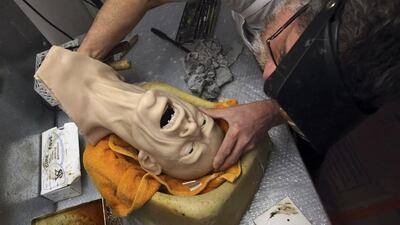
  • Sculptor Eric Saint Chaffray works on the head of Rolling Stones lead singer Mick Jagger in their workshop. Philippe Wojazer / Reuters
    Sculptor Eric Saint Chaffray works on the head of Rolling Stones lead singer Mick Jagger in their workshop. Philippe Wojazer / Reuters
  • Sculptor Eric Saint Chaffray puts the teeth and tongue inside the head of Rolling Stones lead singer Mick Jagger at their workshop in Paris on March 10, 2014. Philippe Wojazer / Reuters
    Sculptor Eric Saint Chaffray puts the teeth and tongue inside the head of Rolling Stones lead singer Mick Jagger at their workshop in Paris on March 10, 2014. Philippe Wojazer / Reuters
  • Painter Franck Bruneau works on the head of Rolling Stones lead singer Mick Jagger at their workshop in Paris on April 9, 2014. Philippe Wojazer / Reuters
    Painter Franck Bruneau works on the head of Rolling Stones lead singer Mick Jagger at their workshop in Paris on April 9, 2014. Philippe Wojazer / Reuters
  • Hairdresser Virginie Dahan puts the final touches to Rolling Stones lead singer Mick Jagger’s statue at the Grevin Wax Museum in Prague on April 24, 2014. David W Cerny / Reuters
    Hairdresser Virginie Dahan puts the final touches to Rolling Stones lead singer Mick Jagger’s statue at the Grevin Wax Museum in Prague on April 24, 2014. David W Cerny / Reuters
  • Hairdresser Virginie Dahan puts the final touches to Rolling Stones lead singer Mick Jagger’s statue. David W Cerny / Reuters
    Hairdresser Virginie Dahan puts the final touches to Rolling Stones lead singer Mick Jagger’s statue. David W Cerny / Reuters

In pictures: The creation of a Mick Jagger wax statue


  • English
  • Arabic

The Rolling Stones frontman Mick Jagger gets a wax statue created for the Grevin Wax Museum in Paris, France.

What is graphene?

Graphene is a single layer of carbon atoms arranged like honeycomb.

It was discovered in 2004, when Russian-born Manchester scientists Andrei Geim and Kostya Novoselov were "playing about" with sticky tape and graphite - the material used as "lead" in pencils.

Placing the tape on the graphite and peeling it, they managed to rip off thin flakes of carbon. In the beginning they got flakes consisting of many layers of graphene. But as they repeated the process many times, the flakes got thinner.

By separating the graphite fragments repeatedly, they managed to create flakes that were just one atom thick. Their experiment had led to graphene being isolated for the very first time.

At the time, many believed it was impossible for such thin crystalline materials to be stable. But examined under a microscope, the material remained stable, and when tested was found to have incredible properties.

It is many times times stronger than steel, yet incredibly lightweight and flexible. It is electrically and thermally conductive but also transparent. The world's first 2D material, it is one million times thinner than the diameter of a single human hair.

But the 'sticky tape' method would not work on an industrial scale. Since then, scientists have been working on manufacturing graphene, to make use of its incredible properties.

In 2010, Geim and Novoselov were awarded the Nobel Prize for Physics. Their discovery meant physicists could study a new class of two-dimensional materials with unique properties. 


GOODBYE%20JULIA
%3Cp%3E%3Cstrong%3EDirector%3A%20%3C%2Fstrong%3EMohamed%20Kordofani%3C%2Fp%3E%0A%3Cp%3E%3Cstrong%3EStarring%3A%20%3C%2Fstrong%3ESiran%20Riak%2C%20Eiman%20Yousif%2C%20Nazar%20Goma%3C%2Fp%3E%0A%3Cp%3E%3Cstrong%3ERating%3A%3C%2Fstrong%3E%205%2F5%3C%2Fp%3E%0A