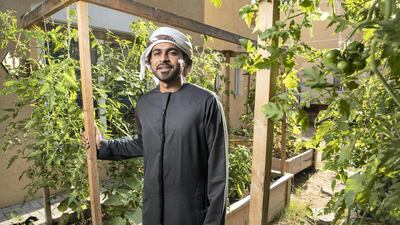
Mohammed Al Dhuhouri, founder of Local Roots, a company that encourages sustainable organic farming. Antonie Robertson / The National

Growing your own food is 'like a superpower' that could save you Dh5,000 a year on grocery bills


  • English
  • Arabic

Buy farm-fresh food

The UAE is stepping up its game when it comes to platforms for local farms to show off and sell their produce.

In Dubai, visit Emirati Farmers Souq at The Pointe every Saturday from 8am to 2pm, which has produce from Al Ammar Farm, Omar Al Katri Farm, Hikarivege Vegetables, Rashed Farms and Al Khaleej Honey Trading, among others. 

In Sharjah, the Aljada residential community will launch a new outdoor farmers’ market every Friday starting this weekend. Manbat will be held from 3pm to 8pm, and will host 30 farmers, local home-grown entrepreneurs and food stalls from the teams behind Badia Farms; Emirates Hydroponics Farms; Modern Organic Farm; Revolution Real; Astraea Farms; and Al Khaleej Food. 

In Abu Dhabi, order farm produce from Food Crowd, an online grocery platform that supplies fresh and organic ingredients directly from farms such as Emirates Bio Farm, TFC, Armela Farms and mother company Al Dahra. 

Along with home chefs and TikTok dancers, the coronavirus pandemic spurred the rise of a UAE community some experts say is the need of the hour: gardeners growing their own food.

Using everything from living-room spaces to balconies in high-rises, many in the community say their passion has made them more aware not only of the foods they consume, but also of the wider environmental impact of the supply chain.

Gardening kits by Local Roots 

"In the UAE, most of our food is imported, almost 90 per cent, which is crazy. Imagine facing a situation where the supply chain stops. We will be left with nothing," says Mohammed Al Dhuhouri, who founded Local Roots UAE in October 2019. The company encourages sustainable and organic local food production by providing consultation and gardening kits to anyone keen to start growing their own food at home.

Al Dhuhouri is an Emirati geologist who works as an environmental specialist at the Ministry of Climate Change and Environment. He says he started his company after he saw a growing interest. "People are realising whatever they put on their plates affects their health. And we wanted to encourage this trend, and provide the right tools and knowledge," he says.

A balcony full of vegetables

Nirmala D'Souza with her Malabar spinach plant.

Dubai resident Nirmala D'Souza discovered the joys of producing her own food during restrictions on movement last year. "We weren't meeting anybody then and spending so much time in front of our screens, so I wanted a diversion," she says. "I started with chilli and once I saw it flourishing, I decided to do more research online and began growing."

The plant produced just one fruit, but the joy I felt was out of this world

D'Souza, who runs her own public relations company, has now converted her two balconies into gardens – one for vegetables, the other for flowers. On the former, she grows everything from coriander, fenugreek, spinach and taro to turmeric, cucumber and tomatoes. She says starting her own garden was one of the best decisions she's ever made.

“The feeling when you plant something and then harvest it, I don’t think anything else makes me this happy. My cucumber plant produced just one fruit, but the joy I felt was out of this world. I am now thinking about moving into a villa where I can have a bigger garden.”

Immunity-boosting microgreens 

Jay Menorca, who works in marketing, says he’s saved a lot of money since he started his microgreens garden in July last year.

“A lot of microgreens are not easily available in the UAE and, where they are sold, they are expensive,” he says. “For example, when you buy wheatgrass at juice bars, one shot will cost you about Dh25. I bought a kilogram of seeds for Dh15 and can harvest it for a month.”

Jay Menorca began growing immunity-boosting micro-greens when his housemate tested positive for Covid-19.

It was Menorca's housemate's Covid-19 diagnosis that led him to set up a microgreens garden in their living room. "When my friend tested positive, we researched superfoods that could help boost the immune system and found that microgreens are 10 times more nutrient compact than a lot of vegetables," he says.

Menorca built a deck with tools, including energy-­efficient lighting, and seeds and trays ordered online. The seeds are ready to harvest within nine to 14 days, depending on the variety. He says he's been so successful with the project that he's helped to set up similar gardens for his friends.

"I am in the process of researching licensing and thinking about selling 'grow kits' for microgreens with all the seeds and tools as I've received so many inquiries.

Sell your own produce  

Leonard Rego, in black, and his cousin Nasser host webinars to encourage people to produce and sell their own food.

Other UAE residents have already turned their passion for gardening into successful businesses. Leonard Rego, who runs a technology and media company, last year decided to set up So We Grow, a company that helps people grow food on their balconies or in their back gardens. Rego and his cousin Nasser host training webinars to encourage people to produce their own food, and teach them how to become "market gardeners", so they can sell their produce.

During our webinars, one of the questions asked was which tree radishes grew on. People had no idea where their food was coming from

The training sessions, held in Arabic and English, are gaining in popularity. Having started it April last year, the duo have more than 13,000 members on their Facebook page and more than 6,000 followers on Instagram. "Our mission is to let people know they don't have to rely on others for their sustenance. And to do it in a clean and healthy way, organically.

"The reason we started [the business] was because as soon as the pandemic hit, one of the fears was about food ­supply. Then there was a fear of contamination," says Rego. "Also there was little knowledge. People are so disconnected from nature in a city. During our webinars, someone asked which tree radishes grew on. People had no idea where their food was coming from."

Al Dhuhouri, who also hosts educational classes, says he's making it his mission to encourage more Emiratis to join him in the movement. "Many people think we live in a desert and we can't garden. We actually have one of the longest growing seasons on the planet, about seven months, compared to, say, Canada, which has just three months. So we are very lucky," says the father-of-three, who plans to set up an organic farm.

"Whenever you're connecting with nature and your hands are touching the soil, there is a sense of being grounded, and you feel peaceful. So you also benefit mentally and spiritually. And at the same time you produce high-quality food," he says.

Mohammed Al Dhuhouri's organic home food garden. Antonie Robertson / The National

“Also environmentally, you’re helping in cleaning all the bad chemicals that are circulating in the atmosphere. When we do gardening, we’re sequestering carbon and putting it back into the ground. So you are part of the solution. Eating healthy, producing food and helping the environment – it’s a win-win situation.”

There is also the monetary aspect. Rego grows more than 20 types of vegetables on his balcony and the garden of his Dubai Hills villa. He estimates that he and his family of four, including live-in house help, save up to Dh5,000 a year on grocery bills, thanks to his gardening.

That and the peace of mind it gives him is rewarding, he says. “I am working in three time zones right now and I don’t have a day off. The only time I feel grounded and present is when I’m gardening. It’s like developing a new superpower.”


COMPANY%20PROFILE
%3Cp%3E%3Cstrong%3ECompany%3A%20%3C%2Fstrong%3EEducatly%3Cbr%3E%3Cstrong%3EStarted%3A%20%3C%2Fstrong%3E2020%3Cbr%3E%3Cstrong%3EBased%3A%20%3C%2Fstrong%3EUAE%3Cbr%3E%3Cstrong%3EFounders%3A%20%3C%2Fstrong%3EMohmmed%20El%20Sonbaty%2C%20Joan%20Manuel%20and%20Abdelrahman%20Ayman%3Cbr%3E%3Cstrong%3EIndustry%3A%20%3C%2Fstrong%3EEducation%20technology%3Cbr%3E%3Cstrong%3EFunding%20size%3A%20%3C%2Fstrong%3E%242%20million%3Cbr%3E%3Cstrong%3EInvestors%3A%20%3C%2Fstrong%3EEnterprise%20Ireland%2C%20Egypt%20venture%2C%20Plus%20VC%2C%20HBAN%2C%20Falak%20Startups%3C%2Fp%3E%0A

Mercer, the investment consulting arm of US services company Marsh & McLennan, expects its wealth division to at least double its assets under management (AUM) in the Middle East as wealth in the region continues to grow despite economic headwinds, a company official said.

Mercer Wealth, which globally has $160 billion in AUM, plans to boost its AUM in the region to $2-$3bn in the next 2-3 years from the present $1bn, said Yasir AbuShaban, a Dubai-based principal with Mercer Wealth.

Within the next two to three years, we are looking at reaching $2 to $3 billion as a conservative estimate and we do see an opportunity to do so,” said Mr AbuShaban.

Mercer does not directly make investments, but allocates clients’ money they have discretion to, to professional asset managers. They also provide advice to clients.

“We have buying power. We can negotiate on their (client’s) behalf with asset managers to provide them lower fees than they otherwise would have to get on their own,” he added.

Mercer Wealth’s clients include sovereign wealth funds, family offices, and insurance companies among others.

From its office in Dubai, Mercer also looks after Africa, India and Turkey, where they also see opportunity for growth.

Wealth creation in Middle East and Africa (MEA) grew 8.5 per cent to $8.1 trillion last year from $7.5tn in 2015, higher than last year’s global average of 6 per cent and the second-highest growth in a region after Asia-Pacific which grew 9.9 per cent, according to consultancy Boston Consulting Group (BCG). In the region, where wealth grew just 1.9 per cent in 2015 compared with 2014, a pickup in oil prices has helped in wealth generation.

BCG is forecasting MEA wealth will rise to $12tn by 2021, growing at an annual average of 8 per cent.

Drivers of wealth generation in the region will be split evenly between new wealth creation and growth of performance of existing assets, according to BCG.

Another general trend in the region is clients’ looking for a comprehensive approach to investing, according to Mr AbuShaban.

“Institutional investors or some of the families are seeing a slowdown in the available capital they have to invest and in that sense they are looking at optimizing the way they manage their portfolios and making sure they are not investing haphazardly and different parts of their investment are working together,” said Mr AbuShaban.

Some clients also have a higher appetite for risk, given the low interest-rate environment that does not provide enough yield for some institutional investors. These clients are keen to invest in illiquid assets, such as private equity and infrastructure.

“What we have seen is a desire for higher returns in what has been a low-return environment specifically in various fixed income or bonds,” he said.

“In this environment, we have seen a de facto increase in the risk that clients are taking in things like illiquid investments, private equity investments, infrastructure and private debt, those kind of investments were higher illiquidity results in incrementally higher returns.”

The Abu Dhabi Investment Authority, one of the largest sovereign wealth funds, said in its 2016 report that has gradually increased its exposure in direct private equity and private credit transactions, mainly in Asian markets and especially in China and India. The authority’s private equity department focused on structured equities owing to “their defensive characteristics.”

Timeline

2012-2015

The company offers payments/bribes to win key contracts in the Middle East

May 2017

The UK SFO officially opens investigation into Petrofac’s use of agents, corruption, and potential bribery to secure contracts

September 2021

Petrofac pleads guilty to seven counts of failing to prevent bribery under the UK Bribery Act

October 2021

Court fines Petrofac £77 million for bribery. Former executive receives a two-year suspended sentence 

December 2024

Petrofac enters into comprehensive restructuring to strengthen the financial position of the group

May 2025

The High Court of England and Wales approves the company’s restructuring plan

July 2025

The Court of Appeal issues a judgment challenging parts of the restructuring plan

August 2025

Petrofac issues a business update to execute the restructuring and confirms it will appeal the Court of Appeal decision

October 2025

Petrofac loses a major TenneT offshore wind contract worth €13 billion. Holding company files for administration in the UK. Petrofac delisted from the London Stock Exchange

November 2025

180 Petrofac employees laid off in the UAE


FIXTURES

All kick-off times 10.45pm UAE ( 4 GMT)

Tuesday
Mairobr v Liverpool
Spartak Moscow v Sevilla
Feyenoord v Shakhtar Donetsk
Manchester City v Napoli
Monaco v Besiktas
RB Leipzig v Porto
Apoel Nicosia v Borussia Dortmund
Real Madrid v Tottenham Hotspur

Wednesday
Benfica v Manchester United
CSKA Moscow v Basel
Bayern Munich v Celtic
Anderlecht v Paris Saint-Germain
Qarabag v Atletico Madrid
Chelsea v Roma
Barcelona v Olympiakos
Juventus v Sporting Lisbon

Buy farm-fresh food

The UAE is stepping up its game when it comes to platforms for local farms to show off and sell their produce.

In Dubai, visit Emirati Farmers Souq at The Pointe every Saturday from 8am to 2pm, which has produce from Al Ammar Farm, Omar Al Katri Farm, Hikarivege Vegetables, Rashed Farms and Al Khaleej Honey Trading, among others. 

In Sharjah, the Aljada residential community will launch a new outdoor farmers’ market every Friday starting this weekend. Manbat will be held from 3pm to 8pm, and will host 30 farmers, local home-grown entrepreneurs and food stalls from the teams behind Badia Farms; Emirates Hydroponics Farms; Modern Organic Farm; Revolution Real; Astraea Farms; and Al Khaleej Food. 

In Abu Dhabi, order farm produce from Food Crowd, an online grocery platform that supplies fresh and organic ingredients directly from farms such as Emirates Bio Farm, TFC, Armela Farms and mother company Al Dahra.