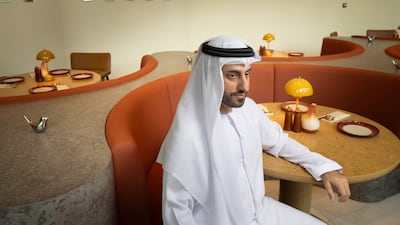

At Murmur, machboos, the generous Emirati rice dish cooked with meat or seafood and a blend of spices, has been reduced to a few bites.
The newly opened restaurant in Sharjah's Aljada district turns it into arancini, crisp on the outside while retaining its original seasoning. It is one of several Emirati and larger Gulf references woven through a menu that otherwise ranges from pasta and burgers to Asian and Levantine flavours.
For founder Saeed AlGaz, machboos was the obvious place to start.

“We wanted something that doesn’t lose its authenticity, but at the same time feels familiar. We know arancini, pizza, burgers and risotto, so my team and I thought, let’s make it happen,” he tells The National.
“Machboos is very much Emirati. If you have friends visiting from abroad, what main course would you want them to try? It has to be machboos. We turned it into arancini, but the spices are still there. You take a bite and you recognise them.”

Restaurants serving Emirati food have been part of the UAE dining scene for years. Al Fanar, founded in 2011, made its name through familiar recipes and a nostalgic setting, while Meylas began as a food truck in 2014 before opening its Al Muneera restaurant later that year.
Murmur belongs to a younger group taking greater liberties with local staples. Its dining room, lined with red walls, earth-toned seating and timber shelving, is crowned by a chandelier of handmade clay forms inspired by pearls.
The menu carries similarly subtle references to Emirati flavours. Saffron appears in a lobster roll, while karak flavours a San Sebastian cheesecake that AlGaz says has become the restaurant's most successful dessert. The Murmur Pearl, a coconut sponge cake with sago pearls, draws more directly on the UAE's pearling history.
Finding the right combinations took time. AlGaz says menu development lasted about 18 months, with one early experiment pairing saffron with ramen eventually abandoned.
“I think the entire idea started from the concept that we have always been associating with fine dining … it has been synonymous with either western cuisine or Asian or French. So as an Emirati, when I want to go out for a fine dining meal and I want to have some dishes that are from my culture at the forefront, where do I go?
“We felt like there was a clear gap in the market. And it was quite a risky gap because sometimes the traditional food scene does not necessarily become financially successful.”

Elsewhere, machboos takes on an even leaner, more textural form. At Michelin-listed Gerbou in Dubai, the kitchen once served it as a tart using the same components, according to head chef Ninad Salvi, who has also considered recasting it as a risotto.
Salvi has explored similar possibilities with margooga, a comforting chicken stew in which bread softens into spiced broth. He retains the liquid while adding noodles and pieces of fried bread for contrasting textures.
Not every idea at Gerbou involves a new technique. The restaurant uses a tanoor, an underground oven, in which marinated meat can cook for 13 or 14 hours.
“People have switched from gas to wood fire, and they try to cook everything on wood fire, charcoal and everything that's there,” Salvi says. “But the underground cooking technique is not being used much.”
Salvi also looked beyond restaurant kitchens while developing the menu. He and his team visited Emirati homes to compare how families prepared dishes including machboos and balaleet, sweetened vermicelli served with an omelette.

“Every house has its own recipes and own spices, and it cannot be compared that this is right or that is wrong.
“We have to find a balance of everything and then get it to a level where it's neutrally balanced, so everybody would accept it, then add our touch to it.”
Acceptance did not always come immediately. When Gerbou introduced its version of baith tamat, an Emirati breakfast staple of scrambled eggs and tomato, the kitchen used local cherry tomatoes with garlic, olive oil and paprika. The smokiness from the paprika drew objections from diners who told Salvi it was not the dish they knew. Gerbou kept serving it. He says it later became one of the restaurant's biggest sellers.
At Erth in Abu Dhabi, chef Arivu Ravi sees spices as the key to how far Emirati food can be pushed without losing its identity. Bezar, a local spice blend, is central to the restaurant's cooking.
“It has about 14 ingredients,” Ravi says. “Here we have coriander, cinnamon and cardamom.”
Loomi, or dried lime, is another essential flavour. “When you talk about meat dishes, they needs loomi and bezar. These give a different level of taste.”
Ravi's thareed ravioli is lamb cooked as a stew for about three and a half hours, then shredded, mixed with vegetables and bezar, and stuffed into pasta. The reduced cooking stock becomes the sauce.

“It’s a modern presentation, but you still feel the original taste. Emirati diners will recognise it as thareed, but in a modern, fine dining way,” he says.
In 2023, Erth became the world's first Emirati restaurant to earn a Michelin star, receiving the accolade in the guide's Abu Dhabi edition.
In the capital’s residential Al Muntazah district, meanwhile, newly opened Jaww Spot has another name for this style of cooking: “neo-Emirati”. Harees becomes croquettes, camel meat fills vol-au-vent pastry, saffron appears with kunafa prawns, and chebab pancakes are served with house-made date syrup.
Chef and restaurateur Steve Delpino, who developed the menu over the course of more than a year, began with a basic question: what counts as Emirati cuisine?

“Two hundred years ago, it was dates, fish and camel milk. It was very simple,” he says.
“Over the years, Indians brought spices, Persians brought fruit and vegetables, and people from the Levant and North Africa brought their own ingredients. That’s how Emirati cuisine developed. It became a combination of all these influences.”
Delpino extends that argument to the people behind the stove. An American who has lived in the UAE with his family for the past decade, he says Jaww Spot grew out of his attachment to the country.
“I created the restaurant as a way of saying thank you to the UAE for the amazing life that I and my children and my wife have had here for the last 10 years,” he says.
“I don’t think you have to be Emirati to do Emirati cuisine. If you love food, you love the ingredients and you have the passion, it doesn’t matter where you’re from. The UAE is a great example of that.”
Delpino is equally unabashed about his ambition for his restaurant. He wants Jaww Spot to earn a place in the Michelin Guide and has brought in consultants to make sure it is well positioned should the food inspectors arrive. He sees recognition from the guide as one way of getting Emirati food in front of diners who may rarely encounter it.

“Nobody really talks about Emirati cuisine as much as they should. You open up your Instagram: are you getting pop-ups of Emirati restaurants? No. And that’s a problem because there are a lot of really cool places, these little mom-and-pop restaurants with amazing Emirati food, but you don’t hear about them. You don’t see them.
“There’s nobody blowing them up on social media. There’s not enough promotion of Emirati cuisine out there. These listings are important because once the restaurants have visibility, people will come.”
Algaz agrees, saying Emirati food’s mix of refinement and rustic traditions can produce homegrown restaurants that he would confidently recommend to visitors.
“Guests from abroad should have the option to go to a homegrown concept that is upscale, while also having the opportunity to try our national dishes,” he says.
“The UAE is a cultural festival for both people who live here and those who are visiting. It appeals to everyone, and we need to show that in our restaurants and on our plates.”

