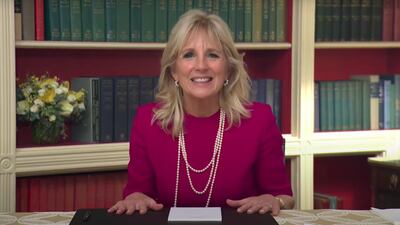

She may now be the first lady of the United States, but Jill Biden is, first and foremost, a teacher.
And the American educator with a doctorate in education was keen to reconnect with her roots in her first official engagement as first lady, taking part in a virtual event with fellow teachers to thank them for their work during the ongoing pandemic.
Ms Biden, 69, participated in a Zoom call with the National Education Association and American Federation of Teachers on Thursday evening during her first full day as first lady.
"I couldn’t wait one more day to have this meeting, to say thank you on behalf of a grateful nation, to educators for their heroic commitment to students during this pandemic," she posted on Twitter after the event.
"You’ve been so strong; and we will be strong in our support for you."
The first lady was joined at the White House by Randi Weingarten, president of the American Federation of Teachers, and Becky Pringle, president of the National Education Association, for the call.
"Thank you for all that you do in the day-to-day. It's not always recognised how much your work matters, but it does ... student by student, you are changing the world," Ms Biden told attendees.
During the event, the first lady confirmed that she will still educate while in her new role, telling attendees she will continue to teach writing at Northern Virginia Community College.
"I am teaching hybrid this semester myself. And I have to tell you, you know, I -- the one thing I love about educators is that we all, I think, help one another," she said.
She also revealed she had held an online class for the community college on Tuesday, hours before flying to Washington for her husband's presidential inauguration on Wednesday.
During the 20-minute Zoom call, the first lady also assured fellow teachers that the Biden administration would help schools during the pandemic by reducing class sizes, providing funding and making sure Covid-19 tests were available.
"This is our moment, because we know how to turn chaos into something beautiful. We do it every day in our classrooms," she said.
"We know how to be a light in the darkness and Joe is going to be a champion for you. Because he knows that's the best way to serve our students. Together we are going to transform our nation's education system. And when we do that, we will change the course of our future forever.
"And if you ever wonder if it's possible. Just remember that the first lady of the United States is one of your own," she concluded.
Ms Biden, who was previously second lady of the US between 2009 and 2017 during the Obama administration, holds a bachelor's degree and a doctoral degree from the University of Delaware, as well as master's degrees from West Chester University and Villanova University.
In a rare move, she will continue to balance an outside paying job alongside her duties as first lady.
In contrast, Melania Trump held her first event as Flotus on March 29, 2017, more than two months after Donald Trump's inauguration on January 20 that year.
Scroll through the gallery below to see more photos of Jill Biden through the years:
-

Dr Jill Biden, in an era-appropriate white blazer, with then-US Senator Joe Biden, at an Illinois Democratic Party Unity dinner in Chicago, Illinois, on May 11, 1987. Getty Images -

Jill Biden, in a gold-buttoned cobalt jacket, during a press conference in Washington on September 23, 1987. Getty Images -

Jill Biden, in a taupe belted number, attends a press conference as Joe Biden announces his bid for 1988 Democratic presidential nomination. Getty Images -

Jill Biden, in a textured wool jacket, attends a rally at the University of Delaware in Newark, Delaware, on October 31, 2008. Getty Images -

Jill Biden, in a crisp blue shirt and pencil skirt, in Washington on 13 January 2009. EPA -

Jill Biden, in a belted coat and tailored trousers, Joe Biden, Barack Obama and Michelle Obama wave to the crowd at Obama's inaugural celebration concert in Washington on January 18, 2009. Getty Images -

Jill Biden, in Reem Acra, attends the Southern Regional Ball at DC Armory on January 20, 2009 in Washington. Getty Images -

Yogi Berra is escorted on to the field by Michelle Obama and Jill Biden, in World Series merch, during the MLB World Series at Yankee Stadium on October 28, 2009 in New York, US. Getty Images -

Joe Biden and Jill Biden, in a blue skirt suit, arrive at Ben Gurion International Airport on March 8, 2010 in Tel Aviv, Israel. Getty Images -

Joe Biden and Jill Biden, in a pink button-detail dress, arrive at Amman Airport on March 11, 2010 in Amman, Jordan. Getty Images -

Jill Biden, in a blazer-inspired shirt, attends the Women's Conference in Long Beach, California, on October 26, 2010. EPA -

Prince Harry greets Jill Biden, in a floral shift dress and cardigan, during a reception for wounded soldiers at the British Ambassador's Residence in Washington on May 7, 2012. EPA -

Jill Biden, in a navy midi dress, attends the Democratic National Convention at Time Warner Cable Arena in Charlotte, North Carolina, on September 6, 2012. EPA -

Joe Biden and Jill Biden, in a pussybow coat, attend the inaugural parade in Washington on January 21, 2013. EPA -

Joe Biden and Jill Biden, in a red coat and knee-length boots, land at Orly airport in Paris, France, on February 3, 2013. EPA -

Jill Biden, in a mauve midi dress, attends an event welcoming British military veterans and their families at Winfield House in London, England, on February 5, 2013. EPA -

Joe Biden and Jill Biden, in a floral dress previously worn to meet Prince Harry, arrive at the Gandhi Smriti, a museum dedicated to Mahatma Gandhi, in New Delhi, India, on July 22, 2013. EPA -

Jill Biden, in a lace-trimmed yellow dress, attends a plenary session at the US-Africa Leaders Summit in Washington on August 6, 2014. EPA -

Jill Biden, in a striped shift dress and blazer, applauds during a medal ceremony at the Invictus Games on September 14, 2014 in London, England. Getty Images -

Joe Biden and Jill Biden, in a striped short-sleeved dress, arrive in Guatemala City, Guatemala, on March 2, 2015. EPA -

Jill Biden, in a colour-blocked shift dress, with Vietnam's First Lady Mai Thi Hanh, visits the Van Mieu temple of literature in Hanoi, Vietnam, on July 20, 2015. EPA -

Jill Biden, in a one-sleeved LBD, and Ashley Biden arrive for the 88th annual Academy Awards at the Dolby Theatre in Hollywood, California, on February 28, 2016. EPA -

Joe Biden and Jill Biden, in chartreuse-embellished florals, arrive at Ben Gurion Airport on March 8, 2016 in Tel Aviv, Israel. Getty Images -

Joe Biden and Jill Biden, in a relaxed white parka, arrive at Marka airport on March 10, 2016 in Amman, Jordan. Getty Images -

Jill Biden, in a floral midi, arrives at Panama Pacifico Airport in Panama City, Panama, on June 25, 2016. EPA -

Joe Biden and Jill Biden, in a flared sleeveless dress, attend the Democratic National Convention at the Wells Fargo Centre in Philadelphia, Pennsylvania, on July 26, 2016. EPA -

Jill Biden, in a floral shift dress, arrives in Havana, Cuba, on October 6, 2016. EPA -

Jill Biden, in a match-ready football shirt, attends a match between the United States and Cuba at Estadio Pedro Marrero on October 7, 2016 in Havana, Cuba. Getty Images -

Jill Biden, in an appliqued shift dress, visits the facilities of the paediatric foundation Por Un Manana in Santo Domingo, Dominican Republic, on October 10, 2016. EPA -

Joe Biden and Jill Biden, in a hot-pink pencil dress, with Mike and Karen Pence, before the inauguration in Washington on January 20, 2017. EPA -

Joe Biden and Jill Biden, in Gabriela Hearst, during a caucus night watch party in Des Moines, Iowa, on February 3, 2020. EPA -

Joe Biden and Jill Biden, in a relaxed blouse and pencil skirt, at the National Constitution Centre in Philadelphia, Pennsylvania, on March 10, 2020. EPA -

Joe Biden and Jill Biden, in a pale pink coat, at an Election Night event at the Chase Centre in Wilmington, Delaware, on November 3, 2020. EPA -

Joe Biden and Jill Biden, in Oscar de la Renta, attend a celebratory event at the Chase Centre in Wilmington, Delaware, on November 7, 2020. EPA



