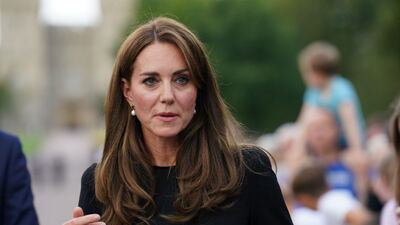
• Kate, Princess of Wales, left, wearing Queen Elizabeth II's Bahraini pearl earrings. She first wore them in public while attending the Remembrance Sunday ceremony with Camilla, Queen Consort in November 2016. AFP
    Kate, Princess of Wales, left, wearing Queen Elizabeth II's Bahraini pearl earrings. She first wore them in public while attending the Remembrance Sunday ceremony with Camilla, Queen Consort in November 2016. AFP
  • The following year, she borrowed the earrings to attend Royal Ascot in June. Reuters
    The following year, she borrowed the earrings to attend Royal Ascot in June. Reuters
  • In August 2018 she wore the earrings to attend church with Queen Elizabeth. Photo: Invicta Kent Media / Shutterstock
    In August 2018 she wore the earrings to attend church with Queen Elizabeth. Photo: Invicta Kent Media / Shutterstock
  • Camilla, left, and Kate, who is wearing the pearl earrings, take part in the Trooping the Colour in June 2019. Reuters
    Camilla, left, and Kate, who is wearing the pearl earrings, take part in the Trooping the Colour in June 2019. Reuters
  • The queen and Kate attend the Remembrance Sunday ceremony in London in 2019. AFP
    The queen and Kate attend the Remembrance Sunday ceremony in London in 2019. AFP
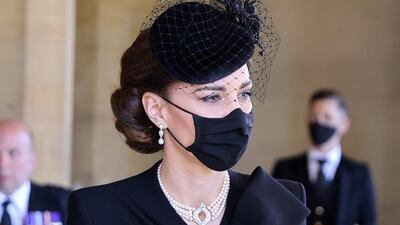
  • Pearls are worn as part of royal mourning fashion protocol. Kate borrowed the queen's pearl earrings for the funeral of Prince Philip in April last year. Reuters
    Pearls are worn as part of royal mourning fashion protocol. Kate borrowed the queen's pearl earrings for the funeral of Prince Philip in April last year. Reuters
  • Kate wore them in June to attend the National Service of Thanksgiving held at St Paul's Cathedral during the queen's platinum jubilee celebrations. Reuters
    Kate wore them in June to attend the National Service of Thanksgiving held at St Paul's Cathedral during the queen's platinum jubilee celebrations. Reuters
  • Kate also wore the earrings for the funeral of Queen Elizabeth. Reuters
    Kate also wore the earrings for the funeral of Queen Elizabeth. Reuters
  • Kate wore the earrings on Saturday to attend the Festival of Remembrance with William, Prince of Wales. AFP
    Kate wore the earrings on Saturday to attend the Festival of Remembrance with William, Prince of Wales. AFP

Every time Kate, Princess of Wales has worn Bahraini pearl earrings to public engagements


Farah Andrews
  • English
  • Arabic

The Princess of Wales is known for making considered style choices, honouring people and places through her sartorial choices. The Festival of Remembrance on Saturday was no exception.

The British royal chose to wear the Bahrain Pearl and Diamond Drop Earrings, which are made with two Bahraini pearls and were loaned to her by Queen Elizabeth II in the past.

The festival is dedicated to all those who have "served and sacrificed from Britain and the Commonwealth". This year, the memory of the queen was also celebrated.

Kate, Princess of Wales and William, Prince of Wales attend the annual Royal British Legion Festival of Remembrance. AFP

The earrings the princess chose to wear each feature one brilliant-cut round diamond, four small round diamonds and three baguette-cut diamonds, with the Bahraini pearl dangling below. The pearls are from a selection of seven given to Queen Elizabeth and Prince Philip in a shell for their wedding in 1947 by Sheikh Salman bin Hamad Al Khalifa of Bahrain.

Significantly, Kate wore the earrings to both the queen's funeral in September and to Prince Philip's in April last year. For the festival, she also chose to wear the same four-row Japanese pearl choker necklace, also from the royal collection, that she wore to both funerals.

She has worn the earrings on a several occasions since 2016, when she was first lent them by the queen to wear on Remembrance Sunday. The year before, the queen wore the pieces to attend the Festival of Remembrance.

Queen Elizabeth II wearing the Bahrani pearl earrings, with Prince William at the annual Festival of Remembrance in November 2015. Reuters

In the years since, the Princess of Wales, then Duchess of Cambridge, has worn the earrings to attend Royal Ascot in 2017, to church in Balmoral in the summer of 2018 and for the 2019 Trooping the Colour.

Aside from periods of mourning and funerals, Remembrance Sunday is the only time British royals typically will wear black outfits. As pearls are worn as mourning jewellery in British royal custom, she wore them in later in 2019 on Remembrance Sunday.

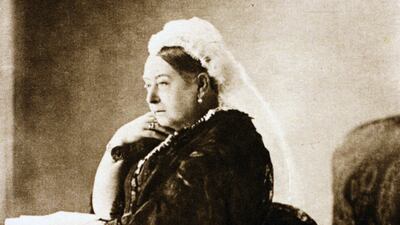
The practice of wearing pearls as mourning jewellery dates back to Queen Victoria, who only wore pearl and black jewellery after the death of her husband, Prince Albert, in 1861.

  • Diana, Princess of Wales wore a necklace with a single white pearl at the funeral of Princess Grace of Monaco in 1982. Getty
    Diana, Princess of Wales wore a necklace with a single white pearl at the funeral of Princess Grace of Monaco in 1982. Getty
  • Catherine, now Princess of Wales, wearing a four-strand pearl necklace at the funeral of Prince Philip in 2021. AFP
    Catherine, now Princess of Wales, wearing a four-strand pearl necklace at the funeral of Prince Philip in 2021. AFP
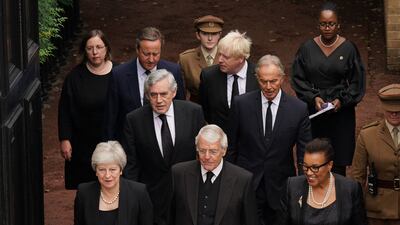
  • Former British prime ministers Theresa May and John Major, with Patricia Janet Scotland, Baroness Scotland of Asthal, arrive ahead of the proclamation of King Charles III. Both May and Scotland wore pearls for the ceremony. AFP
    Former British prime ministers Theresa May and John Major, with Patricia Janet Scotland, Baroness Scotland of Asthal, arrive ahead of the proclamation of King Charles III. Both May and Scotland wore pearls for the ceremony. AFP
  • For the funeral service of the Duke of Windsor, formerly King Edward VIII on June 3, 1972 at Windsor Chapel, Queen Elizabeth II (left) is seen wearing pearls, as is the Duchess of Windsor and Queen Elizabeth, The Queen Mother. Getty Images
    For the funeral service of the Duke of Windsor, formerly King Edward VIII on June 3, 1972 at Windsor Chapel, Queen Elizabeth II (left) is seen wearing pearls, as is the Duchess of Windsor and Queen Elizabeth, The Queen Mother. Getty Images
  • Queen Victoria mourned the death of her husband Prince Albert for almost 40 years, until her death in 1901. She established the tradition of wearing pearls as a sign of mourning. Getty Images
    Queen Victoria mourned the death of her husband Prince Albert for almost 40 years, until her death in 1901. She established the tradition of wearing pearls as a sign of mourning. Getty Images
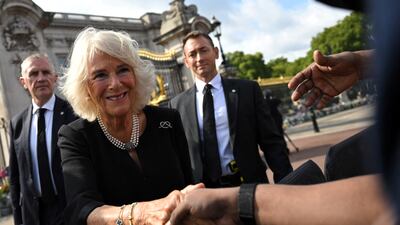
  • In pearl earrings, Camilla, Queen Consort, greets members of the crowd along the Mall, following the death of Queen Elizabeth II on September 10, 2022. AFP
    In pearl earrings, Camilla, Queen Consort, greets members of the crowd along the Mall, following the death of Queen Elizabeth II on September 10, 2022. AFP
  • Catherine, Princess of Wales, wears pearl earrings as she and other Royals view the flowers left in tribute to Queen Elizabeth II. AFP
    Catherine, Princess of Wales, wears pearl earrings as she and other Royals view the flowers left in tribute to Queen Elizabeth II. AFP
SECRET%20INVASION
%3Cp%3E%3Cstrong%3EDirector%3A%3C%2Fstrong%3E%20Ali%20Selim%20%3Cbr%3E%3Cstrong%3EStars%3A%3C%2Fstrong%3E%20Samuel%20L%20Jackson%2C%20Olivia%20Coleman%2C%20Kingsley%20Ben-Adir%2C%20Emilia%20Clarke%20%3Cbr%3E%3Cstrong%3ERating%3A%3C%2Fstrong%3E%203%2F5%26nbsp%3B%3C%2Fp%3E%0A
Moral education needed in a 'rapidly changing world'

Moral education lessons for young people is needed in a rapidly changing world, the head of the programme said.

Alanood Al Kaabi, head of programmes at the Education Affairs Office of the Crown Price Court - Abu Dhabi, said: "The Crown Price Court is fully behind this initiative and have already seen the curriculum succeed in empowering young people and providing them with the necessary tools to succeed in building the future of the nation at all levels.

"Moral education touches on every aspect and subject that children engage in.

"It is not just limited to science or maths but it is involved in all subjects and it is helping children to adapt to integral moral practises.

"The moral education programme has been designed to develop children holistically in a world being rapidly transformed by technology and globalisation."

First Person
Richard Flanagan
Chatto & Windus 

Our legal consultant

Name: Hassan Mohsen Elhais

Position: legal consultant with Al Rowaad Advocates and Legal Consultants.

How%20to%20avoid%20getting%20scammed
%3Cul%3E%0A%3Cli%3ENever%20click%20on%20links%20provided%20via%20app%20or%20SMS%2C%20even%20if%20they%20seem%20to%20come%20from%20authorised%20senders%20at%20first%20glance%3C%2Fli%3E%0A%3Cli%3EAlways%20double-check%20the%20authenticity%20of%20websites%3C%2Fli%3E%0A%3Cli%3EEnable%20Two-Factor%20Authentication%20(2FA)%20for%20all%20your%20working%20and%20personal%20services%3C%2Fli%3E%0A%3Cli%3EOnly%20use%20official%20links%20published%20by%20the%20respective%20entity%3C%2Fli%3E%0A%3Cli%3EDouble-check%20the%20web%20addresses%20to%20reduce%20exposure%20to%20fake%20sites%20created%20with%20domain%20names%20containing%20spelling%20errors%3C%2Fli%3E%0A%3C%2Ful%3E%0A
BEETLEJUICE BEETLEJUICE

Starring: Winona Ryder, Michael Keaton, Jenny Ortega

Director: Tim Burton

Rating: 3/5

The biog

Favourite book: You Are the Placebo – Making your mind matter, by Dr Joe Dispenza

Hobby: Running and watching Welsh rugby

Travel destination: Cyprus in the summer

Life goals: To be an aspirational and passionate University educator, enjoy life, be healthy and be the best dad possible.

Ten tax points to be aware of in 2026

1. Domestic VAT refund amendments: request your refund within five years

If a business does not apply for the refund on time, they lose their credit.

2. E-invoicing in the UAE

Businesses should continue preparing for the implementation of e-invoicing in the UAE, with 2026 a preparation and transition period ahead of phased mandatory adoption. 

3. More tax audits

Tax authorities are increasingly using data already available across multiple filings to identify audit risks. 

4. More beneficial VAT and excise tax penalty regime

Tax disputes are expected to become more frequent and more structured, with clearer administrative objection and appeal processes. The UAE has adopted a new penalty regime for VAT and excise disputes, which now mirrors the penalty regime for corporate tax.

5. Greater emphasis on statutory audit

There is a greater need for the accuracy of financial statements. The International Financial Reporting Standards standards need to be strictly adhered to and, as a result, the quality of the audits will need to increase.

6. Further transfer pricing enforcement

Transfer pricing enforcement, which refers to the practice of establishing prices for internal transactions between related entities, is expected to broaden in scope. The UAE will shortly open the possibility to negotiate advance pricing agreements, or essentially rulings for transfer pricing purposes. 

7. Limited time periods for audits

Recent amendments also introduce a default five-year limitation period for tax audits and assessments, subject to specific statutory exceptions. While the standard audit and assessment period is five years, this may be extended to up to 15 years in cases involving fraud or tax evasion. 

8. Pillar 2 implementation 

Many multinational groups will begin to feel the practical effect of the Domestic Minimum Top-Up Tax (DMTT), the UAE's implementation of the OECD’s global minimum tax under Pillar 2. While the rules apply for financial years starting on or after January 1, 2025, it is 2026 that marks the transition to an operational phase.

9. Reduced compliance obligations for imported goods and services

Businesses that apply the reverse-charge mechanism for VAT purposes in the UAE may benefit from reduced compliance obligations. 

10. Substance and CbC reporting focus

Tax authorities are expected to continue strengthening the enforcement of economic substance and Country-by-Country (CbC) reporting frameworks. In the UAE, these regimes are increasingly being used as risk-assessment tools, providing tax authorities with a comprehensive view of multinational groups’ global footprints and enabling them to assess whether profits are aligned with real economic activity. 

Contributed by Thomas Vanhee and Hend Rashwan, Aurifer

The specs: 2018 Nissan 370Z Nismo

The specs: 2018 Nissan 370Z Nismo
Price, base / as tested: Dh182,178
Engine: 3.7-litre V6
Power: 350hp @ 7,400rpm
Torque: 374Nm @ 5,200rpm
Transmission: Seven-speed automatic
​​​​​​​Fuel consumption, combined: 10.5L / 100km

Mercer, the investment consulting arm of US services company Marsh & McLennan, expects its wealth division to at least double its assets under management (AUM) in the Middle East as wealth in the region continues to grow despite economic headwinds, a company official said.

Mercer Wealth, which globally has $160 billion in AUM, plans to boost its AUM in the region to $2-$3bn in the next 2-3 years from the present $1bn, said Yasir AbuShaban, a Dubai-based principal with Mercer Wealth.

Within the next two to three years, we are looking at reaching $2 to $3 billion as a conservative estimate and we do see an opportunity to do so,” said Mr AbuShaban.

Mercer does not directly make investments, but allocates clients’ money they have discretion to, to professional asset managers. They also provide advice to clients.

“We have buying power. We can negotiate on their (client’s) behalf with asset managers to provide them lower fees than they otherwise would have to get on their own,” he added.

Mercer Wealth’s clients include sovereign wealth funds, family offices, and insurance companies among others.

From its office in Dubai, Mercer also looks after Africa, India and Turkey, where they also see opportunity for growth.

Wealth creation in Middle East and Africa (MEA) grew 8.5 per cent to $8.1 trillion last year from $7.5tn in 2015, higher than last year’s global average of 6 per cent and the second-highest growth in a region after Asia-Pacific which grew 9.9 per cent, according to consultancy Boston Consulting Group (BCG). In the region, where wealth grew just 1.9 per cent in 2015 compared with 2014, a pickup in oil prices has helped in wealth generation.

BCG is forecasting MEA wealth will rise to $12tn by 2021, growing at an annual average of 8 per cent.

Drivers of wealth generation in the region will be split evenly between new wealth creation and growth of performance of existing assets, according to BCG.

Another general trend in the region is clients’ looking for a comprehensive approach to investing, according to Mr AbuShaban.

“Institutional investors or some of the families are seeing a slowdown in the available capital they have to invest and in that sense they are looking at optimizing the way they manage their portfolios and making sure they are not investing haphazardly and different parts of their investment are working together,” said Mr AbuShaban.

Some clients also have a higher appetite for risk, given the low interest-rate environment that does not provide enough yield for some institutional investors. These clients are keen to invest in illiquid assets, such as private equity and infrastructure.

“What we have seen is a desire for higher returns in what has been a low-return environment specifically in various fixed income or bonds,” he said.

“In this environment, we have seen a de facto increase in the risk that clients are taking in things like illiquid investments, private equity investments, infrastructure and private debt, those kind of investments were higher illiquidity results in incrementally higher returns.”

The Abu Dhabi Investment Authority, one of the largest sovereign wealth funds, said in its 2016 report that has gradually increased its exposure in direct private equity and private credit transactions, mainly in Asian markets and especially in China and India. The authority’s private equity department focused on structured equities owing to “their defensive characteristics.”

Washmen Profile

Date Started: May 2015

Founders: Rami Shaar and Jad Halaoui

Based: Dubai, UAE

Sector: Laundry

Employees: 170

Funding: about $8m

Funders: Addventure, B&Y Partners, Clara Ventures, Cedar Mundi Partners, Henkel Ventures

COMPANY%20PROFILE
%3Cp%3E%3Cstrong%3ECompany%3A%3C%2Fstrong%3E%20Vault%3Cbr%3E%3Cstrong%3EStarted%3A%20%3C%2Fstrong%3EJune%202023%3Cbr%3E%3Cstrong%3ECo-founders%3A%20%3C%2Fstrong%3EBilal%20Abou-Diab%20and%20Sami%20Abdul%20Hadi%3Cbr%3E%3Cstrong%3EBased%3A%20%3C%2Fstrong%3EAbu%20Dhabi%3Cbr%3E%3Cstrong%3ELicensed%20by%3A%3C%2Fstrong%3E%20Abu%20Dhabi%20Global%20Market%3Cbr%3E%3Cstrong%3EIndustry%3A%20%3C%2Fstrong%3EInvestment%20and%20wealth%20advisory%3Cbr%3E%3Cstrong%3EFunding%3A%20%3C%2Fstrong%3E%241%20million%3Cbr%3E%3Cstrong%3EInvestors%3A%20%3C%2Fstrong%3EOutliers%20VC%20and%20angel%20investors%3Cbr%3E%3Cstrong%3ENumber%20of%20employees%3A%20%3C%2Fstrong%3E14%3Cbr%3E%3C%2Fp%3E%0A
Updated: November 15, 2022, 2:19 PM