
The first photos of Jordan's Princess Rajwa showing off her pregnancy have been unveiled.
On the first anniversary of her wedding to Crown Prince Hussein, new photos have been released of the princess, wearing a bright ruby Alice and Olivia Vernia blouson-sleeve pleated maxi dress with a cinched waistline.
In April, the royal couple revealed they were expecting their first child, in a statement issued by the Jordanian royal family.

“The Royal Hashemite Court is pleased to announce that their Royal Highnesses Crown Prince Al Hussein bin Abdullah II and Princess Rajwa Al Hussein are expecting their first baby this summer,” the statement read.
The couple married in a glittering ceremony at Zahran Palace in Amman last June. The event was attended by Arab and western royalty.
The royal baby will be the first grandchild for King Abdullah and Queen Rania.
Jordan's line of succession
As the eldest son of King Abdullah and Queen Rania, Prince Hussein is next in line to rule Jordan.
King Abdullah appointed Hussein as Crown Prince in 2009, after a rift with the king’s half-brother, Prince Hamzah. Official media portrayed the wedding as a symbol of continuity in the Hashemite monarchy, which has ruled Jordan since its inception as a British protectorate in 1921.
In a symbol of family unity during their wedding last year, Princess Rajwa – wearing an elegant long-sleeved Elie Saab dress – was escorted down the aisle by the youngest of the Jordanian royal children, Prince Hashem.
Who is Princess Rajwa?
Princess Rajwa was born in Riyadh, on April 28, 1994, according to Roya News in Jordan.
She is the youngest of four siblings – alongside Faisal, Nayef and Dana – born to businessman Khalid Al Saif and his wife Azza Al Sudairi.
Her secondary education took place in Saudi Arabia, before she moved to New York to complete her higher education at the College of Architecture at Syracuse University.
-
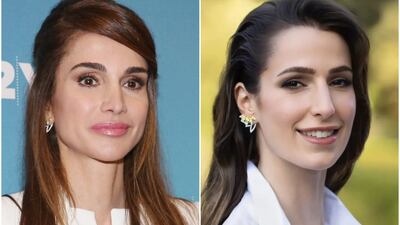
Queen Rania lent a pair of Stephen Webster earrings to Princess Rajwa, right, who has also mirrored her mother-in-law's penchant for crisp white shirts. Photos: Getty Images; @jordansroyalfamily / Instagram -
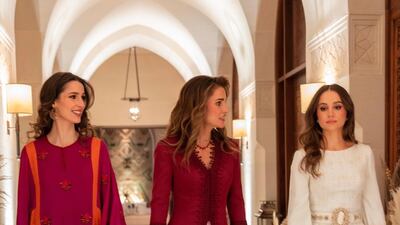
The colour scheme and silhouette of Princess Rajwa's look echoes Queen Rania's outfit at Princess Iman's henna party in March. Photo: Princess Rajwa / Instagram -
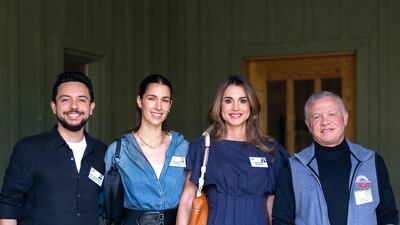
Princess Rajwa and Queen Rania wear denim at a conference in Idaho in July. Photo: Queen Rania / Instagram -

Princess Rajwa wears a gold belt that belongs to Queen Rania for the official portrait released to mark her engagement to Crown Prince Hussein, right. Photo: Royal Hashemite Court
The President's Cake
Director: Hasan Hadi
Starring: Baneen Ahmad Nayyef, Waheed Thabet Khreibat, Sajad Mohamad Qasem
Rating: 4/5
Sun jukebox
Rufus Thomas, Bear Cat (The Answer to Hound Dog) (1953)
This rip-off of Leiber/Stoller’s early rock stomper brought a lawsuit against Phillips and necessitated Presley’s premature sale to RCA.
Elvis Presley, Mystery Train (1955)
The B-side of Presley’s final single for Sun bops with a drummer-less groove.
Johnny Cash and the Tennessee Two, Folsom Prison Blues (1955)
Originally recorded for Sun, Cash’s signature tune was performed for inmates of the titular prison 13 years later.
Carl Perkins, Blue Suede Shoes (1956)
Within a month of Sun’s February release Elvis had his version out on RCA.
Roy Orbison, Ooby Dooby (1956)
An essential piece of irreverent juvenilia from Orbison.
Jerry Lee Lewis, Great Balls of Fire (1957)
Lee’s trademark anthem is one of the era’s best-remembered – and best-selling – songs.
Global state-owned investor ranking by size
|
1. |
United States |
|
2. |
China |
|
3. |
UAE |
|
4. |
Japan |
|
5 |
Norway |
|
6. |
Canada |
|
7. |
Singapore |
|
8. |
Australia |
|
9. |
Saudi Arabia |
|
10. |
South Korea |
Blonde
Voy!%20Voy!%20Voy!
More coverage from the Future Forum
• Remittance charges will be tackled by blockchain
• UAE's monumental and risky Mars Mission to inspire future generations, says minister
• Could the UAE drive India's economy?
• News has a bright future and the UAE is at the heart of it
• Architecture is over - here's cybertecture
• The National announces Future of News journalism competition
• Round up: Experts share their visions of the world to come
KILLING OF QASSEM SULEIMANI
National Editorial: Suleimani has been killed, now we must de-escalate
Mina Al Oraibi: Air strike casts a long shadow over the decade ahead
Jack Moore: Why the assassination is such a monumental gamble
Matthew Levitt: Iran retains its ability to launch terror attacks
Damien McElroy: A CEO tasked with spreading Iran's influence
Hussein Ibish: Trump's order on solid constitutional ground
Simon Waldman: Cautious Israel keeping a low profile
• Remittance charges will be tackled by blockchain
• UAE's monumental and risky Mars Mission to inspire future generations, says minister
• Could the UAE drive India's economy?
• News has a bright future and the UAE is at the heart of it
• Architecture is over - here's cybertecture
• The National announces Future of News journalism competition
• Round up: Experts share their visions of the world to come
On Women's Day
Dr Nawal Al-Hosany: Why more women should be on the frontlines of climate action
Samar Elmnhrawy: How companies in the Middle East can catch up on gender equality
The National Editorial: Is there much to celebrate on International Women's Day 2021?
Justin Thomas: Challenge the notion that 'men are from Mars, women are from Venus'
LUKA CHUPPI
Director: Laxman Utekar
Producer: Maddock Films, Jio Cinema
Cast: Kartik Aaryan, Kriti Sanon, Pankaj Tripathi, Vinay Pathak, Aparshakti Khurana
Rating: 3/5
While you're here
Johann Chacko: Why Maldives has become a theatre for US-China rivalry
C Uday Bhaskar: What is India's Indo-Pacific strategy?
C Uday Bhaskar: The 'Asian Century' depends on China and India working together
While you're here
Gavin Esler: The Good Friday Agreement teaches us some important lessons
Damien McElroy: Boris must listen to Churchill's comments on Irish divisions
Janine di Giovanni: Track 2 diplomacy key to lasting peace in 21st century
More on Yemen's civil war
Saeed Al Batati: How the war played a role in Africa's locust swarm
National Editorial: Thanking the UAE troops for protecting the country
National Editorial: Riyadh deal paves the way for peace in Yemen
National Editorial: The UAE a leader in giving humanitarian aid
Killing of Qassem Suleimani
National Editorial: Suleimani has been killed, now we must de-escalate
Mina Al Oraibi: Air strike casts a long shadow over the decade ahead
Jack Moore: Why the assassination is such a monumental gamble
Matthew Levitt: Iran retains its ability to launch terror attacks
Damien McElroy: A CEO tasked with spreading Iran's influence
Hussein Ibish: Trump's order on solid constitutional ground
Rashmee Roshan Lall: Sound of silence in South Asia
COMPANY%20PROFILE
Founder: Ayman Badawi
Date started: Test product September 2016, paid launch January 2017
Based: Dubai, UAE
Sector: Software
Size: Seven employees
Funding: $170,000 in angel investment
Funders: friends
Mercer, the investment consulting arm of US services company Marsh & McLennan, expects its wealth division to at least double its assets under management (AUM) in the Middle East as wealth in the region continues to grow despite economic headwinds, a company official said.
Mercer Wealth, which globally has $160 billion in AUM, plans to boost its AUM in the region to $2-$3bn in the next 2-3 years from the present $1bn, said Yasir AbuShaban, a Dubai-based principal with Mercer Wealth.
“Within the next two to three years, we are looking at reaching $2 to $3 billion as a conservative estimate and we do see an opportunity to do so,” said Mr AbuShaban.
Mercer does not directly make investments, but allocates clients’ money they have discretion to, to professional asset managers. They also provide advice to clients.
“We have buying power. We can negotiate on their (client’s) behalf with asset managers to provide them lower fees than they otherwise would have to get on their own,” he added.
Mercer Wealth’s clients include sovereign wealth funds, family offices, and insurance companies among others.
From its office in Dubai, Mercer also looks after Africa, India and Turkey, where they also see opportunity for growth.
Wealth creation in Middle East and Africa (MEA) grew 8.5 per cent to $8.1 trillion last year from $7.5tn in 2015, higher than last year’s global average of 6 per cent and the second-highest growth in a region after Asia-Pacific which grew 9.9 per cent, according to consultancy Boston Consulting Group (BCG). In the region, where wealth grew just 1.9 per cent in 2015 compared with 2014, a pickup in oil prices has helped in wealth generation.
BCG is forecasting MEA wealth will rise to $12tn by 2021, growing at an annual average of 8 per cent.
Drivers of wealth generation in the region will be split evenly between new wealth creation and growth of performance of existing assets, according to BCG.
Another general trend in the region is clients’ looking for a comprehensive approach to investing, according to Mr AbuShaban.
“Institutional investors or some of the families are seeing a slowdown in the available capital they have to invest and in that sense they are looking at optimizing the way they manage their portfolios and making sure they are not investing haphazardly and different parts of their investment are working together,” said Mr AbuShaban.
Some clients also have a higher appetite for risk, given the low interest-rate environment that does not provide enough yield for some institutional investors. These clients are keen to invest in illiquid assets, such as private equity and infrastructure.
“What we have seen is a desire for higher returns in what has been a low-return environment specifically in various fixed income or bonds,” he said.
“In this environment, we have seen a de facto increase in the risk that clients are taking in things like illiquid investments, private equity investments, infrastructure and private debt, those kind of investments were higher illiquidity results in incrementally higher returns.”
The Abu Dhabi Investment Authority, one of the largest sovereign wealth funds, said in its 2016 report that has gradually increased its exposure in direct private equity and private credit transactions, mainly in Asian markets and especially in China and India. The authority’s private equity department focused on structured equities owing to “their defensive characteristics.”
Will the pound fall to parity with the dollar?
The idea of pound parity now seems less far-fetched as the risk grows that Britain may split away from the European Union without a deal.
Rupert Harrison, a fund manager at BlackRock, sees the risk of it falling to trade level with the dollar on a no-deal Brexit. The view echoes Morgan Stanley’s recent forecast that the currency can plunge toward $1 (Dh3.67) on such an outcome. That isn’t the majority view yet – a Bloomberg survey this month estimated the pound will slide to $1.10 should the UK exit the bloc without an agreement.
New Prime Minister Boris Johnson has repeatedly said that Britain will leave the EU on the October 31 deadline with or without an agreement, fuelling concern the nation is headed for a disorderly departure and fanning pessimism toward the pound. Sterling has fallen more than 7 per cent in the past three months, the worst performance among major developed-market currencies.
“The pound is at a much lower level now but I still think a no-deal exit would lead to significant volatility and we could be testing parity on a really bad outcome,” said Mr Harrison, who manages more than $10 billion in assets at BlackRock. “We will see this game of chicken continue through August and that’s likely negative for sterling,” he said about the deadlocked Brexit talks.
The pound fell 0.8 per cent to $1.2033 on Friday, its weakest closing level since the 1980s, after a report on the second quarter showed the UK economy shrank for the first time in six years. The data means it is likely the Bank of England will cut interest rates, according to Mizuho Bank.
The BOE said in November that the currency could fall even below $1 in an analysis on possible worst-case Brexit scenarios. Options-based calculations showed around a 6.4 per cent chance of pound-dollar parity in the next one year, markedly higher than 0.2 per cent in early March when prospects of a no-deal outcome were seemingly off the table.
Bloomberg



