

Prince William, who has finally made his first official trip to the UAE this week, was only seven years old when his parents Prince Charles and Princess Diana visited the country for the first time in 1989.
Live updates: follow the latest news on Prince William's visit to the UAE
The six-day trip, which also included a visit to Kuwait, was intended as a boost to British trade, and Charles and Diana were given the ultimate Emirati hospitality in Abu Dhabi and Dubai.
Princess Diana, who was 25 at the time, also made news for her fashion choices during the visit, including the high-waisted blue skirt and white jacket with contrasting blue lapels by designer Catherine Walker that she wore as she stepped off the plane in Dubai. The look, which was paired with a turban hat, immediately became a fashion sensation.

Charles and Diana also met Sheikh Zayed, the Founding Father, at his private majlis in Al Ain where, speaking through his translator, he revealed his plans for Sir Bani Yas Island as a wildlife reserve. The couple were also treated to a camel race and a picnic at Ghabat Raqnah Oasis.
The royals also attended an official reception at the British Embassy in Abu Dhabi. In Dubai, they met Sheikh Mohammed bin Rashid, then Minister of Defence, at another British Embassy reception.
Watch a video of Prince Charles and Diana's UAE visit in 1989 below:
In 1999, Prince Charles returned to the UAE, this time on a solo trip. His seven-day tour of the Gulf also included visits to Oman and Saudi Arabia.
In Dubai, Charles attended the Dubai Airshow, and toured the annual aviation exhibition, which included some 30 British exhibitors. The royal so hopped into the cockpit of a prototype Eurofighter tycoon, made by a British-led consortium.

Charles again returned to the UAE in 2014, and was received in the capital by Sheikh Mohamed bin Zayed, Crown Prince of Abu Dhabi and Deputy Supreme Commander of the Armed Forces.
Prince Charles’s visit, which was supported by the British government, also involved a trip to Manama where he met the Crown Prince of Bahrain, Sheikh Salman bin Hamad Al Khalifa, before holding talks with King Hamad. The British royal also visited Saudi Arabia and Qatar that week.
“The visit of the Prince of Wales symbolises the long-standing friendship between our royal families and demonstrates partnership at the very highest level," Dominic Jermey, then British ambassador to the UAE, said. “These personal ties act as a bedrock in the UK-UAE relationship and allow us to collaborate with confidence on the many issues our people are passionate about, not least critical issues in the region and around the world.”

Charles returned to Abu Dhabi in 2015, for a flying visit, and again met Sheikh Mohamed bin Zayed. The trip also included stops in Jordan, Kuwait, Saudi Arabia and Qatar.
Prince Charles' last visit to the UAE was in 2016, this time accompanied by Camilla, Duchess of Cornwall, whom he married in 2005. The three-day visit in November was part of a regional tour that started in Oman and ended in Bahrain.
Upon their arrival in Abu Dhabi, the royal couple were taken on a tour of the Sheikh Zayed Grand Mosque, where they were accompanied by Sheikha Lubna Al Qasimi, then Minister of State for Tolerance.
After a brief tour of the mosque, Charles and Camilla viewed a photography exhibition and other works presented by a cultural guide. The royal couple then visited the mosque’s main hall to learn about the building’s architecture, design and carpet.

A quick walk around the courtyard to learn more about the distinctive floral design as the call to prayer echoed around the grand setting was followed by a reception to meet guests from different faiths and nationalities.
During the tour, the royals also visited the Bu Tinah archipelago, a sanctuary for endangered species such as the dugong and hawksbill turtle, and a UN-recognised heritage site located about 150 kilometers from Abu Dhabi. They also attended a celebration at Jahili Fort in Al Ain and a Youth Circle event in Masdar City.
The Duchess of Cornwall made time to visit the Abu Dhabi Falcon Hospital, where she was informed about the importance of falconry in Arab culture and watched staff operate on one of the birds.
That same day, she met a group of prominent UAE women at a Women’s Empowerment Lunch, where she was greeted by Noura Al Kaabi, then Minister of State for Federal National Council Affairs.

The duchess met senior government officials, business leaders and Armed Forces officers during the event.
“We were delighted to have had the opportunity to demonstrate to the duchess the way in which UAE women are engaged not only in the building of those ties, but also how Emirati women are engaged in the UAE’s development in all fields,” Al Kaabi said.
In a day with a full appointment book, Camilla also unveiled a plaque to formally inaugurate a branch of the Imperial College London Diabetes Centre in Zayed Sports City.
Prince Charles visited the Masdar Institute of Science and Technology in Abu Dhabi where he was given a guided tour of the facility before meeting students.
In Dubai, the couple visited the logistics hub Dubai International Humanitarian City on the final day of their state visit to the UAE.
The prince met aid workers and viewed innovative projects delivering emergency support to where it is needed most. In a speech, he said the UAE was well placed to become the world’s foremost humanitarian logistical power.
“The UAE is second to none in its generosity. This is one facet of Sheikh Zayed’s remarkable legacy."
In the afternoon, Prince Charles met Sheikh Mohammed bin Rashid, Vice President and Ruler of Dubai, and Sheikh Hamdan bin Mohammed, Crown Prince of Dubai, at Zabeel Palace. They discussed the promotion of cultural, tourism and sports ties between their two countries.
-

The UK's Prince Charles, now King Charles III, plays polo near Muscat, Oman, in 1986. Getty -

Prince Charles and Princess Diana at a picnic near Riyadh, Saudi Arabia, in 1986. Getty -
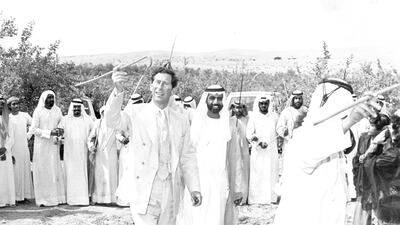
Sheikh Nahyan bin Mubarak with Prince Charles during a visit to the UAE in 1988. Photo: Al Ittihad -

Prince Charles and Diana, Princess of Wales, attend a camel race in Al Ain in March 1989. Getty -
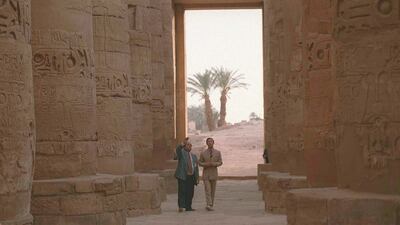
Prince Charles visits the Karnak Temple Complex during a visit to Egypt in 1995. Getty -

Prince Charles tours the Hassan II Mosque in Casablanca during a three-day official visit to Morocco in 1995. Reuters -

The British royal is served Arabic coffee during a visit to Bait Al Zubair in Muscat in 2003. Reuters -

Prince Charles with Maj Gen Andrew Stewart, right, at a British military base in Basra, Iraq, in 2004. Reuters -

The UK royal is shown a map of Arg-e-Bam during a 2004 visit to the ruins in Bam, southern Iran. Reuters -
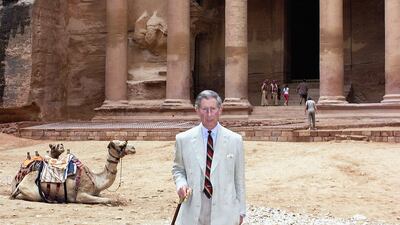
Prince Charles in Petra, Jordan, in 2004. Getty -
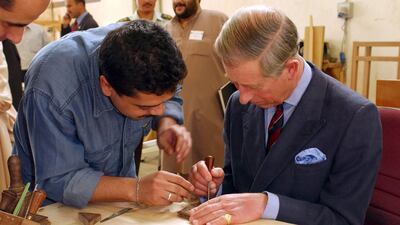
Charles, Prince of Wales at the time, visits the College of Islamic Art at Salt University in Amman, Jordan, in 2004. Getty -

Prince Charles wears a bisht during a 2007 visit to a traditional handicraft centre in Kuwait with Camilla, now Queen Consort. Reuters -

The royal visits Al Safwa farm in Doha in 2013. Reuters -

Prince Charles with former Saudi tourism minister Prince Sultan bin Salman at Al Diriyah in 2014. Reuters -

Prince Charles wears a traditional Saudi uniform to perform a sword dance, known as ardah, in Riyadh in 2014. Reuters -
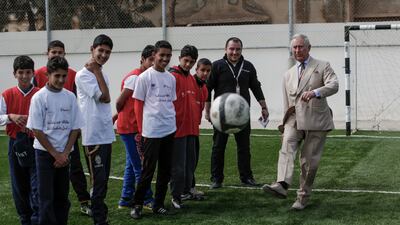
Prince Charles visits Jordanian children and Syrian refugees at a sports ground in Zaatari, Jordan, in 2015. Getty -
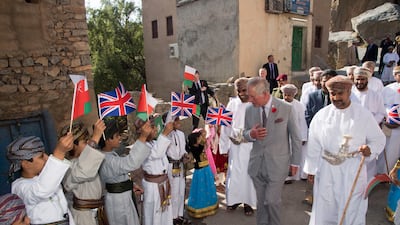
The royal is greeted by children during a walking tour in Muscat in 2016. Getty -
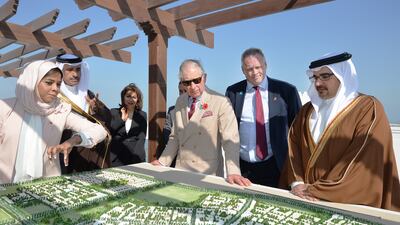
Prince Charles during a visit to the Tubil Bay regeneration project in Bahrain, in 2016. Getty -

Prince Charles visits Manama Souq, Bahrain, in 2016. Getty -
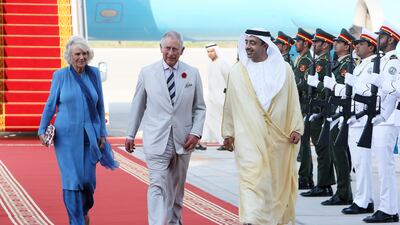
Sheikh Abdullah bin Zayed, Minister of Foreign Affairs and International Co-operation, receives Prince Charles and Camilla in Abu Dhabi in 2016. Photo: Abu Dhabi Crown Prince Court -
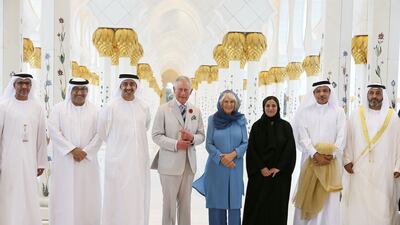
Sheikh Abdullah with Prince Charles and Camilla after a meeting at the Sheikh Zayed Grand Mosque in 2016. Photo: Abu Dhabi Crown Prince Court -
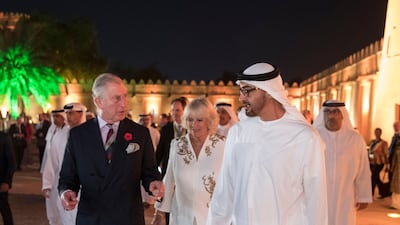
President Sheikh Mohamed, who at the time was Crown Prince of Abu Dhabi and Deputy Supreme Commander of the Armed Forces, receives Charles and Camilla, at Al Jahili Fort in Al Ain in 2016. Photo: Abu Dhabi Crown Prince Court -
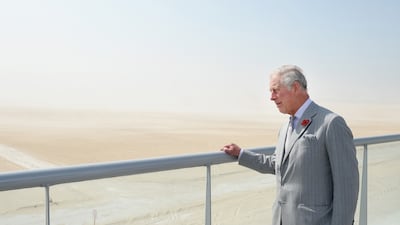
Prince Charles visits the site of Expo 2020 Dubai in 2016. Getty -

Prince Charles visits Bu Tinah island on the second day of his tour of the UAE, in November 2016. Getty -
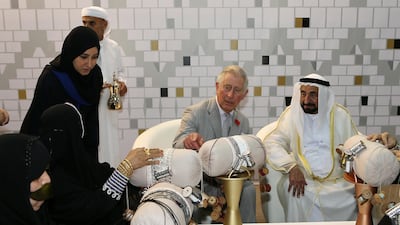
Sheikh Dr Sultan bin Muhammad Al Qasimi, Ruler of Sharjah, with Prince Charles during his visit to the Regional Conservation Centre in Sharjah, in November 2016. Photo: Ab Dhabi Crown Prince Court -

Prince Charles lays a wreath during the Fifth World Holocaust Forum in Jerusalem in 2020. Reuters -

Prince Charles with Roman Krassovsky, right, Archimandrite of the Russian Orthodox Church Outside Russia and chief of its Russian Ecclesiastical Mission in Jerusalem, during a visit in Russian Orthodox Church of Mary Magdalene in 2020. Reuters -
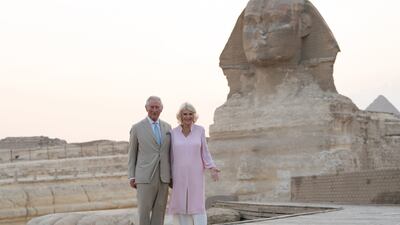
Prince Charles and Camilla visit the Great Sphinx of Giza during a regional tour in 2021. Getty -
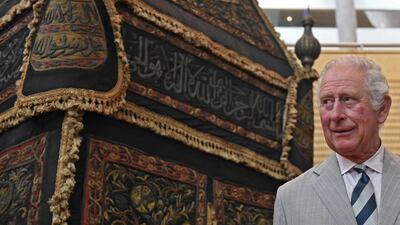
Prince Charles stands next to the mahmal, the palanquin used to transport the kiswah that covers the Kaaba in Makkah, during a visit to Alexandria, Egypt, in 2021. AFP



